What Is a Utility Bill and How Do You Read It?
At its most basic, a utility bill is just a monthly statement from a provider for services like electricity, water, gas, or internet. But it's so much more than that. Think of it less as a simple demand for payment and more as a detailed report on your business's resource consumption.
It tells you exactly what you used, when you used it, and all the specific costs that go into that final number at the bottom of the page.
Your Quick Guide to Understanding a Utility Bill
For many finance and operations teams, these documents are a headache. They're often packed with industry jargon, confusing rate structures, and a whole mess of taxes and fees. It's easy to just look at the total, pay it, and file it away.
But in today's climate, simply paying the bill isn't enough. With operational costs climbing, these documents are a goldmine of information for smart financial management. For example, average household utility costs for electricity, gas, and water are projected to hit $412 per month in 2025—a 7% jump from 2024. For a business, those numbers are much, much higher.
This makes bill analysis a critical business function, not just an administrative chore. You can read more on the trend of rising utility rates to get a better sense of the financial pressures at play.
Anatomy of a Utility Bill
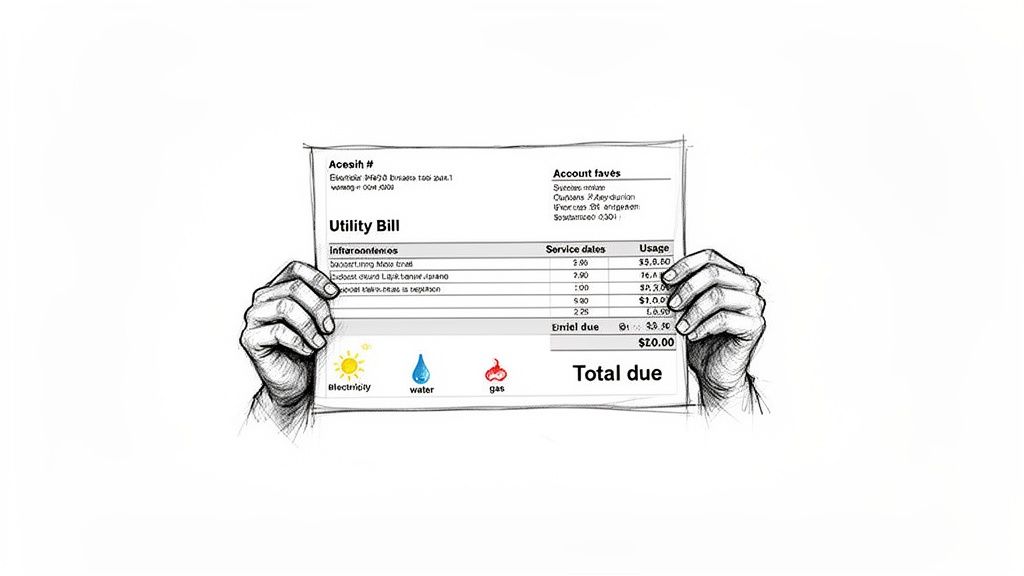
So, where do you start? While every provider's bill looks a little different, they all share a few key ingredients. Getting comfortable with these core components is the first step to decoding any utility bill that lands on your desk.
Below is a quick breakdown of the essential parts of a utility bill. Understanding what each section means—and why it's important—turns a confusing document into a powerful tool for your business.
Anatomy of a Utility Bill at a Glance
| Component | Description | Why It Matters |
|---|---|---|
| Account Information | Your unique account number, service address, and mailing address. | This is your business's primary identifier. It’s essential for communicating with the provider and ensuring payments are applied correctly. |
| Service Dates | The start and end dates for the billing cycle, usually a one-month period. | Tracking usage by period helps you spot seasonal trends, identify anomalies, and forecast future costs. |
| Usage Data | The raw data showing how much service you consumed (e.g., kilowatt-hours, gallons, cubic feet). | This is the heart of the bill. Analyzing this data is key to finding cost-saving opportunities and verifying charge accuracy. |
| Charges and Fees | A line-by-line itemization of all costs, including the base rate, taxes, and surcharges. | This breakdown reveals the true cost of your service. Scrutinizing it helps you catch errors and understand where your money is going. |
| Total Amount Due | The final, total amount your business owes for the billing period. | The most obvious part of the bill, but it's the result of all the other components. |
| Due Date | The deadline for payment to avoid penalties or service interruptions. | Missing this date can lead to late fees and negative impacts on your business's credit, making it critical for accounts payable. |
Once you can confidently find these key pieces of information, you're no longer just a passive bill-payer. You're an active manager of one of your company's most significant operational expenses.
Breaking Down the Different Types of Utility Bills
Think all utility bills are the same? It's a common mistake. On the surface, they all look like requests for money, but each one tells a completely different story about how your business runs. Every service—from the lights overhead to the water in the tap—speaks its own language, with its own measurements and weird pricing rules.
Getting a handle on these differences is the first real step toward managing your costs, catching expensive errors, and making smarter decisions for your company. Let’s pull apart the four main types of bills that land on a business owner's desk.
Electricity Bills: The Language of Kilowatts
Electricity bills are often the trickiest of the bunch. The main number you'll see is the kilowatt-hour (kWh). This is pretty straightforward—it’s the total amount of electricity you used during the billing period. Just think of it as the total mileage you put on a company car in a month.
But here’s where it gets complicated for businesses. Many commercial bills also have something called demand charges, which are measured in kilowatts (kW). This has nothing to do with your total usage. Instead, it’s based on the single highest spike of electricity you pulled from the grid at any one time. It’s like a sudden, all-out sprint in the middle of a long marathon—that one burst of intensity can set a high charge for the entire month. In fact, demand charges can make up over 50% of a commercial bill.
Water Bills: Tiered Pricing and Gallons
Water bills usually seem simpler, but their pricing can catch you by surprise. Your usage is measured in gallons (or sometimes cubic feet), which is easy enough to understand.
The real secret to a water bill is tiered pricing. The whole system is set up to encourage conservation. You pay one rate for the first chunk of water you use, but once you cross a certain threshold, the price per gallon jumps. Cross another, and it jumps again.
This means a small, unnoticed leak can easily push your usage into a much pricier tier, causing your bill to skyrocket without a huge change in your actual operations.
Natural Gas Bills: Demystifying Therms and CCF
If your business relies on natural gas for heat, cooking, or other processes, your bill will talk in therms or CCF (hundreds of cubic feet). Both are just ways of measuring the gas you've consumed.
- CCF (Hundred Cubic Feet): This is a measure of the volume of gas that flowed into your building.
- Therm: This measures the heat energy you get from burning that gas. The formula to convert CCF to therms can change slightly, so it’s always a good idea to find it on your bill.
Knowing the difference helps you accurately compare energy costs, especially when you're trying to figure out if that new, efficient heating system is actually saving you money.
Internet and Telecom Bills: Beyond Just Speed
Finally, we have internet and telecom bills. These are a different animal altogether because they're based on services, not consumption. You won’t find gallons or kWh here. Instead, the charges are all tied to your service level agreement (SLA).
Your SLA is the contract that spells out exactly what you're paying for: guaranteed upload and download speeds, uptime percentages, and customer support response times. For businesses, checking this bill isn’t about tracking usage—it’s about making sure you’re getting the performance you were promised and not paying for add-ons or service tiers you don't actually need.
How to Read the Fine Print on Your Utility Bill
Ever feel like you need a decoder ring to understand your utility bill? You’re not the only one. These documents are packed with numbers, codes, and jargon that can make your head spin. But once you know what to look for, you can read them with confidence and pull out the data that really matters for your business.
The first step is to think of your bill as having two main parts: the cost of the resource you used, and the cost to get that resource to you. Grasping this simple split is the key to making sense of all the details.
This map lays out the common types of services you’ll encounter. Each one comes with its own unique billing structure and terminology.
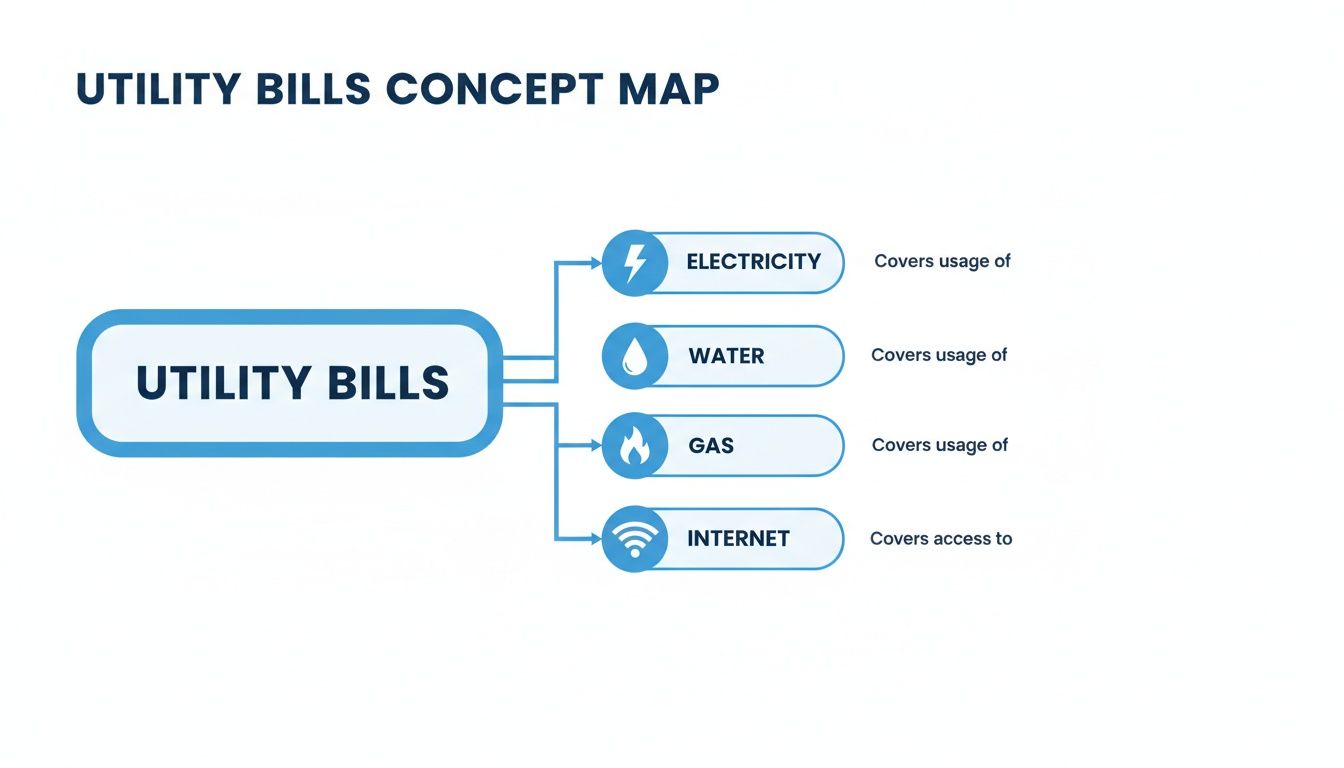
Whether it's electricity, water, gas, or internet, knowing the service category helps you anticipate the kinds of charges you’re about to see.
Supply Charges vs. Delivery Charges
Let's start with the two heavy hitters that make up most of what you owe, especially on energy bills.
- Supply Charges: This is the straightforward cost for the actual product your business used—the electricity or natural gas itself. Think of it as the raw material.
- Delivery Charges: This covers all the work it takes to move that energy from the power plant or pipeline to your front door. It’s essentially the "shipping and handling" fee for your power.
This delivery portion pays for maintaining the power lines, gas pipes, and the entire grid that keeps things running. It’s a huge operational cost, and sometimes it can be even higher than the supply charge itself.
The biggest mistake I see businesses make is just glancing at the total amount due. A utility bill tells a story about your consumption habits. The real value is hidden in the individual charges and fees that add up to that final number.
Decoding Taxes, Surcharges, and Fees
Beyond supply and delivery, your bill is full of smaller items that can add up quickly. These are costs that are passed on to you, the consumer, and they vary a lot depending on where you're located.
You’ll typically find a few common culprits:
- Taxes: Standard state and local sales taxes on your energy consumption.
- Regulatory Fees: These charges fund the government agencies that oversee the utility companies.
- Program Surcharges: These fees pay for specific state or local programs, like energy efficiency initiatives or financial assistance for low-income families.
Each of these is a line item—a separate charge that contributes to your total. If you want to get a better handle on how these individual charges impact your accounting, take a look at our guide on what is a line item. Understanding this helps you see exactly where your money is going and makes it much easier to spot an unusual fee or an error.
Why Utility Bills Are a Strategic Business Asset
Most businesses see a utility bill and think one thing: an expense to be paid. But that’s a huge missed opportunity. If you treat these documents as just another invoice, you’re leaving valuable intelligence on the table, especially as operational costs continue to climb.
Think of it this way: a utility bill is a detailed report on your company's operational health. From an accounting standpoint, it's official proof of an expense, which is just as fundamental as understanding what is a receipt in accounting. Viewing it through this lens turns a simple bill from a liability into a source of real, actionable data.
A Key for Compliance and Verification
One of the most immediate and critical roles a utility bill plays is providing proof of address. This isn't just a formality; for many financial and legal processes, it's a non-negotiable requirement.
When you're opening a new business bank account, applying for a loan, or going through any kind of regulatory check, you'll inevitably be asked to prove where your business physically operates. A recent utility bill is the gold standard for this.
A utility bill acts as a trusted third-party verification of a company's existence and location. For Know Your Customer (KYC) compliance, it is one of the most reliable documents a business can provide, preventing delays and strengthening trust with financial partners.
This makes keeping organized, easily accessible utility records essential. Without them, you can find your most important financial transactions stalled.
Unlocking Savings and Driving Strategy
Beyond ticking compliance boxes, the real power of a utility bill is hidden in its data. With a little discipline, finance and procurement teams can dig in and find major opportunities for savings and smarter planning.
By tracking your usage data over time, you can:
- Negotiate Better Rates: When you can show a supplier your detailed consumption history, you're in a much stronger position to negotiate a better contract, especially in deregulated energy markets.
- Forecast Budgets Accurately: Past bills give your finance team the data they need to predict future utility spending with surprising accuracy. This makes overall financial planning much more reliable. To see how this fits into your bigger picture, it helps to know how to categorize business expenses correctly.
- Identify Inefficiencies: Did your electricity usage suddenly spike last month? That could be a sign of a failing piece of equipment or a leak in your operations. Catching these red flags early can lead to huge savings.
This kind of analysis isn't just a "nice-to-have" anymore. In 2025 alone, U.S. utilities requested rate increases totaling $22.06 billion—a staggering 35% jump from the year before, all thanks to grid upgrades and soaring demand. You can explore the data behind these record-breaking rate hikes in a recent S&P Global report. By seeing your utility bill as a strategic tool, you can get ahead of these rising costs instead of just reacting to them.
Leave Manual Data Entry in the Past with DocParseMagic
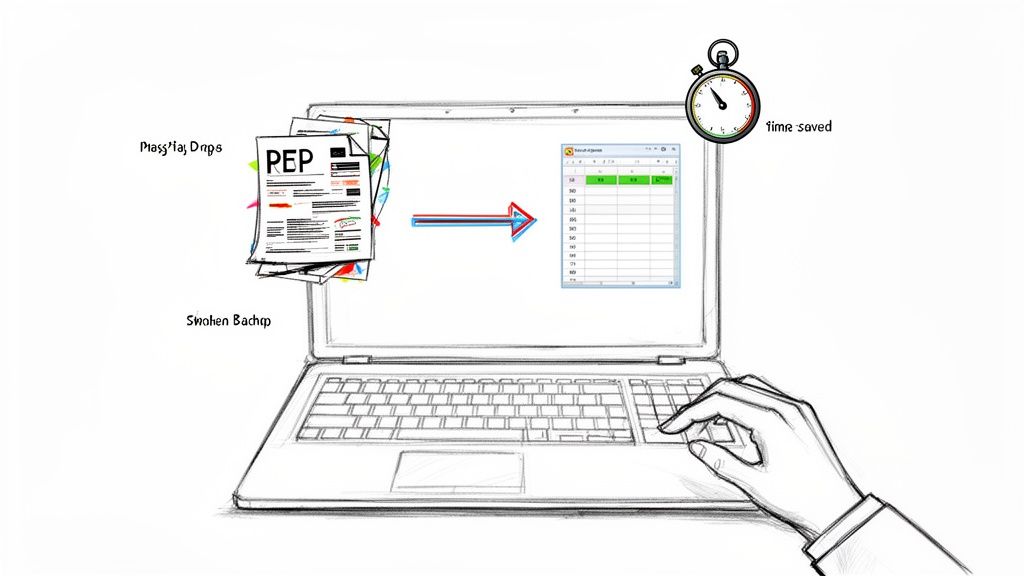
Let’s be honest: manually typing information from a utility bill into a spreadsheet is a soul-crushing task. It’s not just boring; it’s a huge time-sink and a breeding ground for costly mistakes. For every single bill, someone on your team has to squint at a PDF, hunt for the right numbers, and hope they get it all right. It's a slow, frustrating process that takes talented people away from work that actually matters.
What if you could take a messy pile of utility bills—in all sorts of formats like PDFs, scans, or even phone pictures—and turn it into perfectly organized data just by dragging and dropping them into a folder? That’s not science fiction; it’s what modern automation tools do. Instead of relying on manual labor, you can let intelligent document processing do the heavy lifting for you.
How Automated Extraction Works
Think of automated data extraction as a hyper-efficient assistant who can instantly read, understand, and categorize every bit of information on a utility bill. DocParseMagic uses powerful OCR technology to recognize the text, but the real magic is in its ability to understand the context. It knows the difference between a "due date" and an "invoice date," ensuring a level of accuracy that’s nearly impossible to achieve by hand.
Here’s what that looks like in the real world for an accounting team:
- Reconcile accounts in minutes, not days, by having invoice data automatically matched against payments.
- Build automated workflows with no coding required, simplifying the entire accounts payable process from start to finish.
- Instantly compare vendor costs by pulling historical usage and rate information from months, or even years, of past bills.
Moving from manual entry to automation gives your team the freedom to focus on analyzing data, not just inputting it. If you want to dive deeper into how this works across different departments, our guide on what is document automation has you covered.
From Manual Headaches to Automated Insights
The gap between manual and automated processing is night and day. The old way is slow, surprisingly expensive when you factor in labor, and riddled with errors that can cost your business real money. An automated tool like DocParseMagic completely overhauls that workflow, giving you faster, more reliable results.
By automating data extraction from each utility bill, businesses have reported an accuracy improvement of over 99% compared to manual entry. This simple change helps eliminate billing disputes and provides trustworthy data for financial planning.
To put it in perspective, let's compare the two approaches side-by-side.
Manual Processing vs. Automated Extraction with DocParseMagic
| Metric | Manual Processing | DocParseMagic Automation |
|---|---|---|
| Time per Bill | 5-10 minutes | Less than 30 seconds |
| Error Rate | 3-5% on average | Less than 0.5% |
| Cost per Bill | High (labor costs) | Low (fixed per document) |
| Scalability | Poor (requires more staff) | Excellent (handles high volume) |
| Data Accessibility | Locked in files/silos | Centralized and analysis-ready |
As you can see, the numbers speak for themselves. Automation does more than just speed up a task; it transforms the value you get from your documents. It turns that stack of utility bills from an administrative burden into a goldmine of business intelligence.
Common Questions About Utility Bills Answered
Even with a solid grasp of what’s on a utility bill, you’re bound to run into some real-world head-scratchers. Over the years, I've seen business owners and finance teams hit the same few roadblocks when putting that knowledge into practice.
So, let's get into the nitty-gritty. I’ve put together answers to the questions that come up most often, designed to help you solve common problems and actually use the information your bills provide.
How Can I Lower My Business Utility Bills?
Cutting your utility costs really comes down to two things: using less and paying less for what you use. You have to tackle both.
First, take a hard look at your consumption. A simple walk-through energy audit can reveal some quick wins. Still using those old fluorescent tubes? Switching to modern LEDs can slash your lighting expenses by up to 75%. It's also worth looking into upgrading older, energy-hogging appliances or HVAC systems. When it comes to water, don't underestimate the small stuff—fixing tiny leaks and putting in low-flow fixtures can make a real dent in your bill.
Once you’ve addressed consumption, it's time to dig into your bills. This is where your past statements become a goldmine. By pulling data from the last several months, you can see your usage patterns, identify seasonal spikes, and find out if you’re truly on the best rate plan your provider offers. If you operate in a deregulated market, this data is the ammunition you need to negotiate a better deal with other suppliers.
What Should I Do If I Find an Error on My Bill?
If something on your bill seems off, don't just set it aside. Time is of the essence. The trick is to be methodical.
Start by pulling out your last few bills and comparing them to the current one. Can you spot the problem? Maybe it’s a meter reading that makes no sense, a rate that doesn't match your agreement, or a strange new fee that just appeared out of nowhere. Before you do anything else, gather your proof, like a photo of your meter or a copy of your contract.
With your facts in order, it's time to call the utility company. Have your account number handy, and be ready to calmly explain what you found and what evidence you have.
As you're on the phone, take notes. Jot down the date, who you spoke with, and any reference number they give you. This little bit of documentation is invaluable if the issue isn't fixed on the first go.
If you don't get a resolution, don't hesitate to politely ask to speak with a supervisor. If you're still getting nowhere, your next move is to file a formal complaint with your state's public utility commission or the relevant regulatory body.
Can a Utility Bill Be Used as Legal Proof of Address?
Yes, absolutely. A utility bill is one of the most common and trusted documents for proving where your business operates, making it a key piece of the puzzle for things like Know Your Customer (KYC) checks and opening bank accounts.
But not just any bill will do. For a utility bill to be accepted, it generally has to tick a few boxes:
- It needs to be recent. Most places will ask for a bill from the last three to six months.
- It must be legible. Your official business name and service address have to be printed clearly and match your other paperwork.
- It has to be from a major provider. Bills for essential services like electricity, water, or natural gas are the gold standard.
A word of caution: bills for mobile phones or even internet-only services are often rejected. To avoid any holdups, always use a bill that's tied to a fixed physical location.
Ready to stop wrestling with messy utility bills and start unlocking the valuable data inside? DocParseMagic turns your stacks of PDFs and scans into clean, analysis-ready spreadsheets in minutes. Sign up for free and see how easy it is to automate your workflow.