What Is a Line Item? A Simple Guide to Financial Documents
Ever glanced at a bill and just seen a big, intimidating number at the bottom? That's where line items come in to save the day.
Think about your last grocery receipt. It didn't just say "$150." Instead, it listed every single thing you bought: 'Organic Milk, $4.99,' 'Dozen Eggs, $3.50,' 'Avocados, 2 at $1.50 each.' Each of those entries is a line item. It’s a single, distinct entry on a financial document—like an invoice, purchase order, or expense report—that breaks a large total down into its individual parts.
Deconstructing the Total: A Look Inside Your Bill
Imagine you get a car repair bill for a flat $1,200. Without any details, that number is a complete mystery. What did you actually pay for? You're left guessing, and it’s impossible to know if the charge is fair.
Now, picture that same bill with a few clear entries: one line item for 'Brake Pad Replacement - $450,' another for 'Oil Change Service - $100,' and a third for 'Labor - 5 hours at $130/hr.' Suddenly, that $1,200 total makes perfect sense. You can see exactly where your money went.
This is the real job of a line item: to bring clarity and detail to any transaction. Each entry is a building block that creates a complete, verifiable story. Instead of one opaque figure, you get an itemized list that answers the most important questions:
- What exactly was purchased or what service was delivered?
- How much of it was there (the quantity)?
- What was the price for each individual unit?
This simple concept is the bedrock of good financial management. It’s what turns an expense from a vague number into a clear story. The total tells you the cost, but the line items tell you why.
The High Cost of Small Mistakes
Getting these details right isn't just about being neat and tidy; it's critical for accuracy. When line items are wrong or get misinterpreted, the ripple effects can be surprisingly costly.
A Deloitte survey of 500 global finance teams found that a staggering 78% of invoice processing errors come directly from mismatched or misread line items. For U.S. businesses, these small mistakes add up to over $8.5 billion in losses every single year. You can dive deeper into this topic in the complete line-item glossary explanation.
A bill without line items is just a number. A bill with line items is a transparent record of every product purchased or service delivered, empowering accurate tracking, analysis, and financial control.
At the end of the day, a line item transforms a financial document from a simple summary into a rich, actionable source of information.
The Anatomy of a Line Item
So, what exactly makes up a line item? Let's break it down. Think of a line item as a single, detailed entry on a list. Each part of that entry gives you a crucial piece of information, and when you put them all together, you get the full story of that specific part of the transaction. Without these details, you’re just looking at a vague, unhelpful list.
At its core, a line item is just a neat package of data. While the layout might change from one invoice to another, you'll almost always find a few key elements. These are the non-negotiables that make the line item useful for everything from accounting to inventory management.
This diagram shows how a line item is a building block of the entire receipt. You start with the whole document, zoom in on a single line, and then see the individual components that make it up.
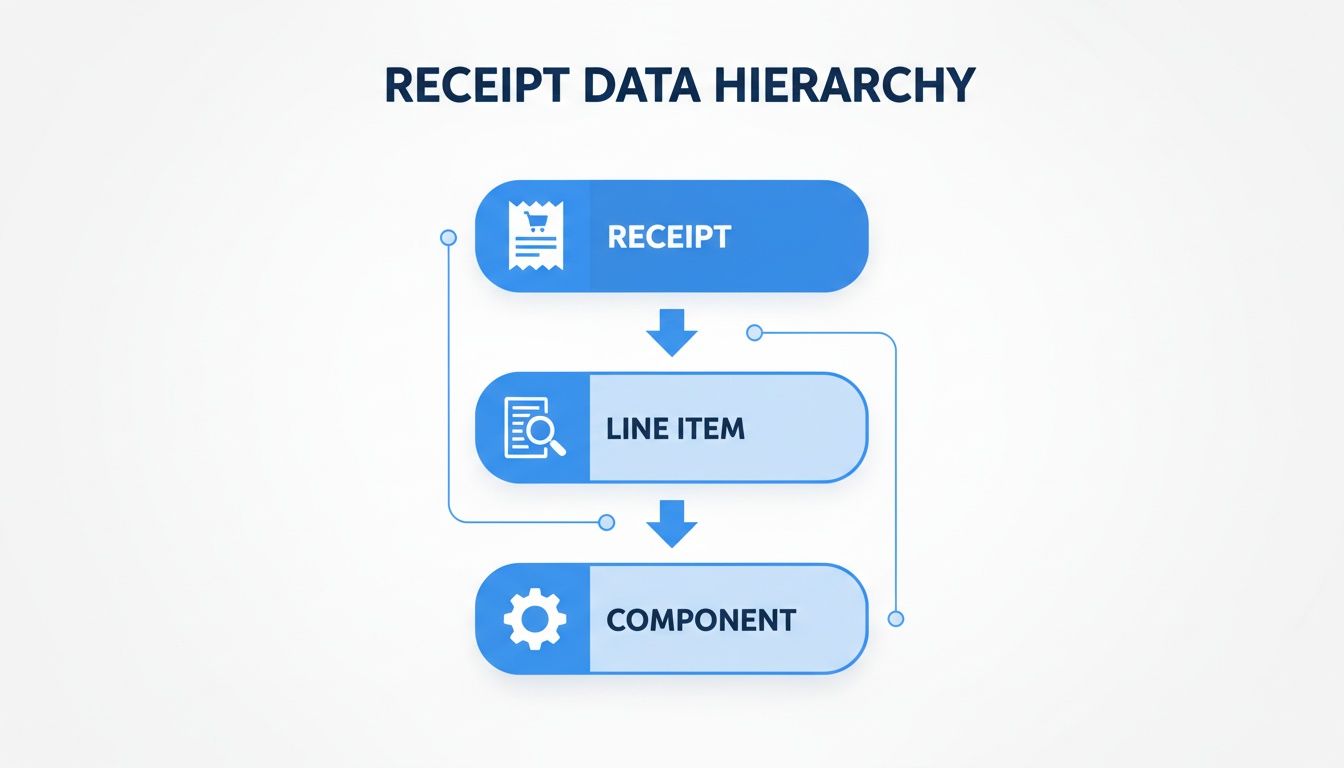
As you can see, a line item isn't just a random bit of text. It's a structured container holding multiple, specific details that paint a complete financial picture.
Key Components Explained
Let’s dissect the most common pieces you’ll find in any line item. A vague entry like "Marketing Services" on an invoice is practically useless for tracking your budget. It’s ambiguous and forces your finance team to chase people down for answers. A proper line item, on the other hand, tells you everything you need to know.
- Product or Service Description: This is exactly what it sounds like—it describes what was purchased. Specificity is everything here. Instead of just "Consulting," a good description would be "Q3 Financial Audit Preparation - 20 hours."
- Quantity: This tells you how many units were bought or how much service was provided. It could be 15 laptops, 40 hours of labor, or 5 software licenses.
- Unit Price: This is the cost for one single item or unit of service. Think price per laptop or the hourly rate for a contractor.
- SKU or Product Code: A Stock Keeping Unit (SKU) is a unique code a business uses to track its products. For any company managing physical inventory, this code is essential for keeping track of what's been sold and what's still on the shelf.
A single missing or incorrect component can create a ripple effect of problems. An wrong quantity could mean you pay for goods you never got, while a vague description makes it impossible to know where your money is actually going.
Bringing It All Together
These core components work together to calculate the total for that line. For example, 15 laptops (Quantity) at $800 each (Unit Price) gives you a line total of $12,000. Often, you'll see other details here too, like item-specific discounts or taxes.
If you look at a well-designed itemized receipt template, you'll see how each field is laid out to make every charge clear and justifiable. That structure is what makes it easy for any department, from procurement to accounting, to process the document without a headache.
Seeing Line Items in the Real World
The idea of a “line item” isn’t just some stuffy accounting term; it’s a concept you see in action every single day, no matter the industry. Looking at how they work in different situations is the best way to connect the dots between theory and practice.
From a creative agency billing for ideas to a construction firm ordering steel beams, the core principle is always the same: break down the total to understand the details.
Let's walk through a few common scenarios.
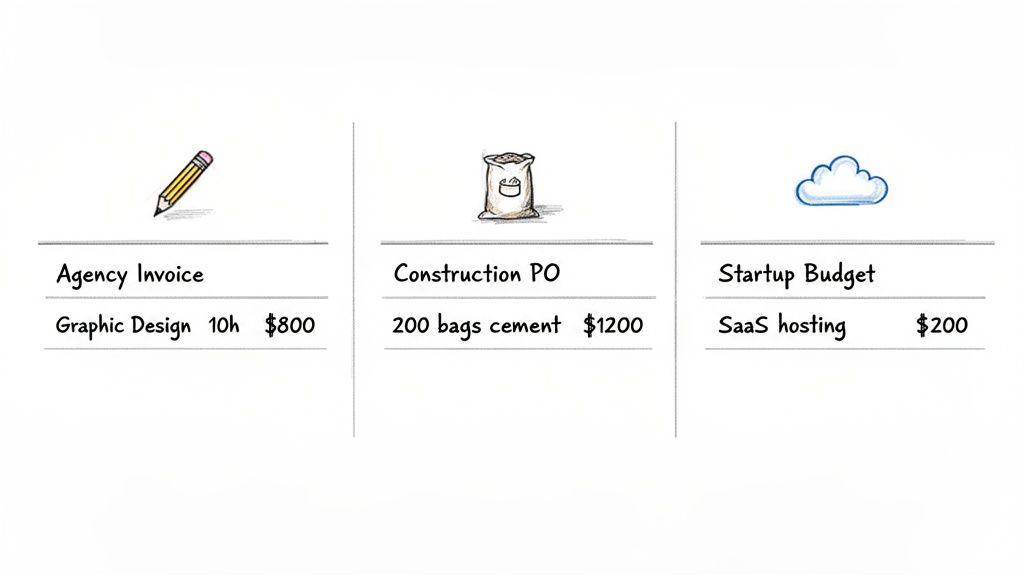
Example 1: The Creative Agency Invoice
Imagine your company hires a marketing agency and gets an invoice for $10,000. If that's all it says, you have no clue what you're actually paying for. A proper invoice tells the full story by breaking down the total into specific, billable services.
- Line Item 1: Graphic Design - Logo Concepts (20 hours @ $150/hr) - $3,000
- Line Item 2: Copywriting - Website Content (30 hours @ $120/hr) - $3,600
- Line Item 3: Social Media Campaign Setup (1 license @ $400) - $400
- Line Item 4: Project Management (20 hours @ $150/hr) - $3,000
Each line provides clarity, tying a cost directly to a deliverable. The client sees exactly where their money went, and the agency can track which services are most profitable. It’s a win-win.
Example 2: The Construction Purchase Order
Now, picture a construction company building a new office tower. A purchase order (PO) for raw materials is absolutely critical for keeping the project on time and on budget. You’d never see a PO that just says "Building Materials - $50,000."
Instead, it would be painstakingly detailed:
- Line Item 1: SKU 845-B, Portland Cement (200 bags @ $15/bag) - $3,000
- Line Item 2: SKU 112-S, 20-ft Steel I-Beams (50 beams @ $800/beam) - $40,000
- Line Item 3: SKU 303-C, Copper Wiring (2,000 feet @ $3.50/ft) - $7,000
In this case, every line includes a specific product code (SKU), quantity, and price per unit. This granularity is essential for managing inventory on-site, verifying deliveries, and making sure the right materials were ordered. It’s the kind of detail that prevents very expensive mistakes and project delays.
A line item transforms a vague financial plan into a roadmap of specifics, listing every expense category for meticulous control. This granular view is the difference between guessing and knowing where your money is going.
Example 3: The Software Startup Budget
Finally, let’s look at an internal document—a startup's quarterly budget. For a young company, a line-item budget is a powerful tool for financial planning and survival. In fact, a Gartner analysis of over 1,200 SMEs found that companies using line-item budgets cut overspending by 22% on average. You can dive deeper into these budgeting insights and their impact.
Instead of a huge, vague category like "Marketing - $100,000," a smart budget gets specific:
- Line Item 1: Digital Ad Spend - Google Ads - $40,000
- Line Item 2: Content Marketing - Freelance Writers - $15,000
- Line Item 3: SEO Software Subscription - $5,000
- Line Item 4: Trade Show Booth - Industry Expo - $40,000
This approach gives the leadership team the power to analyze the return on investment for each specific activity. If one marketing channel isn't delivering, they can reallocate that money with precision. Whether you’re a project manager, a procurement specialist, or a CEO, these details are what drive smart, informed decisions.
Why Accurate Line Item Data Is a Business Superpower
Understanding what a line item is gets you halfway there. The real magic, though, happens when you grasp why this granular data is so crucial for your business. Accurate line item information isn't just about keeping tidy books; it's a strategic asset that gives you a massive competitive edge. It fundamentally changes how you see your own operations.
Let’s picture two different companies.
The first relies on manual data entry. An accountant spends days typing up invoice details, constantly chasing down surprise expenses and struggling to explain why the budget is off. Their financial strategy is purely reactive—they’re always playing catch-up.
The second company uses automated tools to capture every single line item instantly. They don't just see a $50,000 supplier invoice; they see a detailed breakdown of every component, every unit cost, and every tax. This clarity allows them to spot spending trends in real time, pinpoint overpriced items, and negotiate better deals. They've shifted from putting out fires to strategic financial planning.
From Reactive Bookkeeping to Proactive Strategy
For an accounting manager under pressure to close the books, accurate line item data is the key to both speed and precision. Instead of manually cross-referencing purchase orders with invoices, the process becomes automated and virtually error-free. You can learn more about how this works in our guide on the three-way matching process for invoices.
This shift from manual to automated empowers teams across the entire organization.
- Tighter Financial Control: You can track spending against specific budget categories with surgical precision, which helps you prevent overspending before it even happens.
- Smarter Spending Analysis: Procurement teams can dig into purchasing patterns to find cost-saving opportunities, consolidate vendors, or secure better volume discounts.
- Seamless Audits and Compliance: When auditors ask for backup documentation for an expense, having clean, instantly accessible line item data makes the entire process quick and painless.
When you have accurate line item data, you stop asking, "What did we spend?" and start asking, "Are we spending our money in the smartest way possible?" This shift is the foundation of a scalable, data-driven business.
The table below breaks down just how stark the difference is between the old way and the new way.
Manual vs. Automated Line Item Processing
| Metric | Manual Processing | Automated Processing |
|---|---|---|
| Accuracy Rate | Prone to human error (typos, misinterpretations) | 99%+ accuracy with modern AI-powered tools |
| Processing Speed | Minutes or even hours per document | Seconds per document |
| Labor Cost | High; requires dedicated staff for data entry | Significantly lower; frees up staff for strategic tasks |
| Data Visibility | Delayed; insights are historical, not real-time | Instant; enables proactive decision-making |
| Scalability | Poor; hiring more people is the only way to scale | Excellent; handles volume spikes without extra staff |
| Audit & Compliance | Slow and stressful; requires manual document retrieval | Fast and simple; data is indexed and searchable |
As you can see, automation doesn't just make the process faster—it fundamentally improves the quality and utility of your financial data.
Turning Data into Decisions
This level of detail directly solves common business headaches. For a procurement leader tasked with cutting costs, analyzing line items reveals exactly which suppliers are hiking prices on specific goods. For a project manager, it confirms that subcontractors are billing for the correct materials and labor hours they quoted.
Ultimately, harnessing this information transforms financial data from a historical record into a forward-looking tool. It’s the difference between navigating with a rough, outdated map versus a high-resolution, real-time satellite image. One gets you there eventually; the other shows you the smartest, most efficient path forward.
The Hidden Struggles of Manual Data Entry
If accurate line item data is a business superpower, then manual data entry processes are its kryptonite. For so many finance and accounting teams, the reality is a daily grind of tedious, mind-numbing tasks that chip away at both time and morale. It’s the all-too-familiar process of squinting at a grainy PDF, trying to make out faded text, and keying every single detail into a spreadsheet by hand.
This isn't just slow—it's a system practically designed for mistakes. Every vendor sends an invoice in a slightly different format. Some are neat and tidy with clean tables, but others bury critical information in dense blocks of text. Then you have the multi-page invoices that split a single table right down the middle, leaving you to piece it all back together.
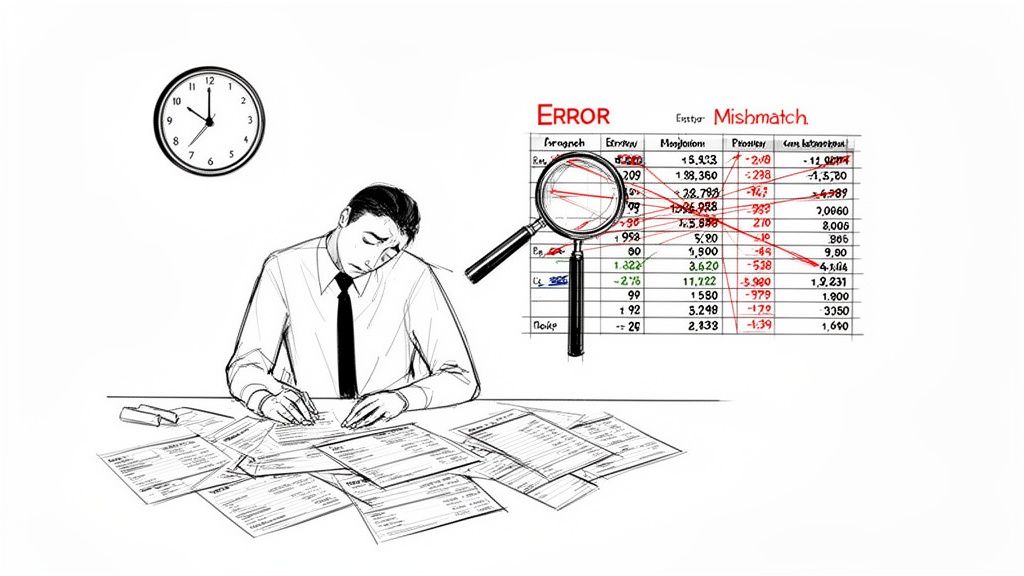
Just picture an accountant staring down a 50-page invoice from a major supplier. They can spend hours meticulously typing in each description, quantity, and unit price. But then, halfway through, they realize a complex tax calculation on page 17 just doesn't add up. Now they have to backtrack, re-checking every single entry and derailing their entire afternoon.
The Real-World Consequences
This manual struggle is far more than a simple annoyance; it creates tangible problems for the business. All those hours spent on repetitive data entry are hours not spent on strategic analysis, negotiating better terms with vendors, or finding real cost-saving opportunities. The risk of employee burnout is high, and the financial fallout from even tiny errors can be massive.
Some of the most common frustrations we hear about include:
- Inconsistent Formats: No two vendors use the same layout, forcing your team to constantly re-learn where to find information.
- Poor Quality Scans: Illegible text from low-resolution scans turns data entry into a guessing game, leading to incorrect numbers.
- Multi-Page Tables: Line items that spill across multiple pages are a nightmare to reconcile manually.
- Complex Calculations: Manually verifying every tax, discount, and total for each line is incredibly time-consuming and prone to error.
The real issue with manual entry is that it forces highly skilled professionals to do low-value, repetitive work. It’s like asking a master chef to chop vegetables all day—a complete waste of their talent.
This is exactly why so many businesses are looking for a better way. The constant errors and lost productivity make a powerful case for moving to a modern, automated solution.
And the stakes are higher than just internal efficiency. A KPMG global survey of 800 public companies revealed that clear line-item details actually improve investor confidence by 28%, which helps reduce stock volatility. Getting the details right, from the ground up, matters to the entire business. You can learn more about how line items impact financial reporting and investor trust.
How to Automate Your Line Item Workflow
If you’ve felt the pain of manual line item entry, the solution is probably obvious: automation. Modern AI tools are built specifically to handle the headaches that come from inconsistent document formats and mind-numbing copy-paste work.
Forget about those rigid templates that fail the moment a supplier tweaks their invoice design. Today's technology reads documents more like a person does. It intelligently spots tables, figures out the columns and rows, and understands the context to pull out each line item with its description, quantity, and price. This process transforms a jumble of messy PDFs and grainy scans into clean, structured data in seconds.
The workflow couldn’t be simpler. You just upload a stack of documents, and the system does all the heavy lifting for you.
From Manual Drudgery to Strategic Insight
The point of automation isn’t just about doing things faster—it’s about doing them smarter. When you get rid of hours of manual data entry, you free up your team to focus on work that actually drives the business forward.
- Prevent Costly Human Errors: Good automation tools can reach over 99% accuracy, catching small mistakes a tired human eye might miss and preventing costly payment errors.
- Unlock Faster Processing Cycles: A task that used to eat up an entire afternoon can be done in just a few minutes. This means you can close the books sooner and keep suppliers happy with on-time payments.
- Gain Access to Clean Data: With line item data organized and ready to go, your teams can finally dig into spend analysis and make better strategic decisions.
The real win with automation is transforming your finance team from data entry clerks into strategic analysts. They get the clean, reliable information needed to find savings, improve budgets, and guide the business forward.
This shift helps any finance, accounting, or operations team get ahead of problems instead of just reacting to them. To see how this works in more detail, check out our guide on intelligent data extraction from invoices. Ultimately, automation turns a major operational bottleneck into a source of valuable business intelligence.
Got Questions About Line Items? We’ve Got Answers.
When you start digging into financial documents, a few common questions always seem to pop up. Let's clear up some of the usual points of confusion so you can get a solid handle on what line items are and why they're so critical for running a business.
Wait, Isn't a Line Item Just a General Ledger Entry?
This is a common mix-up, but they're two very different things.
Think of a line item as the raw evidence. It’s the specific detail on the original document, like an invoice that lists "10 laptops @ $800 each." The general ledger entry is the summary of that transaction after it’s been recorded in your accounting books. It gets categorized under a broad account like 'Office Equipment.'
In short, the line items are the proof that backs up the summarized ledger entry.
Can Modern Software Really Handle All the Different Invoice Formats Out There?
Absolutely. It’s a valid concern, especially if you've ever dealt with older, template-based software. Those systems would break the moment a vendor moved a column or changed their invoice layout.
Thankfully, modern AI platforms are built differently. They don't just look for data in fixed positions; they're trained to understand the context and structure of a document, much like a person would. This means they can intelligently find tables and pull out line item details even when the format, columns, or layout is completely different from the last one.
How Exactly Does Line Item Data Make Budgeting Better?
It all comes down to detail. When you have accurate line item data, you get a crystal-clear picture of exactly what your company is buying. This level of detail is a massive advantage for financial planning.
Instead of just seeing a vague "$50,000" expense for 'IT Costs,' you can see that $30,000 went to new servers, $5,000 was for software licenses, and the rest was for peripherals.
This kind of insight makes your future budgeting far more precise. It also makes it incredibly easy to spot where you might be overspending and find real opportunities to save money. You're not just guessing anymore; you're forecasting with confidence.
Ready to stop wasting hours on manual data entry? DocParseMagic turns your messy invoices and documents into clean, structured spreadsheets in minutes. Start for free and see how it works.