What Is a Lien Waiver in Construction?
You’re usually introduced to lien waivers at the worst possible moment. A pay application is ready, accounting wants to release funds, the owner wants backup for the draw, and someone asks, “Do we have all the waivers?”
If that question gets a slow answer, money stalls.
That’s why project managers need to understand what is a lien waiver in construction beyond the legal definition. It isn’t just paperwork for closeout. It’s a payment control document. It protects the project from duplicate payment risk, gives lenders comfort, and gives accounting a clean record of who was paid, for what, and through when.
Handled well, lien waivers keep cash moving. Handled poorly, they create exactly the dispute they were supposed to prevent.
Why Lien Waivers Are Critical for Construction Projects
A draw package is ready to go. The owner expects funding, accounting has the payment batch queued, and one supplier on the job still has not returned a waiver. If funds go out anyway and that supplier later records a lien, the project can end up dealing with a title issue after everyone thought the pay cycle was closed.
That is the risk lien waivers are meant to control.
A lien waiver in construction is a legally binding document in which a contractor, subcontractor, or supplier acknowledges payment and gives up lien rights for a stated amount or time period, as explained in CrewCost’s construction lien waiver guide. In practice, it functions as payment evidence with legal consequences attached.
For project teams and accounting teams, the primary value is operational. A waiver ties together the pay application, the approved scope, the payment release, and the remaining lien exposure. If one of those pieces is out of sync, cash can stall or, worse, funds can be released without the protection the owner or GC expected.
Why owners and GCs ask for them
Owners ask for waivers to reduce the chance of downstream claims after money has already been disbursed. Lenders ask for them because draw decisions depend on clean documentation. General contractors ask for them to avoid paying once upstream and then fighting a second claim from a subcontractor or supplier that says it never received its share.
That makes lien waivers part of the project’s payment control process.
Practical rule: If money is leaving the project and the file does not show what lien rights were waived in exchange, the payment process is not finished.
Why project managers should care
Project managers often assume waivers belong entirely to accounting. In the field, that separation does not hold up. The PM knows whether billed work is in place, whether a back charge is pending, whether retention changed, and whether a disputed item should be excluded from the waiver amount. Accounting knows whether payment was approved, cut, and cleared. Both sides need the same answer, on the same pay period, before funds move.
This is why waiver management sits close to other project controls. Teams already track revised scope, pending pricing, and billing shifts through tools and documents such as construction change orders. Waivers belong in that same workflow, not in a separate folder someone checks at month-end.
A disciplined waiver process supports three parts of the job at once:
- Payment release control so funds do not go out without matching documentation
- Title and financing protection so the owner, lender, and GC have fewer surprises after a draw
- Audit-ready records so each payment has a clear trail showing who was paid, how much was covered, and the through date tied to that waiver
The trade-off is straightforward. Tight waiver controls add a step to the pay cycle. Weak controls create rework, funding delays, disputed balances, and long email chains between project teams, AP, and legal. On active jobs, the first option is cheaper.
The Four Types of Lien Waivers Explained
A subcontractor submits a pay app on Friday. AP is ready to release funds, but the waiver attached to the invoice says "unconditional." The check has not cleared. On a busy project, that one word can shift risk from a normal payment cycle into a claims problem.
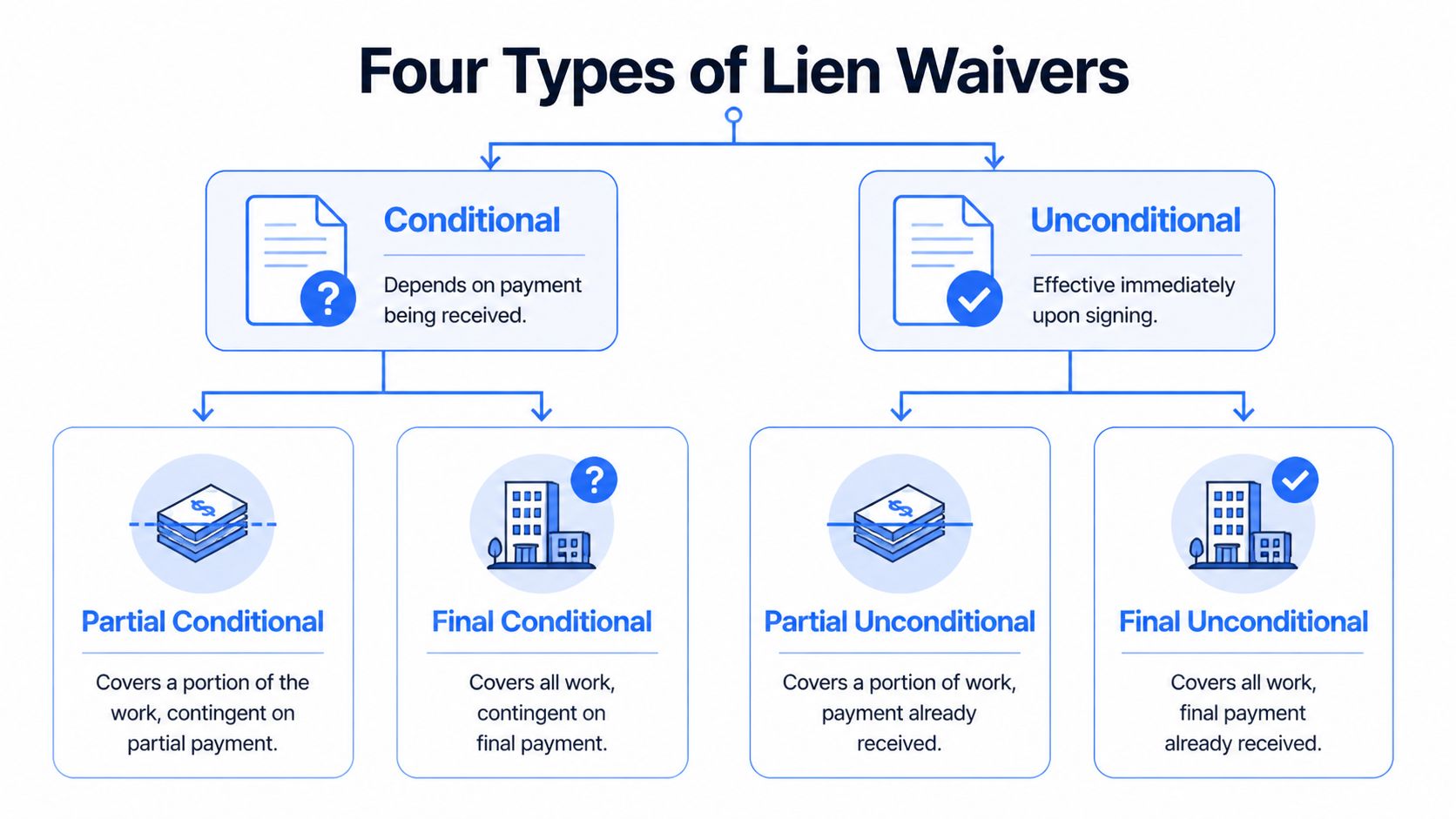
The four waiver types make sense once you sort them by two questions. Is the waiver conditional or unconditional? Is it tied to a progress payment or the final payment?
Conditional versus unconditional
A conditional waiver becomes effective only after the payment is received and clears. In day-to-day operations, this is the form that best matches the way money moves through construction. A conditional waiver on progress payment is common because it lets the payer collect waiver coverage for a specific billing period without asking the signer to give up rights before funds are in hand, as explained in GetBuilt’s explanation of conditional and unconditional lien waivers.
An unconditional waiver takes effect when signed, subject to state law and the wording of the form. That creates obvious exposure for the signer if payment is delayed, reversed, or never arrives. From a controls standpoint, unconditional forms belong after cash receipt is confirmed, not earlier in the approval chain.
Conditional means payment is still the trigger. Unconditional means the rights are already being released.
That distinction matters to project teams and accounting teams for one reason above all. It keeps the waiver aligned with cash status.
Progress versus final
The second question is about scope.
A progress waiver covers work through a stated billing period or through date. If that date runs past the period covered by the invoice, the signer may waive rights for work that has not been paid yet. That is why experienced teams review the amount, the through date, and any carve-outs together instead of treating the waiver as a simple attachment.
A final waiver is used at closeout and is intended to release any remaining lien rights on the project. Because it reaches the end of the job, final waivers deserve a tighter review. Pending change orders, disputed back charges, punch list holdbacks, and retention issues should all be resolved or clearly excluded before anyone signs.
Teams that need a starting point for form review often use a construction lien waiver template to compare titles, payment language, and through-date wording before routing documents for signature.
The four waiver types in practice
Here is the practical breakdown.
| Waiver Type | When to Use | Risk Level for Signer | Key Phrase to Look For |
|---|---|---|---|
| Conditional on Progress Payment | During routine pay applications for work through a billing cutoff | Low | Effective upon payment clearance |
| Unconditional on Progress Payment | Only after progress funds are confirmed received | High | Effective upon signing |
| Conditional on Final Payment | At closeout while final funds are still processing | Low | Final rights waived upon payment clearance |
| Unconditional on Final Payment | Only after all final funds are confirmed received | Highest | Final rights already released |
What works on live projects
On active jobs, the cleanest process is usually conditional progress waivers during the project and conditional final waivers until final funds are confirmed in the bank. That protects lien rights while giving owners, lenders, and GCs the documentation they need to release money.
The operational benefit is just as important as the legal one. Standardizing waiver type by payment status reduces exceptions, shortens AP review, and makes draw support easier to audit later. Firms that already keep tight records around vendor compliance and cash movement, including groups like Bookkeeping and Accounting of Florida Inc., understand that waiver discipline is part of payment control, not separate from it.
A few habits make the process safer:
- Match the waiver type to payment status.
- Review the through date against the pay app and schedule of values.
- Check for carve-outs covering retention, disputed amounts, and pending change orders.
- Do not rely on the title alone. The legal effect language controls the risk.
If a new project manager keeps one rule in mind, it should be this. The right waiver is the one that matches the money that has been paid, the work period being billed, and the claims the signer still needs to preserve.
State Laws and Navigating Lien Waiver Risks
A PM approves a pay app on Friday. AP cuts the check. The waiver is signed, filed, and everyone assumes the project is covered. Two months later, a dispute hits and legal finds the form did not comply with the state’s rules. The paperwork looked complete. The exposure never closed.
That is the main problem with lien waivers across state lines. The risk is not just legal interpretation. It is bad payment control.
The statutory state problem
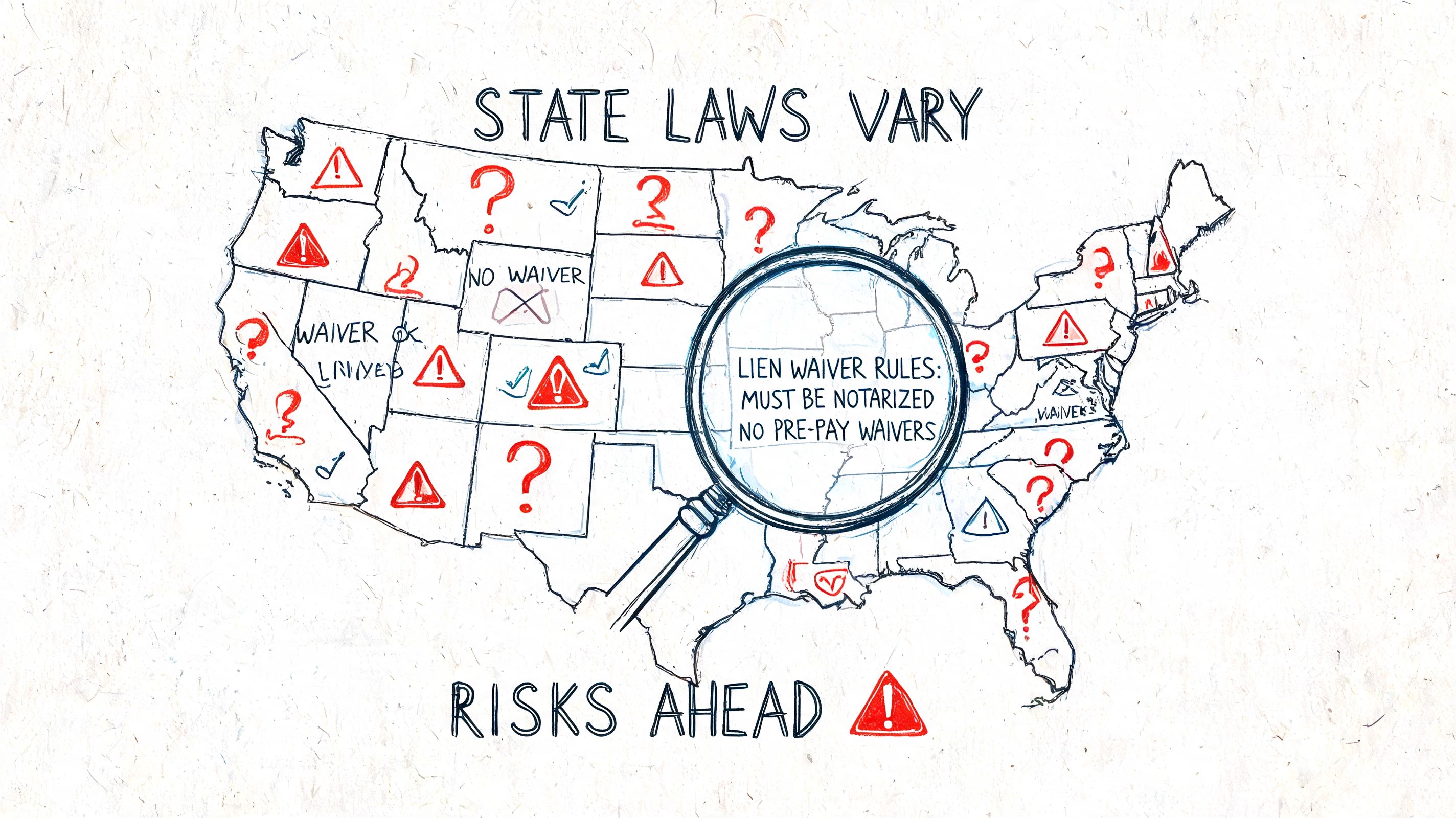
In 12 states with mandatory statutory forms, using noncompliant language can invalidate the waiver entirely, according to Document Crunch’s review of lien waiver requirements. For project teams, that creates a false sense of security. You may have a signed document in the file and still have open lien exposure.
I have seen this happen in companies with decent AP discipline but weak form control. Accounting collected the waiver. The PM approved the bill. No one checked whether the state required specific language, timing, or formatting. On paper, the payment package was complete. From a risk standpoint, it was not.
Hidden traps outside statutory states
Non-statutory states create a different problem. More flexibility usually means more custom language, more markups, and more opportunities for someone to sign away rights that were supposed to stay intact.
Document Crunch’s review points out that in some non-statutory states, including Colorado and Nebraska, the rules can let upstream parties affect downstream lien rights under certain conditions. The same review says 75% of contractors are unaware of those state-specific nuances. That lack of awareness shows up in operations first. Teams reuse old templates, accept edited forms under payment pressure, and do not catch the risk until a dispute or audit forces a closer review.
The practical issue is simple. A waiver can be signed on time, attached to the invoice, and still be the wrong document for the job.
If your company works in more than one state, a single “standard waiver” is not a control. It is only a starting point.
Where the risk starts in the workflow
Waiver problems usually begin long before anyone calls counsel. They start in the handoff between estimating, project management, accounting, and whoever owns contract review.
Common failure points look like this:
- The wrong form gets pulled at payment time. Someone copies a waiver from a prior project in another state.
- The through date does not match the pay app. The waiver covers more work than the current billing period.
- Exceptions are missing. Retention, disputed amounts, pending change orders, or backcharges are not carved out.
- Custom language slips through. A signer focuses on getting paid and misses broad release terms.
- No one owns the final review. PM, AP, and legal each assume another group checked the form.
Document Crunch also says waivers can increase subcontractor payment disputes by 28% in non-statutory states when the language causes parties to over-waive their rights. That should get the attention of both operations and finance. A bad waiver does not just create legal exposure. It can delay draws, hold up vendor payments, strain subcontractor relationships, and distort the aging report because everyone is arguing over what was released.
A workable multi-state control
The better approach is to build waiver review into the payment workflow instead of treating it as end-of-process paperwork.
- Assign the correct waiver template when the job is set up. The project state should drive the approved form library from day one.
- Check waiver language against the pay app before payment approval. Review amount, through date, signer, and carve-outs as part of the invoice package.
- Route edited or custom forms for escalation. Do not let field or AP teams approve legal changes out of habit.
- Store waivers with payment support. Keep the signed waiver tied to the invoice, pay application, and proof of payment so audit and dispute review are fast.
- Use exception reporting. Flag missing waivers, conditional versus unconditional mismatches, and forms that do not match the project state.
That process does two things at once. It protects lien rights where they should stay protected, and it gives accounting a cleaner path to release funds with fewer last-minute document chases. On a busy portfolio, that is the difference between waivers being a compliance headache and waivers functioning as a real cash flow control.
A Practical Guide to Managing Lien Waivers
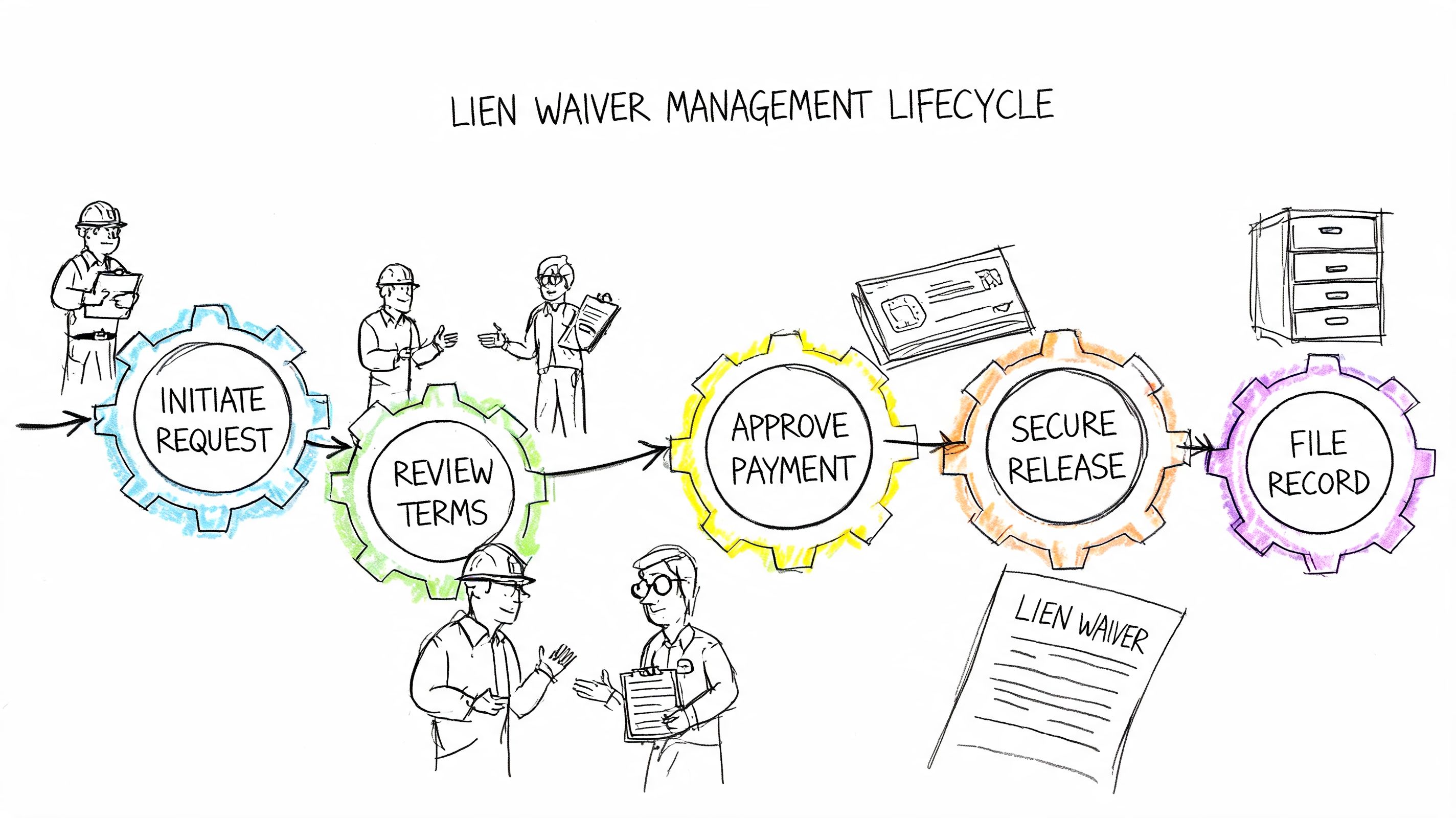
The teams that handle waivers well don’t rely on memory. They use a repeatable workflow tied to every payment cycle.
If your current process lives in email threads, shared drives, and someone’s spreadsheet, tighten it up. Construction bookkeeping firms often stress that payment documentation has to line up with job costing and vendor records, which is one reason resources like Bookkeeping and Accounting of Florida Inc. for construction bookkeeping are useful for finance teams building cleaner back-office processes.
A practical payment-cycle workflow
Start the waiver process when the pay application starts, not after the check run.
-
Request waivers with every pay application
Don’t wait until payment day. Ask for the waiver package as part of the billing submission so review happens before release pressure builds. -
Collect from everyone who matters
Don’t stop at the subcontractor. If your process requires lower-tier support, track those documents too. A missing supplier waiver can leave a gap even when the prime sub’s paperwork looks complete. -
Verify the document against the payment record
Waiver review should happen against actual billing data, not by visual guesswork. -
Release payment only after review is complete
That doesn’t mean every payment has to be delayed. It means the review has to be built into the payment calendar.
What to check on every waiver
The review itself doesn’t need to be complicated. It needs to be consistent.
-
Correct project identity
Confirm the project name and address match the job file. -
Correct waiver type
Make sure the form is conditional or unconditional as intended, and progress or final as intended. -
Correct amount
The amount should match the payment being exchanged. -
Correct through date
For progress waivers, the through date should align with the billing period being paid. -
Correct parties and signatures
The signer should be the proper party, and the document should be complete before filing.
Controller’s habit: If the through date, amount, and waiver type don’t match the pay application, stop there. Don’t try to “clean it up later.”
Where teams usually break down
The breakdown usually isn’t legal complexity. It’s handoff failure.
A PM approves the work. AP cuts the payment. Someone notices the waiver is missing or wrong after the release is already scheduled. Then the team starts chasing revised PDFs while everyone claims the job is urgent.
That’s why many teams standardize intake with a single waiver checklist and a consistent file naming rule. If you need a starting point for that workflow, a construction lien waiver template guide can help teams define what fields should be captured and reviewed each time.
Here’s a quick visual walkthrough of the process in action.
How to store them so they’re usable later
A waiver isn’t useful if no one can find it during a draw review, audit, or dispute.
Store each waiver with:
- The matching pay application
- The payment support
- The signed execution copy
- Any exception notes or carve-outs
- A status marker showing whether it’s progress or final
That gives accounting, project management, and leadership one shared record of payment status instead of three partial versions.
Common Lien Waiver Pitfalls and How to Avoid Them
The mistakes that cause waiver problems are usually small on paper and expensive in practice. Most of them look harmless when someone is rushing.
The wrong through date
A subcontractor submits a waiver dated through the end of the month. The payment only covers work through the middle of the month. Nobody catches the mismatch because the dollar amount seems close enough.
Later, there’s a dispute over the unpaid portion. The subcontractor argues they weren’t paid for the later work. The GC points to the signed waiver. Now both sides are fighting over what the document released.
The prevention is simple. Match the through date to the actual billing cutoff, not the date someone signed the form.
The unconditional waiver signed too early
A supplier receives a check and signs an unconditional waiver the same day. The supplier treats the check as payment received. Then the payment fails.
At that point, the supplier may be in the worst possible position. No money and no lien power tied to that payment period.
That’s why experienced teams are careful with unconditional forms. They’re fine after confirmed receipt of funds. They’re dangerous before that.
Don’t sign based on a promise to pay. Sign based on payment status.
The missing lower-tier waiver
A GC collects a clean waiver from a subcontractor and assumes the package is complete. Weeks later, a lower-tier supplier claims they never got paid and files against the project.
From the GC’s perspective, this feels unfair because payment already went out. From the supplier’s perspective, it makes perfect sense because their rights weren’t waived.
The lesson is operational. If your project requires lower-tier coverage, your process has to identify who those parties are and whether their waivers are also needed. A top-tier waiver doesn’t automatically clean up downstream exposure.
The waiver that releases more than intended
This one shows up in custom forms. The document may look like a standard payment receipt, but the language reaches further and releases claims beyond the amount being paid.
Teams miss this when they review only the title and signature block. The title might say “conditional waiver,” but the body can still contain broader release language.
Practical ways to reduce that risk:
- Read the effect language, not just the document title
- Reserve exceptions for unpaid items when needed
- Escalate custom language instead of approving it casually
- Train PMs and AP staff to spot mismatch issues before payment day
A waiver should document a narrow exchange. Payment for a defined amount or period. If it starts acting like a broad settlement agreement, slow down.
How Technology Streamlines Lien Waiver Management
A payment run can stall over one missing field on one waiver. AP is ready to cut checks, the PM wants subs paid before the next billing cycle, and someone is still opening PDFs by hand to confirm whether the form is conditional, what amount it covers, and which through date applies.
That is where waiver administration stops being clerical work and starts affecting cash flow.
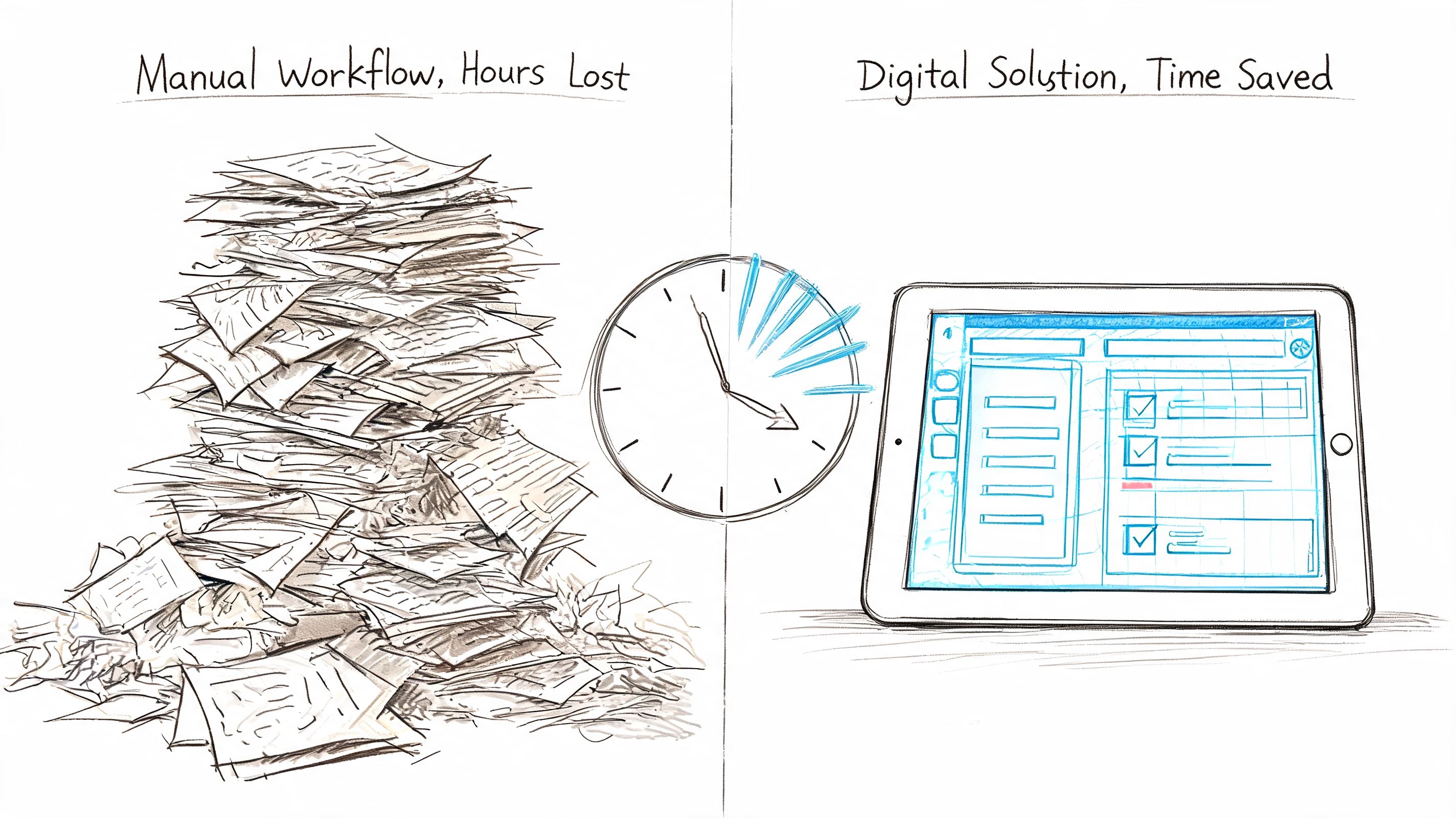
Manual handling creates cost in two places. Teams spend hours receiving, renaming, reviewing, routing, chasing signatures, and filing documents. They also absorb preventable risk when the wrong waiver is approved, key data is entered incorrectly, or a signed form cannot be found during a draw review or dispute.
For a mid-size GC with 10 projects, manual lien waiver processes cost an estimated $48,000 to $96,000 annually in labor, payment delays, and risk exposure, while automation reduces that to $6,000 to $18,000. In the same sentence, US Tech Automations’ 2026 lien waiver ROI analysis estimates 3 to 8x first-year ROI, 783% over three years, and $141,150 in net savings in moderate scenarios.
What automation should do
Good waiver automation gives project and accounting teams clean data they can review before money goes out. At a minimum, that means extracting:
- Waiver type
- Payment amount
- Through date
- Project identifiers
- Signatory details
- Status for tracking and audit
Those fields drive decisions. If the waiver type is wrong, the payment package may not match company policy. If the amount or through date is wrong, the team can release funds with a false sense of coverage. Speed matters, but accuracy matters more.
Where document parsing fits in the workflow
Organizations often do not receive waivers in one standard format. They come from different subcontractors, in different templates, with different scan quality, and often mixed in with invoices, statements, and backup. That is why document parsing is useful. It converts key waiver details into a consistent record so a reviewer can focus on exceptions instead of retyping routine fields.
For teams building a tighter intake process, construction document parsing workflows can support waiver review alongside invoices and other project records. DocParseMagic is one option in that category. It extracts structured fields from lien waiver PDFs so teams can track type, amounts, dates, and related payment data without relying on manual copy-paste.
The primary value of automation is control. One searchable record shows what was waived, by whom, for which payment, and whether the document still needs review.
What works and what does not
What works:
- A single intake point for incoming waiver documents
- Automatic extraction of key fields before review
- Human review for exceptions, custom language, and payment mismatches
- Searchable records tied to vendor, project, and billing period
- Status tracking that lets PMs and AP see what is still holding up payment
What does not:
- Shared folders with inconsistent file names
- Spreadsheet logs updated only after someone has time
- Reviewing waivers after checks are already queued
- Treating scanned PDFs as if they were reliable data
- Splitting waiver ownership between project teams and accounting with no shared view
Well-run teams use technology to shorten review time, reduce keying errors, and keep payment moving without lowering controls. Weak processes stay weak if the software only stores files faster. The gain comes from connecting document intake, field extraction, exception review, and payment release in one operating process.
Making Lien Waivers Your Project’s Shield Not Its Sword
A lien waiver should protect the project, not create a new fight.
Used properly, it documents a fair exchange. Money goes out. Rights tied to that payment are waived. Everyone knows what period was covered, what amount changed hands, and what risk remains open. That’s why the safest habit on active jobs is usually a conditional waiver, and why no one should sign an unconditional waiver until funds are confirmed.
The bigger lesson is operational. Waivers work best when project management and accounting run one shared process. Review the right form, confirm the amount, match the through date, preserve exceptions where needed, and store the signed record where the whole team can find it.
That turns the waiver from a recurring annoyance into something more useful. A control that supports trust, clean draws, and steadier cash flow.
If your team is chasing waiver PDFs, retyping dates and amounts into spreadsheets, and trying to reconcile payment status by hand, DocParseMagic can help you extract key lien waiver fields into clean, usable data for review and tracking. It’s a practical way to reduce manual handling without changing the purpose of the document itself.