Your Free Construction Lien Waiver Template and Guide
A construction lien waiver template is a simple but crucial document. It’s a form that anyone on a project—contractors, subs, or suppliers—signs to officially give up their right to file a mechanics lien against the property, but only in exchange for getting paid. Think of it as a formal receipt for payment, confirming that a specific bill has been settled.
What Is a Lien Waiver and Why Does It Matter?

At its heart, a lien waiver is the construction industry's version of a receipt. When you buy something at a store, the receipt proves you paid. On a job site, a lien waiver proves a contractor or supplier has been paid for their work and, in return, gives up their right to put a lien on the property for that specific payment.
This straightforward document is the linchpin of secure payments in construction. It protects everyone in the payment chain, providing the peace of mind needed to keep a project moving forward without nasty surprises.
The Role of Lien Waivers in Construction Payments
First, let's talk about the tool that makes waivers so necessary: the mechanics lien. A mechanics lien is a legal claim that an unpaid contractor, sub, or supplier can file against a property. If the bill remains unpaid, the lienholder can even force a sale of the property to get the money they’re owed. It’s a powerful protection for anyone who adds value to a property.
But for a property owner or general contractor, an unexpected lien is a nightmare. It clouds the property’s title and can bring financing to a screeching halt. That’s exactly where lien waivers come in.
A lien waiver is a proactive tool. It’s an agreement signed before a problem arises, ensuring that as soon as a payment is made, the threat of a future lien for that specific work is completely off the table.
This simple exchange—a signed waiver for a cleared payment—is what keeps transactions transparent and secure. It clarifies who has been paid for what, protecting everyone from future disputes.
Why Lien Waivers Are Non-Negotiable
Let's be honest: the construction industry can be terrible with payments. The average delay to get paid is over 90 days, which is more than double the healthy 45-day benchmark. This cash flow crunch often leads to a standoff—owners won't pay until they have a signed waiver, and subs won't sign until they see the money.
The good news? Using lien waivers correctly helps resolve an estimated 70% of these payment standoffs.
Here’s why they are so vital for everyone involved:
- For Property Owners: Waivers ensure the property title stays "clean" and free of claims. This is absolutely critical for selling, refinancing, or getting more construction financing.
- For General Contractors: GCs use waivers to manage risk from their own subs and suppliers. By collecting waivers as they pay people, they can prove to the property owner that everyone downstream has been paid.
- For Subcontractors and Suppliers: At the end of the day, signing a waiver in exchange for payment is how you get your money. It's a standard business practice that helps you close out an invoice, maintain good cash flow, and move on to the next job.
Handling these documents properly is the key to preventing the kind of misunderstandings that cause project delays and expensive legal fights. For teams juggling dozens of waivers across multiple projects, using technology to automate the process is a game-changer. You can see how to simplify this with better construction document management.
The Four Types of Lien Waivers Explained
Lien waivers can seem confusing, but they all boil down to answering two simple questions. Getting them right is the difference between a smooth payment process and a financial nightmare.
First, is the payment guaranteed, or is it still pending? This gives us conditional vs. unconditional. Second, are you getting paid for a piece of the job or for the whole thing? That's progress vs. final payment.
Combine these, and you get the four types of lien waivers. Using the wrong one is a surprisingly common mistake, and it can cost you dearly. A proper construction lien waiver template will always make it crystal clear which type it is.
1. Conditional Waiver on Progress Payment
This is your go-to waiver for most of the project and by far the safest one to sign. Think of it as a receipt you write before the money hits your account.
It’s “conditional” because it only kicks in once you’ve actually been paid. The waiver basically says, "if I receive this payment, then I agree to waive my right to file a lien for this specific portion of work." If the check bounces, the waiver is just a useless piece of paper and your lien rights are still intact.
When to Use It:
- You’re a subcontractor submitting a monthly pay application.
- You’re a supplier dropping off materials and invoicing for that specific delivery.
- You’ve hit a project milestone and are requesting a partial payment.
This is the workhorse for routine payments, keeping cash flowing without putting anyone in a tough spot.
2. Unconditional Waiver on Progress Payment
Here’s where the risk ramps up. An “unconditional” waiver is effective the second you sign it. It doesn’t matter if the check you were promised is good, lost in the mail, or never existed in the first place.
By signing an unconditional waiver, you are legally declaring that you have been paid for that portion of the work. Your lien rights for that amount are gone for good—even if you never see a dime.
When to Use It: The golden rule is simple: only sign this waiver when you can confirm the funds are in your bank account. That means the wire transfer is complete, the check has cleared, or you're holding physical cash. Never, ever sign it based on a promise.
3. Conditional Waiver on Final Payment
This waiver is used when the project is wrapping up. It’s for the last payment you’ll receive, which usually includes your final invoice amount plus any retainage that was held back.
Like its progress payment cousin, it’s conditional. It states that once you successfully receive that final payment, you agree to waive all remaining lien rights on the project. It’s a safe way to close out a job, because the waiver has no power until the money is officially yours.
When to Use It:
- The job is 100% complete and you're submitting your final invoice with retainage.
- The general contractor is gathering final waivers from everyone to officially close out the project with the owner.
4. Unconditional Waiver on Final Payment
This is the big one—the final handshake that closes the book on your involvement in a project. Signing an Unconditional Waiver on Final Payment means you are declaring, without any conditions, that you have been paid in full and you give up all rights to file a lien on the property.
The moment it's signed, your ability to file a lien is gone forever. The stakes are incredibly high. A case study from CohnReznick highlights a scenario where a property owner faced millions in losses because subcontractors had signed unconditional waivers before payments cleared, leading to massive legal battles.
When to Use It: Only sign this document when you have 100% confirmation that the final payment has cleared and the money is securely in your account. This should be the absolute last piece of paper you sign for a project.
Choosing the right form is critical. The table below simplifies this decision, helping you match the payment situation to the correct waiver.
Choosing the Right Lien Waiver Type
| Scenario | Waiver Type to Use | Key Consideration |
|---|---|---|
| Submitting a regular monthly invoice | Conditional on Progress Payment | Safest option; waiver is only valid after payment is received. |
| You have received a progress payment and the funds have cleared | Unconditional on Progress Payment | Only sign after confirming payment. You are giving up rights immediately. |
| Submitting your final invoice, including retainage | Conditional on Final Payment | Protects your lien rights until the final payment is secure in your account. |
| You have received final payment and the funds have cleared | Unconditional on Final Payment | The final step. This closes out all lien rights on the project for good. |
Ultimately, understanding the difference between "conditional" and "unconditional" is key to managing your risk. Industry data shows that conditional waivers are used for over 80% of progress payments precisely because they protect the party getting paid. When the wrong waiver is used at the wrong time, it contributes to the estimated $10 billion in mechanics lien claims filed each year in the U.S.
Alright, theory is great, but now you need the actual documents to get the job done. Let's get into the free, ready-to-use construction lien waiver templates for each of the four types we've just discussed.
Each template is a simple, editable form you can download right away. They have clear placeholders like [Company Name], [Amount], and [Property Address] so you can’t go wrong. Just fill in the details for your project, and you're set.
If you're ever unsure which one to grab, this quick visual guide should help. It all comes down to one simple question: has the money hit your account yet?

The single biggest factor is always the payment status. That one detail determines whether you need the safety net of a conditional waiver or if it's safe to sign an unconditional one.
Conditional Waiver on Progress Payment Template
This is your workhorse waiver—the safest and most common one you'll use throughout a job. It's the perfect document to send along with your pay application or invoice before you've actually been paid.
- Its Job: To waive your lien rights for a specific partial payment, but only after that payment has cleared.
- The Magic Words: Look for a phrase like, "This waiver is effective upon receipt of payment."
- When to Use It: Every time you submit an invoice for a progress payment.
[Download Your Conditional on Progress Payment Template Here]
To see exactly what it looks like in action, here’s a correctly filled-out example. Notice how the "Through Date" and the specific payment amount are clearly defined.
(Image: Sample Filled Conditional on Progress Payment Waiver)
Unconditional Waiver on Progress Payment Template
Tread carefully with this one. When you sign this waiver, you're giving your legal word that you have received a progress payment. Once signed, your lien rights for that specific work are gone for good.
- Its Job: To permanently give up lien rights for a partial payment after the funds are securely in your account.
- The Magic Words: It will state something direct, like, "The undersigned has been paid and received a progress payment."
- When to Use It: Only after you’ve logged into your bank account and confirmed the money is there. No exceptions.
[Download Your Unconditional on Progress Payment Template Here]
Here’s a sample of how to complete this form. Before you even think about signing, double-check that the amount on the waiver exactly matches the funds you received.
(Image: Sample Filled Unconditional on Progress Payment Waiver)
Conditional Waiver on Final Payment Template
As you wrap up a project, this is the waiver you'll use to close things out. It covers your final draw, including any retainage that was held back. Just like its progress payment cousin, it’s conditional, so it keeps you protected until that final check clears.
This is the smart way to handle the financial closeout of a job. The waiver doesn't become active until the final payment is successfully processed, which means you can still file a lien if something goes sideways with that last transaction.
- Its Job: To waive all remaining lien rights on the project, but only once the final payment is in your hands.
- When to Use It: When you submit your final invoice for the project, retainage and all.
[Download Your Conditional on Final Payment Template Here]
Check out the example below to see how to fill out this final conditional waiver. Accuracy is key to making sure the project is closed out cleanly.
(Image: Sample Filled Conditional on Final Payment Waiver)
Unconditional Waiver on Final Payment Template
This is it—the very last document you should sign for any project. Signing this form officially declares that you’ve been paid in full and you are permanently giving up all your lien rights. It’s the final handshake.
- Its Job: To completely and irreversibly waive all lien rights for the entire project.
- When to Use It: Only after you have 100% confirmed that all final funds, including every penny of retainage, have been received.
[Download Your Unconditional on Final Payment Template Here]
This last sample shows a completed unconditional final waiver. Once this is signed, the payment cycle for the project is officially complete.
(Image: Sample Filled Unconditional on Final Payment Waiver)
While we’ve focused on lien waivers here, you might also find a library of other contract templates helpful for different aspects of your business.
State-Specific Lien Waiver Rules You Must Know
The templates we've shared are a great foundation, but here’s a critical piece of advice that can save you a world of trouble: lien waiver laws are not the same everywhere. Thinking you can use one generic waiver for every project is a major—and costly—mistake.
It’s like trying to use a key for a house in California to open a door in Texas. It just won’t fit. In the same way, a lien waiver that’s perfectly valid in one state could be worthless in another. This isn’t about small-print details; it’s about fundamental legal requirements that protect your bottom line.
States with Mandatory Lien Waiver Forms
This is especially true for a handful of states that have taken all the guesswork out of the equation. They’ve created specific, statutory lien waiver forms that you are legally required to use. No substitutions, no creative edits.
If your project is in one of these states, you must use the exact form provided in their laws. Using your own custom template, no matter how well-drafted, will likely make the waiver unenforceable. This rule creates consistency, but it also puts the responsibility squarely on your shoulders to know the law where you're working.
Currently, 12 states either mandate or strongly recommend using their official statutory forms. If you're getting paid for work in any of these places, you need to be using their specific documents:
- Arizona
- California
- Florida (while not strictly mandatory, their statutory forms are a "safe harbor" and the smartest option to use)
- Georgia
- Massachusetts
- Michigan
- Mississippi
- Missouri
- Nevada
- Texas
- Utah
- Wyoming
Crucial Takeaway: Using a generic construction lien waiver in one of these 12 states is asking for trouble. If a payment dispute ends up in court, your non-compliant waiver could be thrown out, allowing a lien to be filed against the property even after you've been paid.
The Real-World Cost of Using the Wrong Form
The consequences here aren't just theoretical. In construction, lien waivers are the primary defense for property owners and GCs against mechanics liens. Get them wrong, and the financial hit can be massive.
Just look at California. Using an incorrect waiver form there can invalidate it completely, exposing property owners to liens that averaged a staggering $150,000 per claim in resolved cases from 2020-2023. On the flip side, states with mandatory forms have seen a 25% drop in lien-related lawsuits compared to other states since 2018. Clearly, standardization works. You can read more about the impact of state-specific lien waiver regulations to see the data for yourself.
This isn’t just bureaucratic red tape; it's a critical financial safeguard. Before you ever send or sign a lien waiver, your first step should always be confirming the project’s state and checking for a required form. A quick search for "[State Name] statutory lien waiver form" is a small investment of time that can save you from a six-figure headache down the road.
Common Mistakes to Avoid When Using Lien Waivers
A lien waiver looks like a simple piece of paperwork, but it’s packed with legal tripwires. Even if you’re using the right template, one small oversight can cause huge financial headaches down the road.
Think of it this way: signing a waiver is like telling everyone on the project, "I'm all paid up and have no claims for this work." If that's not exactly true, you could be signing away rights you desperately need to keep. Let’s go over the most common mistakes I see people make so you can steer clear of them.
Signing an Unconditional Waiver Before Payment Clears
This is the cardinal sin of lien waivers. An unconditional waiver is effective the second you sign it—it doesn't care if the check you were handed bounces or the promised wire transfer never shows up. Once it's signed, you've legally stated you have the money.
- Real-world scenario: A sub signs an unconditional waiver for a $50,000 progress payment because the check is "on the way." The check never arrives. Because the waiver is signed, the sub has legally forfeited their right to file a lien for that $50,000. They're left with virtually no leverage.
The golden rule is simple: NEVER sign an unconditional waiver until the funds are actually in your bank account. No promises. No exceptions. Cash in hand (or in the bank) is the only green light.
Using the Wrong Waiver Type for the Situation
There are four types of waivers for a reason—each one is designed for a specific scenario. Grabbing a final waiver for a mid-project progress payment is a classic error that can create a world of confusion and risk.
For example, using a final waiver when you're only getting a progress payment could accidentally waive your right to get paid for all future work, retainage, or even disputed change orders. You can read more about how to handle those scope changes in our guide to the construction change order process.
Forgetting or Misstating the Through Date
Pay close attention to the “through date.” This little detail on a progress waiver specifies the exact date your waiver is effective through. Getting this date wrong or leaving it blank is asking for trouble.
If the through date is a future date or is left empty, you could accidentally waive your rights for work you haven't even been paid for yet.
- Real-world scenario: You finished your work for the month on June 30th and submitted your pay application. If the waiver you sign mistakenly lists the through date as July 31st, you just gave up your right to lien for an entire month of work you haven't even invoiced for.
Always double-check that the through date matches the last day of the pay period your payment covers.
Neglecting to Exclude Retainage or Disputed Amounts
Most standard waiver forms use broad language that releases all claims up to the through date. This is a problem if you have outstanding retainage or are waiting on a decision for a disputed change order. A generic waiver could wipe out your ability to collect that money later.
You have to be proactive and add specific language that carves out these exceptions.
How to Protect Yourself: Add a clear, written exception to the waiver form. It can be as simple as:
- "This waiver does not include unbilled work or any retainage held."
- "This waiver specifically excludes any claims related to Change Order #7, valued at $15,000."
- "Notwithstanding anything to the contrary in this document, this waiver does not cover any disputed claims or unexecuted change orders."
By adding these specific exclusions, you're making it crystal clear that you're only waiving rights for the money you've actually received. This protects your right to get paid for everything else you are rightfully owed.
How to Automate Lien Waiver Processing
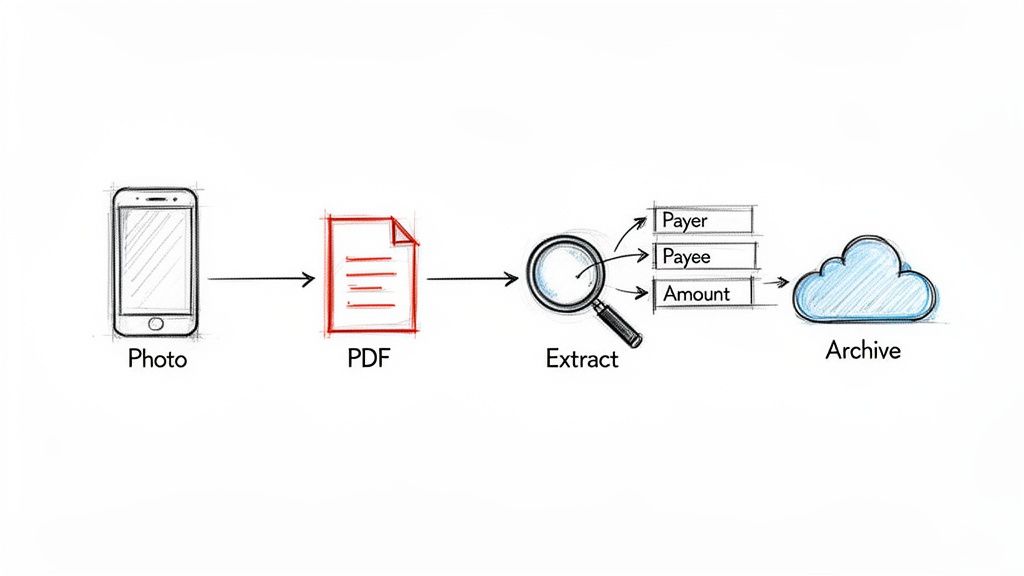
If you handle more than a few lien waivers every month, you know the drill. That manual workflow quickly turns into a major bottleneck. The endless cycle of printing, signing, scanning, and then trying to track every single document is not just slow—it's a recipe for costly mistakes.
Frankly, that old-school administrative burden just doesn't work as your business grows. The good news is you can ditch the paper chase for good. Instead of wrestling with stacks of paper, automation gives you a faster, more accurate way to manage your construction lien waiver templates and the signed forms that come back. It’s all about freeing up your team to focus on what matters, not just pushing paper.
From Manual Data Entry to Instant Extraction
Let's be honest, the real headache with manual processing is the data entry. Someone on your team has to squint at each waiver and painstakingly type all the key information—payer, payee, effective date, payment amount—into a spreadsheet or your accounting system.
A single typo can spiral into a huge compliance problem or a payment dispute that holds up a project. It happens all the time.
This is where automation changes the game. A tool like DocParseMagic can instantly "read" and pull the critical data from any lien waiver you throw at it. It doesn't matter if it's a perfect PDF or a grainy photo someone snapped on their phone in the field. The technology is smart enough to find the fields it needs, regardless of the document's layout.
Think of it this way: automation transforms that messy pile of documents into a structured, searchable database. It prevents data entry errors, keeps your waivers perfectly organized for compliance, and gives you a clear, real-time picture of your entire payment process.
Imagine uploading a batch of 50 lien waivers from all your different subcontractors. In just a few minutes, the system pulls out all the important details and organizes them into a clean, simple table. From there, you can push that data right into your project management or accounting software. To really get a handle on this, it's worth looking into specialized accounting software for construction companies designed for these exact challenges.
Scaling Your Payment Process with Confidence
When you automate lien waiver processing, you’re building a reliable, repeatable workflow that can easily handle more projects as you grow. This isn't just about saving a few hours here and there; it's about reducing financial risk and getting a much tighter grip on the money flowing through your jobs.
You can dive deeper into what is document automation to see how it can help your entire operation, but the benefits for lien waivers are crystal clear:
- Eliminate Manual Errors: Say goodbye to typos and misplaced documents that leave you exposed to risk.
- Improve Compliance: Easily track every single waiver and prove you have the right documentation for every payment made.
- Increase Efficiency: Get your subs paid faster and let your administrative team focus on more valuable work.
This is how you finally move away from a reactive, paper-based system and start running a proactive, data-driven payment operation.
A Few Common Questions About Lien Waivers
Even after you get the hang of lien waivers, a few nagging questions always seem to pop up right when you're ready to sign. Let's clear up some of the most common ones you'll run into on the job.
Does a Lien Waiver Need to Be Notarized?
Good question, and the answer is: it depends entirely on where your project is.
Only a handful of states require notarization by law. If your project is in Texas, Mississippi, or Wyoming, then yes, you absolutely must get your lien waivers notarized for them to be valid. It's not optional.
For projects in most other states, notarization isn't legally required. However, a general contractor or property owner might still write it into your contract as their own policy. Think of it as an extra layer of security. When in doubt, just getting it notarized is always the safest bet.
What Happens If I Sign a Waiver for the Wrong Amount?
This is one of the most dangerous mistakes you can make, especially with an unconditional waiver. It can cost you real money.
Let's say you're owed $50,000, but you only received $40,000 so far. If you sign an unconditional form saying you got the full $50,000, you’ve just legally kissed that remaining $10,000 goodbye. The document essentially acts as a receipt, and you’ve just signed saying you were paid in full for that amount.
Before your pen ever touches that paper, triple-check that the payment amount on the waiver matches what has actually cleared in your bank account. If you spot a difference, do not sign the document. Call the person who paid you and ask them to send a corrected waiver. It's a simple step that protects the money you've earned.
What Is a Through Date on a Lien Waiver?
The "through date" is a crucial little detail on any waiver for a progress payment. It marks the exact cut-off date for the work you're being paid for.
For instance, if a payment covers all your work and materials through June 30th, then June 30th is your through date. It clearly states you are only waiving your right to file a lien for the work done up to that specific date.
Be careful here. An incorrect through date can backfire badly. If you accidentally write in a future date, you might give up your lien rights for work you haven't even been paid for yet, which could include things like retainage or unbilled change orders.
Always make sure the through date perfectly lines up with the end of the pay period for the check you're receiving.
Can I Waive Lien Rights for Future Work?
Nope. In nearly every state, it's illegal for someone to stick a "no-lien clause" in your contract that makes you give up your lien rights before you even start the job. Lien rights are earned as you perform the work, and you can only waive them in exchange for payment.
Laws in most states treat these kinds of upfront waivers as unenforceable because they unfairly tip the scales against subcontractors and suppliers. You should only ever sign a waiver for work that's already been done and paid for. If you see a clause in a contract trying to take away your future lien rights, consider it a major red flag.
Tired of chasing down waivers and manually typing everything into a spreadsheet? DocParseMagic can pull all the key details from any lien waiver automatically, turning a pile of paperwork into clean, useful data. Stop wasting hours on admin work and get back to building your business. Try DocParseMagic for free and see how it works!