What Is a 3 Way Match Your Guide to Flawless Invoice Processing
A 3 way match is a straightforward but powerful accounting control. It’s all about verifying a supplier's invoice before you pay it by checking it against two other critical documents: the purchase order and the goods receipt note.
This simple verification step ensures a company only pays for the exact goods or services it ordered and actually received.
Breaking Down the 3 Way Match Process
Think of a 3 way match as your company's financial safety net. It's your first line of defense against paying for the wrong items, incorrect quantities, or even fraudulent invoices. Just like you'd glance at your restaurant bill to make sure you weren't charged for a dish you didn't order, this process validates every purchase before any money leaves your account.
At its heart, the concept of three-way matching is about confirming that everyone is on the same page. The process hinges on getting three key documents to agree with one another.
The Three Core Documents
So, what exactly are we matching? The whole process boils down to these three pieces of paper (or, more commonly these days, digital records).
-
Purchase Order (PO): This is the official order you sent to the supplier. It spells out exactly what your company agreed to buy, including the specific items, the quantities, and the agreed-upon prices.
-
Goods Receipt Note: This document is created when the shipment arrives at your loading dock or your team receives the service. It’s your internal proof of what was physically received from the supplier.
-
Supplier Invoice: This is the bill. It's the supplier's formal request for payment for the goods or services they claim to have delivered.
The goal is to make sure the invoice (what the supplier wants you to pay) matches the goods receipt (what you actually got) and the purchase order (what you agreed to pay for in the first place).
The table below breaks down what you're looking for on each document.
Document Comparison in a 3 Way Match
| Document | What It Confirms | Key Information Checked |
|---|---|---|
| Purchase Order | What your company ordered. | Item description, quantity, price, payment terms |
| Goods Receipt | What your company received. | Item description, quantity received, condition of goods |
| Supplier Invoice | What your company is being billed for. | Item description, quantity, price, totals, tax |
When the key details—especially item, quantity, and price—align across all three, you have a successful match and can confidently approve the payment.
This flowchart gives you a great visual of how these documents come together.
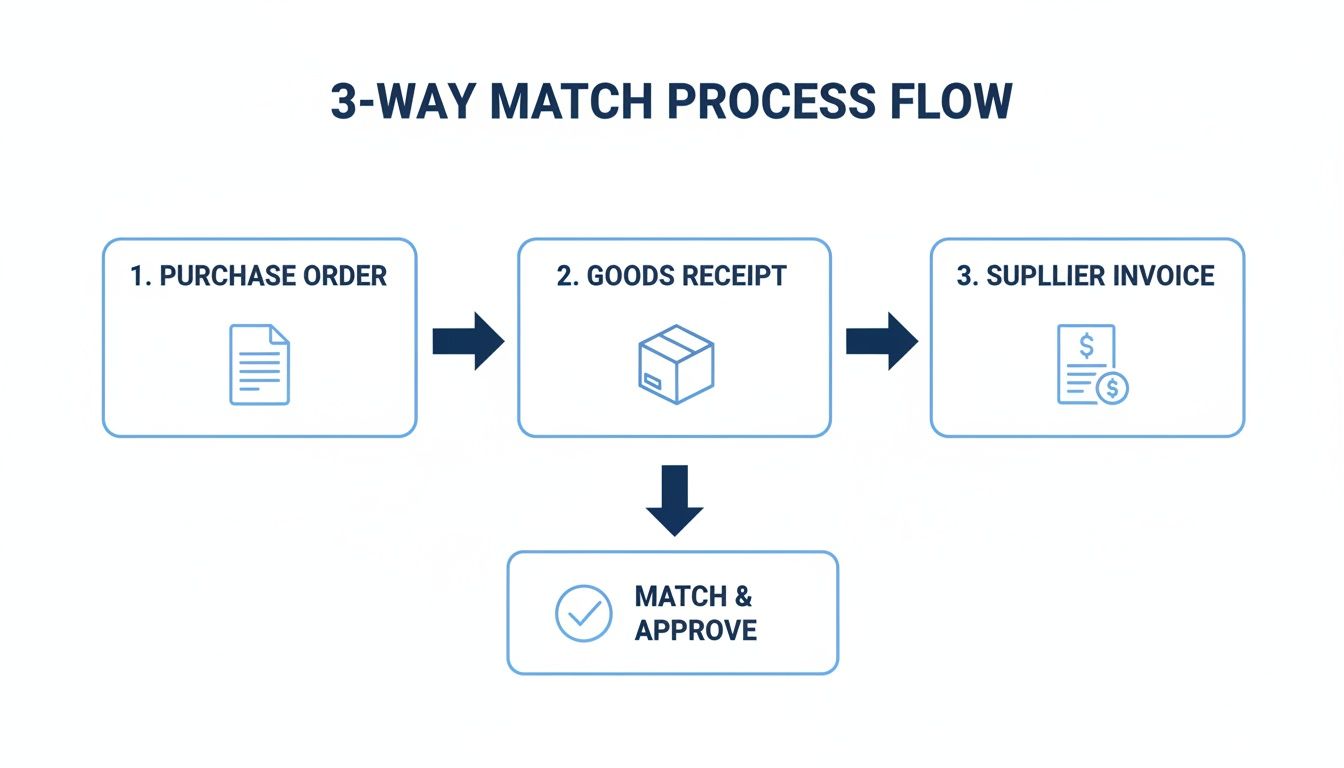
As you can see, it's a linear check. The purchase order sets the expectation, the goods receipt confirms delivery, and the invoice requests payment. If all three line up, the invoice is approved. If there's any discrepancy, the process stops until the issue is investigated and resolved.
Why This Process Is Your Financial Bodyguard
Think of the 3-way match as more than just a procedural step—it's a crucial bodyguard for your company's cash. This process is your front-line defense against some very real financial threats, like paying fake invoices, getting billed twice for the same thing, or being overcharged.
Without this simple verification, your business is wide open to losses that can quietly drain your profits. It effectively turns your accounts payable team from a payment-processing department into a proactive financial gatekeeper.
Shielding Your Company from Costly Mistakes
Invoice errors are far more common, and more expensive, than most people think. According to the Association of Certified Fraud Examiners, unauthorized transactions can cost a business an estimated 5 percent of its annual revenue. That’s a huge number, and it’s why understanding what a 3 way match is has become absolutely essential. For a deeper dive into these kinds of issues, you can find great insights on reconciliation challenges from Spend Matters.
This process gives you a reliable system for catching mistakes before they hit your bank account, protecting your company’s hard-earned money.
At its heart, the three-way match is about one simple rule: only pay for what you actually ordered and received. It’s how you stop payments for "ghost" shipments or unapproved purchases, directly protecting your cash flow.
Putting this system in place also has a great side effect: it builds trust with your suppliers. They appreciate a clear, fair process that gets their accurate invoices paid promptly, which cuts down on frustrating back-and-forth calls and emails for everyone.
The Real Cost of Invoice Errors
Just how common are these problems? Industry data shows that over 20 percent of invoices have exceptions that need someone's time and attention to fix. On top of that, about 2 percent of all business payments are either duplicates or have another major error.
These aren't just small accounting hiccups; they're a direct hit to your bottom line. A solid 3-way match process stops these issues in their tracks by:
- Preventing overpayments: It ensures you don't pay for 100 widgets when you only got 95.
- Catching duplicate bills: The system flags any invoice that's already been paid, so you never pay twice.
- Verifying prices: It confirms the price on the invoice is the same one you agreed to on the purchase order.
- Stopping fraud: By creating a clear audit trail, it makes it incredibly difficult for a phony invoice to slip through.
By putting these financial guardrails in place, you make your budgets more accurate and give your finance team the confidence to do their best work.
The 3 Documents at the Heart of the Match
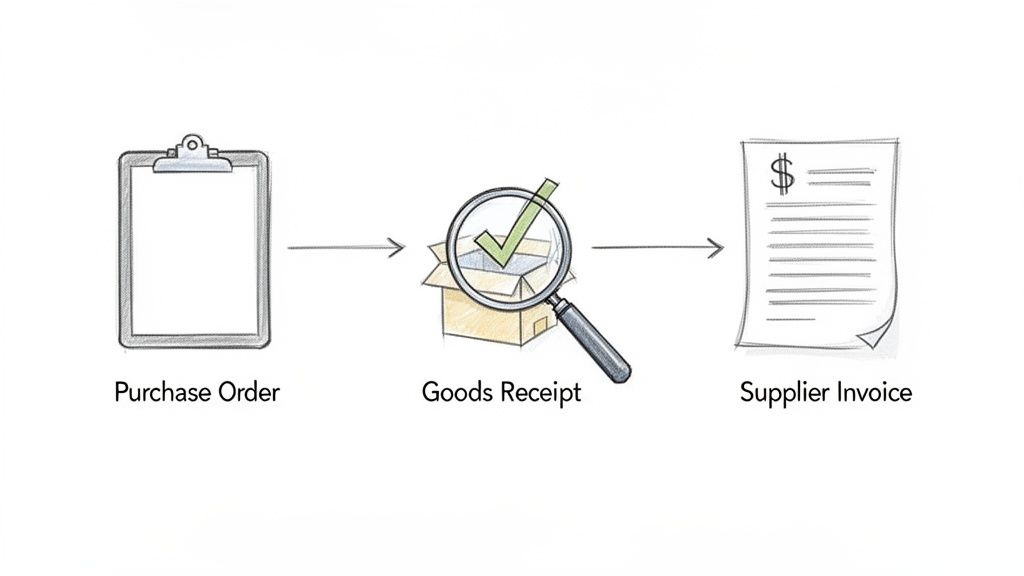
To really get your head around the 3-way match, you need to know the three documents that make it work. I like to think of the Accounts Payable (AP) team as financial detectives. Before they approve any payment, they need to line up three key pieces of evidence to make sure the story checks out.
When these three documents are in perfect sync, you have a solid, verifiable audit trail that proves a transaction is legitimate. This is the whole point of the 3-way match. Let's look at each document's role in the process.
The Purchase Order
The journey begins with the Purchase Order (PO). This is the official document your company issues to kick off a purchase. Think of it as the contract—it’s your formal agreement with a supplier on exactly what you intend to buy.
A solid PO spells out all the important details, including:
- Clear item descriptions and part numbers
- The specific quantities you agreed to
- The exact price per unit
The PO is your source of truth for the entire transaction. If an invoice shows up later with a different price or quantity, the PO is the official record you'll use to spot the error. Each item on the order is a specific commitment, and you can learn more about these entries by understanding what is a line item in our detailed guide.
The Goods Receipt
Next up is the Goods Receipt, which acts as the physical proof in our detective case. This is an internal document your team creates the moment an order arrives at your warehouse or receiving dock. It confirms what was actually delivered. In many businesses, this is handled through inventory software, like the systems covered in guides to Odoo Inventory Management.
For any physical products, this step is absolutely critical. It answers one simple question: "Did we get what the supplier says they sent us?" Without it, you’re just taking their word for it.
The Supplier Invoice
Finally, we have the Supplier Invoice. This is the bill from your vendor asking to be paid for the goods or services they delivered. It's the AP team's job to meticulously check this invoice against both the original purchase order and the goods receipt.
For example, let's say you created a PO for 100 hard hats at $20 each. Your goods receipt shows that only 95 hats actually arrived. If the supplier sends an invoice demanding payment for all 100, the 3-way match will instantly flag this discrepancy and prevent a $100 overpayment.
Comparing Two Way vs Three Way Matching
When it comes to paying supplier invoices, you have a couple of core methods for making sure everything lines up. The most basic approach is two-way matching, which is exactly what it sounds like. Your team simply compares two documents: the purchase order you created and the invoice the supplier sent.
This method still has its place. It's perfectly fine for routine, non-physical purchases. Think of things like recurring software subscriptions or other services where you don't actually receive a physical shipment, making a "goods receipt" document unnecessary.
The Limitation of Two Way Matching
The big problem with two-way matching should be pretty obvious: it never actually confirms if you received what you paid for. You're essentially just taking the supplier's word that the items on the invoice were delivered. This leaves you wide open to paying for goods that never showed up.
This exact gap is why the three-way match is now the standard for most business purchases. By adding a third document—the goods receipt note—into the mix, you close that critical loophole. It provides concrete proof that you only cut checks for products or services that have been physically delivered or verifiably completed.
While two-way matching is fine for small or low-risk buys, the three-way match is the real benchmark for strong financial control. When it does catch a problem, suppliers get an alert so issues can be fixed in minutes, not held up for weeks.
This smarter process shores up your financial defenses and speeds up the entire reconciliation process. The payoff is quicker payment cycles, a lower balance of outstanding accounts payable, and a much more efficient system from start to finish.
To get a better sense of how this works in practice, you can find more great insights about 3-way matching on Rillion.com. It’s a simple change, but it turns accounts payable from a potential liability into a solid financial safeguard for your company.
The Hidden Costs of Manual Matching
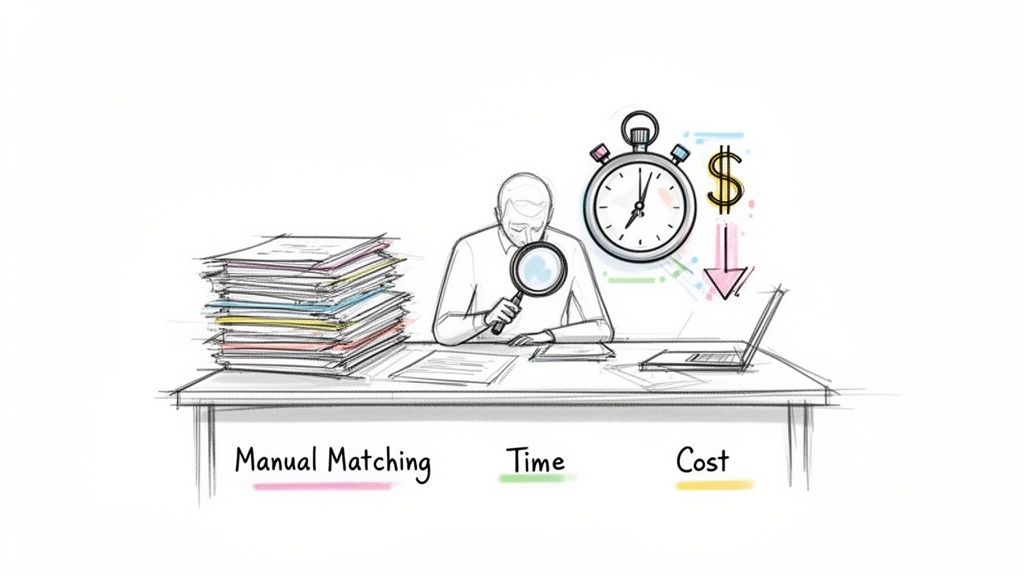
Let's get real about what it takes to do a 3-way match by hand. Picture a member of your accounts payable team drowning in a sea of paperwork, hunting for PO numbers, and trying to visually cross-reference every single line item. It’s a thankless, mind-numbing task.
And it’s not just a drain on morale; it's a drain on your bank account. The average cost to manually process just one invoice is a staggering $9.25. For any company handling a decent volume of transactions, that number adds up fast. This has always been a slow, error-prone way of doing things. You can find more insights on the real cost of supplier mismatches on Phacet Labs.
This kind of bottleneck doesn't just stop at one desk. It sends ripples across the entire business, affecting your bottom line and your relationships with suppliers.
The Domino Effect of Inefficiency
Relying on manual matching is about more than just wasted time—it introduces real business risks. Every hour your team spends on tedious clerical tasks is an hour they aren't spending on high-value financial analysis.
The biggest problem with manual 3-way matching is that it turns your skilled finance experts into data entry clerks. This not only grinds productivity to a halt but also opens the door to expensive mistakes.
This inefficiency snowballs into a whole host of other problems, including:
- Delayed Supplier Payments: When approvals get bogged down, payments get sent late. This can seriously strain vendor relationships and tarnish your company's reputation.
- Missed Early Payment Discounts: Those valuable discounts for paying early? They’re impossible to catch when an invoice is sitting in a manual approval queue for weeks.
- Increased Error Rates: Humans make mistakes. It’s that simple. The risk of typos and comparison errors is huge, often leading to overpayments or paying the same invoice twice.
- Poor Visibility: With paper documents floating around on different desks, getting a clear, real-time picture of your company's financial commitments is next to impossible.
When you add it all up, these hidden costs paint a clear picture. The constant struggle with manual data entry is a sure sign that your current processes are holding your business back from what it could be.
How Automation Creates a Flawless 3 Way Match
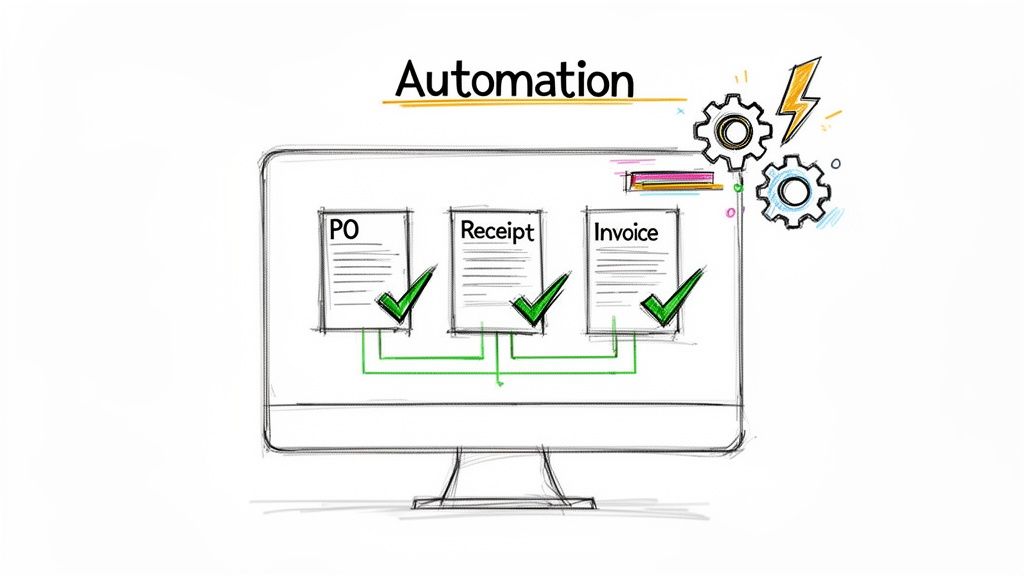
When you look at how much time and money is lost to manual matching, switching to automation feels less like an option and more like a necessity. It’s the clear answer to turning the 3 way match from a tedious, error-prone task into a smooth and nearly instantaneous part of your workflow.
Think of an automated system as your most efficient team member—one that never gets tired, never makes a typo, and works at lightning speed. It can receive an invoice as a PDF, a scanned image, or even just text in an email, and immediately get to work.
This is where smart, AI-powered technology really shines. The system reads and understands the key information on its own, pulling out quantities, prices, and part numbers from all three documents. It then runs the comparison in seconds, flagging only the few invoices that have actual discrepancies that need a human eye.
The Immediate Impact of Automation
You don't have to wait months to see the results. The benefits are felt almost immediately, making it easy to justify the investment. An automated system makes a perfect what is a 3 way match not just a theoretical goal, but a daily reality for any business.
By bringing in automation, the entire 3 way matching process can happen just minutes after an invoice arrives. This doesn't just speed things up; it makes your entire payment cycle more accurate and reliable.
The advantages are clear and compelling:
- A huge increase in speed: Tasks that once took days of painstaking manual cross-referencing are now done in seconds.
- A major drop in costs: Automation slashes the cost per invoice by removing the hours of manual labor required to process it. You can learn more about this in our guide to automated invoice processing.
- A more strategic AP team: Your finance professionals are no longer stuck doing data entry. Instead, they can focus their expertise on high-value work like analyzing spending, improving vendor relationships, and finding new cost-saving opportunities.
Got Questions About 3-Way Matching? We've Got Answers
Getting your head around 3-way matching usually brings up a few common questions. Let's walk through the answers to the ones we hear most often.
What Happens When a 3 Way Match Fails?
So, what happens when the numbers don't line up? If an invoice lists a higher price than the purchase order, or you were billed for 10 items but only received 8, the process comes to a halt.
That invoice is immediately put on hold and flagged as an exception. No payment goes out. It's then up to the accounts payable team to play detective, reaching out to the supplier or your own receiving department to sort out what went wrong. The bill only gets paid once everything is corrected and all three documents are in perfect agreement.
Is a 4 Way Match a Real Thing?
Yes, it absolutely is! A 4 way match just adds one more layer of verification: the inspection slip.
This is a big deal in fields where quality is everything, like manufacturing or pharmaceuticals. It’s not enough to know the goods arrived—you need proof they passed a quality inspection before they officially enter your inventory. This fourth document provides that final stamp of approval.
Crucial Takeaway: It’s easy to think of this as a "big company" process, but small businesses are actually the most vulnerable to cash flow problems caused by overpayments or simple mistakes. A 3 way match provides a vital financial backstop right from the start, protecting a small company's precious cash reserves.
Ready to stop wasting time on manual document checks? DocParseMagic turns messy invoices and purchase orders into clean, organized data in seconds. Sign up for free and see how it works.