Vendor Management Best Practices to Boost Procurement and Partnerships
In today's interconnected business environment, your suppliers, contractors, and partners are more than just line items on a balance sheet; they are a direct extension of your business. How you manage these relationships can either create a powerful competitive advantage or introduce significant risks and inefficiencies. Strong vendor management isn't just about negotiating lower prices. It's a strategic discipline that drives innovation, ensures operational continuity, and protects your brand reputation.
Many organizations, however, find themselves tangled in disorganized vendor data, inconsistent performance reviews, and manual, paper-heavy workflows. These challenges obscure critical insights, drain resources, and prevent teams from building valuable partnerships. For accounting teams drowning in invoices or procurement managers trying to compare complex proposals, the lack of a structured system can be a major roadblock to success.
This article cuts through the noise to provide a clear, actionable guide. We will detail 10 essential vendor management best practices designed to help you build a robust and efficient framework. From initial vendor selection and crafting ironclad contracts to implementing advanced performance tracking and fostering supplier innovation, these strategies will equip you with the tools needed to transform your vendor ecosystem. Whether you are building a new program or refining an existing one, these proven techniques will help you unlock the full potential of your supplier relationships and turn them into a true strategic asset.
1. Master Vendor Selection and Due Diligence
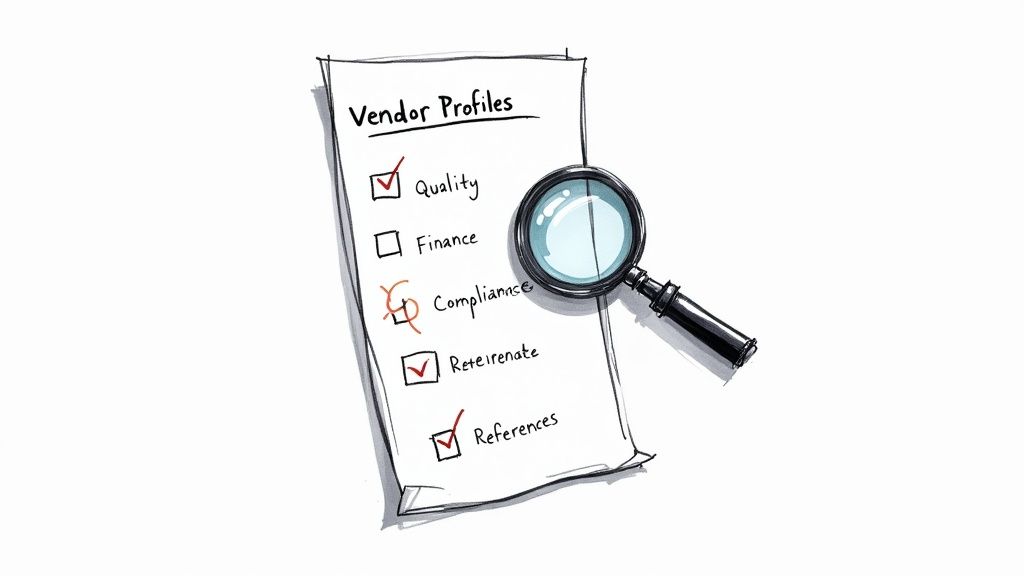
Effective vendor management best practices begin long before a contract is signed. The foundation of a successful partnership lies in a rigorous, data-driven selection and due diligence process. This initial phase involves moving beyond surface-level cost analysis to conduct a comprehensive evaluation of a potential vendor’s capabilities, financial stability, and operational integrity. A thorough approach at this stage prevents future disruptions, mitigates risks, and ensures that every new vendor aligns with your organization's quality standards and strategic goals.
This proactive vetting safeguards your business from partners who might offer low prices but deliver poor quality, experience financial instability, or fail to meet critical compliance standards. Investing time here ensures you select partners who are not just suppliers but true contributors to your success.
Actionable Tips for Implementation
To build a robust selection process, start by creating a standardized framework. Documenting every step ensures consistency, fairness, and a clear audit trail.
- Develop a Standardized Scorecard: Create a vendor evaluation scorecard with weighted criteria such as price, quality, technical capability, financial health, and security posture. This provides an objective basis for comparing different proposals.
- Form a Selection Committee: Assemble a cross-functional team with members from procurement, finance, IT, and the end-user department. This diversity ensures a 360-degree assessment, preventing crucial details from being overlooked.
- Conduct Financial Health Checks: Use services like Dun & Bradstreet to assess a vendor’s financial stability. Look for red flags like poor credit ratings or declining revenues that could signal future performance issues.
- Verify Compliance and Certifications: For industries with strict regulations, like healthcare (HIPAA) or finance (SOC 2), demand proof of compliance. Never take a vendor's claims at face value; always verify their certifications. This is a critical step in modern procurement and sourcing.
2. Clear Contract and Service Level Agreements (SLAs)
Once a vendor is selected, the next critical step is to formalize the partnership with a comprehensive, legally sound contract and clearly defined Service Level Agreements (SLAs). These documents are the blueprint for the entire vendor relationship. They translate verbal promises and proposals into binding commitments, ensuring both parties understand their roles, responsibilities, and performance expectations. A well-drafted agreement minimizes ambiguity, prevents scope creep, and provides a clear framework for managing the partnership.
This foundational work protects your organization by setting measurable standards for performance and outlining remedies for non-compliance. From uptime guarantees for software to quality thresholds in manufacturing, a strong contract turns abstract expectations into tangible, enforceable metrics. It is an essential component of proactive vendor management best practices.
Actionable Tips for Implementation
To create effective contracts and SLAs, move beyond generic templates and tailor each document to the specific vendor relationship and its strategic importance.
- Define Measurable and Achievable SLAs: Ensure all performance metrics are specific and quantifiable. For a tech vendor, an SLA might mandate 99.9% uptime; for a service provider, it could specify a 4-hour maximum response time for critical issues.
- Include Escalation and Remedy Clauses: Clearly outline the procedures for addressing performance failures. This should include a step-by-step escalation path and predefined remedies, such as service credits or termination rights for repeated breaches.
- Customize Beyond Templates: While templates are useful starting points, always customize them. Add clauses relevant to your industry, the specific services being provided, and any unique business requirements.
- Secure a Legal Review: Before finalizing any contract, have it reviewed by your legal counsel. Their expertise ensures the agreement is enforceable, compliant with regulations, and fully protects your organization’s interests.
3. Regular Performance Monitoring and Metrics
Once a vendor is onboarded, the real work of managing the relationship begins. A cornerstone of effective vendor management best practices is the continuous, systematic monitoring of performance against pre-defined metrics. This involves moving beyond occasional check-ins to establish a data-driven framework that tracks Key Performance Indicators (KPIs) and Service Level Agreements (SLAs). This approach enables the early identification of potential issues, facilitates objective conversations, and ensures vendors consistently deliver the value promised in their contracts.
This ongoing vigilance ensures that small performance dips don't escalate into major disruptions. By collecting and analyzing performance data, you can make informed decisions, hold vendors accountable, and proactively manage the health of your supply chain. For example, a retail chain might track a logistics provider’s on-time delivery percentage, while a hospital monitors a medical supplier’s order accuracy and product quality.
Actionable Tips for Implementation
To build a successful performance monitoring system, you need clear metrics, consistent reviews, and transparent communication. This creates a partnership based on mutual goals and accountability.
- Define and Align on KPIs: Before the work starts, collaboratively define specific, measurable, achievable, relevant, and time-bound (SMART) KPIs. Ensure the vendor understands exactly how their performance will be measured and agrees to the targets.
- Establish a Review Cadence: Schedule regular performance review meetings (e.g., monthly or quarterly) to discuss the data. These meetings should be a two-way street, providing a forum for vendors to share challenges and for you to provide constructive feedback.
- Use Balanced Scorecards: Create scorecards that measure performance across multiple dimensions, not just cost. Include metrics for quality, delivery, service responsiveness, and compliance to get a holistic view of vendor value.
- Implement an Escalation Path: Clearly document the steps to be taken if a vendor consistently underperforms. An established escalation path ensures issues are addressed swiftly and formally before they impact business operations.
4. Vendor Relationship Management (VRM)
Moving beyond transactional interactions is a cornerstone of modern vendor management best practices. Vendor Relationship Management (VRM) transforms the dynamic from a simple buyer-supplier exchange into a strategic, collaborative partnership. This approach focuses on building long-term, mutually beneficial relationships through open communication, shared goals, and mutual investment. It involves treating key vendors as extensions of your own team, fostering an environment of trust and innovation.
By investing in these relationships, you unlock value far beyond cost savings. Strategic partners are more likely to offer preferential treatment, provide innovative solutions to your challenges, and collaborate on long-term growth initiatives. This relational approach turns vendors into vested partners who are committed to your success because it is intertwined with their own.
Actionable Tips for Implementation
To shift from a purely transactional model to a relational one, you must implement structured communication and engagement practices. These efforts show vendors you value their partnership and are invested in a shared future.
- Schedule Regular Business Reviews: Institute quarterly or semi-annual business reviews with strategic vendors. Use this time to discuss performance, align on future goals, review roadmaps, and address any challenges collaboratively.
- Assign Dedicated Relationship Managers: For your most critical vendors, assign a dedicated internal manager. This single point of contact streamlines communication, builds rapport, and ensures accountability for the relationship's health.
- Share Forecasts and Strategic Plans: Transparency builds trust. Share relevant business forecasts and strategic plans with key partners. This allows them to better anticipate your needs, manage their resources, and propose more relevant solutions.
- Invest in Vendor Development: True partnerships involve mutual growth. Look for opportunities to invest in your vendors’ capabilities, whether through joint training programs, co-developing new solutions, or providing feedback that helps them improve their service delivery. Toyota's supplier development program is a classic example of this, creating deeply integrated, high-performing supply chains.
- Celebrate Successes and Milestones: Acknowledge and celebrate achievements together. Publicly recognizing a vendor’s exceptional performance or contribution to a major project strengthens the relationship and motivates continued excellence.
5. Risk Management and Mitigation Planning
Relying on external vendors inherently introduces risks, from supply chain disruptions and data breaches to financial instability and non-compliance. Effective vendor management best practices require a proactive approach to identifying, assessing, and mitigating these potential threats. This process involves creating a structured framework to understand your vendor risk landscape and developing contingency plans to ensure business continuity when disruptions occur.
A robust risk management strategy protects your organization from unforeseen events that could halt operations, damage your reputation, or lead to significant financial loss. By anticipating potential failures and building resilience, you transform your vendor ecosystem from a potential liability into a strategic asset. To effectively prioritize proactive risk management, consider implementing strategies from a guide to third-party risk assessment to evaluate potential vendor vulnerabilities.

Actionable Tips for Implementation
To build a resilient vendor network, integrate risk management into every stage of the vendor lifecycle, from selection to offboarding.
- Conduct Regular Risk Assessments: At least annually, perform a comprehensive risk assessment for all critical vendors. Evaluate operational, financial, cybersecurity, and compliance risks, updating your vendor profiles accordingly.
- Use a Risk Scoring Model: Develop a scoring model to categorize vendors based on their potential impact and likelihood of risk. This allows you to prioritize high-risk vendors for more intensive monitoring and contingency planning.
- Develop Contingency Plans: For your most critical suppliers, create detailed contingency plans. This could involve identifying pre-vetted backup vendors, establishing inventory buffers for key materials, or diversifying your supply chain across different geographic regions.
- Implement Cybersecurity Audits: Mandate and conduct regular cybersecurity audits for vendors with access to sensitive data. Verify their security posture and ensure they meet your organization's standards for data protection and incident response.
6. Spend Analysis and Cost Optimization
Effective vendor management best practices extend beyond relationships and performance to include a deep understanding of your financial outflows. Spend analysis is the process of systematically collecting, cleansing, classifying, and analyzing expenditure data to decrease procurement costs, improve efficiency, and monitor compliance. This data-driven approach moves organizations from reactive purchasing to strategic sourcing, revealing hidden opportunities for savings and process improvements.
By gaining clear visibility into what you are buying and from whom, you can identify chances to consolidate suppliers, negotiate better volume discounts, and eliminate rogue or maverick spending. A thorough spend analysis is not just a cost-cutting exercise; it is a strategic tool that maximizes the value of every dollar spent and enhances overall financial health.
Actionable Tips for Implementation
To turn spend data into actionable insights, you need a structured approach and the right tools. This ensures your analysis is both accurate and repeatable.
- Implement Spend Management Software: Use specialized software to aggregate purchasing data from various systems like ERPs and accounting platforms. This provides a single source of truth and automates the classification of expenditures.
- Establish Standardized Spend Categories: Create a clear taxonomy for all purchases. Classifying spend into logical categories like "Office Supplies," "IT Hardware," or "Professional Services" makes it easier to spot trends and identify consolidation opportunities.
- Calculate Total Cost of Ownership (TCO): Look beyond the initial purchase price. Factor in all associated costs, including maintenance, training, and operational expenses, to understand the true financial impact of a vendor partnership.
- Consolidate Maverick Spending: Identify purchases made outside of established procurement channels. For instance, if multiple departments are buying the same software from different resellers, consolidate these under a single enterprise agreement to leverage volume pricing. This process can be streamlined with tools that help manage and issue an automated purchase order.
7. Vendor Segmentation and Tiered Management
Not all vendors are created equal, and your management approach shouldn't be a one-size-fits-all strategy. Effective vendor management best practices involve segmenting suppliers into tiers based on their strategic importance, risk level, and overall impact on your business. This allows you to allocate your resources-time, attention, and capital-more effectively, focusing intensely on high-impact partnerships while efficiently managing lower-stakes relationships.
This tiered approach ensures that your most critical partners receive the strategic engagement they deserve, while transactional vendors are managed with streamlined, low-touch processes. By classifying your vendor base, you can tailor everything from contract terms to communication frequency, optimizing each relationship for maximum value and minimizing unnecessary administrative overhead. This strategic allocation is a cornerstone of mature and scalable vendor management.
Actionable Tips for Implementation
To implement a tiered system, you must first define clear, objective criteria. This framework ensures fairness and provides a solid rationale for your management strategy.
- Develop Clear Classification Criteria: Create a vendor segmentation matrix based on factors like annual spend, business criticality, risk exposure, and potential for innovation. Common tiers include Strategic Partners, Key Suppliers, Preferred Vendors, and Transactional Vendors.
- Allocate Resources Proportionally: Dedicate senior-level relationship managers and schedule quarterly business reviews for your strategic partners. For transactional vendors, rely on automated purchasing systems and periodic, exception-based check-ins.
- Differentiate Contract Terms: Apply more rigorous terms, service-level agreements (SLAs), and performance metrics for higher-tier vendors. Contracts for lower-tier suppliers can be more standardized and less complex.
- Establish Paths for Advancement: Clearly communicate your segmentation criteria to vendors and outline a path for them to move up to a higher tier. This incentivizes better performance and strengthens partnerships across your entire supply chain.
8. Compliance, Audit, and Governance
Beyond performance metrics and contract terms, robust vendor management best practices must include a formal framework for compliance, audits, and governance. This involves establishing clear rules and processes to ensure every vendor meets regulatory requirements, adheres to ethical standards, and operates with full transparency. This structured oversight is not just about ticking boxes; it is a critical defense mechanism that protects your organization from significant legal, financial, and reputational damage.
A strong governance structure ensures that vendors are held accountable for their actions, from data security to environmental standards. Failing to monitor compliance can lead to severe penalties, security breaches, and a damaged public image, turning a seemingly low-cost partnership into an expensive liability. Prioritizing this framework is essential for maintaining operational integrity and long-term resilience.
Actionable Tips for Implementation
To build a culture of compliance, you must integrate governance into the entire vendor lifecycle, from onboarding to offboarding. Documenting and communicating these standards clearly is the first step toward effective enforcement.
- Document All Requirements in Contracts: Embed specific compliance clauses directly into vendor contracts. This should include adherence to regulations like GDPR or HIPAA, security protocols, and ethical conduct policies, making these requirements legally binding.
- Establish a Regular Audit Cadence: Don't wait for an incident to check for compliance. Schedule regular audits, at least annually, to proactively assess vendor adherence to your standards. These audits can be remote or on-site, depending on the risk level.
- Create Clear Escalation Paths: Develop and communicate a formal procedure for handling compliance violations. This should define the steps to take, who is responsible, and the potential consequences, ranging from corrective action plans to contract termination.
- Maintain Detailed Documentation: Keep meticulous records of all compliance activities, including audit reports, vendor certifications, and communication regarding policy updates. This audit trail is invaluable for demonstrating due diligence to regulators and stakeholders.
9. Implement a Vendor Diversity and Supplier Inclusion Program
Beyond traditional metrics, a mature vendor management strategy incorporates a commitment to diversity and inclusion. This involves actively building a supplier base that includes minority-owned, women-owned, veteran-owned, and other small or disadvantaged businesses. This practice is not just a social responsibility initiative; it is a strategic business decision that drives innovation, enhances brand reputation, and can unlock new market opportunities by reflecting the diversity of your customer base.
Fostering supplier diversity injects fresh perspectives, agility, and competitive pricing into your supply chain. Companies like Cisco and JPMorgan Chase have demonstrated that robust supplier diversity programs lead to billions in diverse spending, fostering economic growth and strengthening their own operational resilience. Integrating this approach is a key component of modern vendor management best practices.
Actionable Tips for Implementation
To build a meaningful supplier diversity program, you must move from intention to action with a formal, structured approach. This ensures your efforts are measurable, sustainable, and integrated across the organization.
- Establish a Formal Policy and Goals: Develop a clear supplier diversity policy that outlines your company's commitment. Set realistic and measurable annual goals for diverse spend, such as aiming for 10-15% of your total procurement budget.
- Track and Report on Metrics: Implement a system to track your spending with diverse suppliers. Regularly report these metrics to senior leadership and stakeholders to maintain visibility and accountability for your diversity goals.
- Actively Engage with Diversity Networks: Don’t wait for diverse vendors to find you. Participate in supplier diversity councils, attend business conferences for minority-owned enterprises, and network with organizations that certify diverse businesses.
- Provide Mentorship and Development: Go beyond just awarding contracts. Offer mentorship, training, and development support to help smaller, diverse suppliers grow their capacity and capabilities, turning them into long-term strategic partners.
10. Supplier Innovation and Collaboration
Transforming the traditional client-vendor dynamic into a strategic partnership is one of the most advanced vendor management best practices. This approach involves moving beyond transactional relationships to actively leverage your suppliers' expertise, capabilities, and market insights to drive innovation. By treating vendors as extensions of your own team, you unlock a powerful source of new ideas, process improvements, and competitive advantages that can significantly enhance your products and services.
This collaborative model redefines vendors from simple cost centers into strategic partners in value creation. For example, Apple works in deep collaboration with its component suppliers on design innovation, while automotive manufacturers often co-develop cutting-edge solutions with their tier-one suppliers.

Actionable Tips for Implementation
Fostering a culture of shared innovation requires a structured and intentional approach. Building trust and creating formal channels for collaboration are key to turning this concept into a reality.
- Establish Structured Innovation Forums: Create regular working groups or forums dedicated to innovation. Invite key vendors to participate in brainstorming sessions, share strategic roadmaps, and co-develop solutions to shared challenges.
- Clarify IP Ownership Upfront: Before embarking on collaborative projects, establish clear and mutually beneficial agreements regarding intellectual property ownership. This transparency prevents future disputes and encourages open sharing.
- Share Strategic Insights: Provide your most trusted partners with visibility into your long-term goals and market challenges. This context empowers them to propose more relevant and impactful innovations. The integration of modern tools is also a critical factor; for an in-depth look, see how automation in the supply chain can enhance these partnerships.
- Reward Collaborative Success: Acknowledge and celebrate joint successes. Implement a system to recognize and reward vendors who contribute valuable innovations, reinforcing the value you place on their partnership and encouraging continued collaboration.
10-Point Vendor Management Best Practices Comparison
| Practice | 🔄 Implementation complexity | ⚡ Resource requirements | 📊 Expected outcomes | 💡 Ideal use cases | ⭐ Key advantages |
|---|---|---|---|---|---|
| Vendor Selection and Due Diligence | High — multi-step evaluations, specialist reviews | High — financial checks, site visits, expert time | Reduces vendor risk; better long-term fit; fewer replacements | Critical suppliers, regulated sectors, large-value contracts | Ensures quality, reliability, reputation protection |
| Clear Contract and Service Level Agreements (SLAs) | Medium–High — legal drafting and negotiation cycles | Medium — legal counsel, contract managers | Clear accountability; measurable KPIs; fewer disputes | Service providers, uptime-sensitive systems, IP-sensitive deals | Enforceable obligations and legal protection |
| Regular Performance Monitoring and Metrics | Medium — KPI design, tooling, integrations | Medium–High — monitoring systems, analysts | Early issue detection; data-driven improvements; increased compliance | High-volume operations, SLA-driven relationships | Improves performance, accountability, benchmarking |
| Vendor Relationship Management (VRM) | Medium — recurring engagement and governance | Medium — vendor managers, meeting cadence | Stronger collaboration; improved service and innovation | Strategic partners; long-term supplier relationships | Boosts loyalty, cooperation, joint problem-solving |
| Risk Management and Mitigation Planning | High — cross-functional risk modeling, contingency plans | High — risk analysts, scenario planning, backups | Greater resilience; fewer supply disruptions; reduced exposure | Global supply chains, critical component sourcing, finance | Protects continuity, reduces financial and reputational risk |
| Spend Analysis and Cost Optimization | Medium — data consolidation and analytics setup | Medium — analytics tools, finance/procurement teams | Identifies savings; better negotiation leverage; lower maverick spend | Organizations with significant procurement spend | Drives cost savings and improved financial visibility |
| Vendor Segmentation and Tiered Management | Low–Medium — classification framework and reviews | Low–Medium — governance, basic tooling | Focused management effort; optimized resource allocation | Large vendor bases, need for prioritization | Efficient allocation of resources; focus on high-impact vendors |
| Compliance, Audit, and Governance | High — regulatory mapping, audits, controls | High — compliance teams, audit tools, ongoing monitoring | Reduced legal/reputational risk; audit readiness | Regulated industries (finance, healthcare, utilities) | Ensures regulatory compliance and stakeholder confidence |
| Vendor Diversity and Supplier Inclusion Programs | Medium — program policies, outreach, tracking | Medium — diversity teams, reporting, development support | Broader supplier base; social impact; new market access | CSR initiatives, public-sector mandates, market expansion | Drives innovation, reputation gains, and supplier diversification |
| Supplier Innovation and Collaboration | Medium–High — IP agreements, co-development governance | Medium–High — joint R&D, cross-functional teams | Faster innovation; reduced time-to-market; product differentiation | Product development, R&D-intensive sectors | Accesses vendor expertise and accelerates innovation |
Turn Best Practices into Standard Procedure with Automation
Navigating the landscape of vendor relationships can be complex, but as we’ve explored, a structured approach transforms this challenge into a significant competitive advantage. From rigorous vendor selection and crafting ironclad contracts to fostering collaborative relationships and managing risk, each of these vendor management best practices serves as a pillar supporting a resilient, efficient, and innovative supply chain. Moving beyond mere transactions to build strategic partnerships is no longer an option; it's a necessity for sustainable growth.
The core message is clear: proactive, strategic management of your vendor ecosystem directly impacts your bottom line, operational stability, and capacity for innovation. You've seen how segmenting suppliers allows you to focus your resources where they matter most, how diligent performance monitoring with clear KPIs prevents value leakage, and how robust compliance frameworks protect your organization from unforeseen liabilities. These aren't just items on a checklist; they are interconnected components of a holistic strategy.
From Aspiration to Operation: The Automation Bridge
While understanding these best practices is the first step, consistent implementation is where many organizations stumble. The sheer volume of associated paperwork, from initial proposals and RFPs to ongoing invoices, compliance certificates, and performance reports, can quickly overwhelm even the most dedicated teams. This is the critical juncture where aspiration meets operational reality. Manual data entry, document verification, and information consolidation are not just time-consuming; they are fertile ground for errors that can undermine your entire vendor management framework.
This is precisely why automation is no longer a luxury but an essential component of modern vendor management. By automating the extraction of key data from your vendor documents, you bridge the gap between knowing what to do and having the capacity to do it consistently and accurately. This allows your team to shift its focus from tedious, low-value administrative tasks to high-impact strategic activities.
Key Takeaway: Effective vendor management isn't about working harder; it's about working smarter. Automation provides the leverage to turn best-in-class principles into everyday operational reality, ensuring consistency, accuracy, and strategic focus.
Your Actionable Path Forward
To truly embed these vendor management best practices into your organization's DNA, you need to systematize them. This means creating clear, repeatable workflows that leave no room for ambiguity. To effectively transform best practices into consistent, automatable processes, it's crucial to first understand what a Standard Operating Procedure (SOP) is. An SOP documents a task step-by-step, making it the perfect foundation for automation.
Here are your next steps to operationalize these concepts:
- Audit Your Current Processes: Identify the most time-consuming, manual, and error-prone tasks in your vendor lifecycle. Are you spending hours keying in invoice data or manually comparing proposal terms?
- Prioritize for Impact: Start with one or two high-impact areas. Automating invoice processing or compliance document verification can deliver immediate returns in time saved and errors reduced.
- Implement a Document Automation Tool: Integrate a solution designed to handle unstructured data. A platform like DocParseMagic can instantly parse vendor documents, extract critical information like invoice totals, contract end dates, or compliance statuses, and feed that structured data directly into your existing systems (ERP, CRM, etc.).
By embracing this technology-driven approach, you are not just improving efficiency. You are creating a reliable, data-rich environment where strategic decisions can be made with confidence. You empower your finance, procurement, and operations teams to spend less time chasing paper and more time negotiating better terms, mitigating risks, and collaborating with suppliers on new innovations. Mastering these vendor management best practices is the roadmap, and intelligent automation is the vehicle that will get you to your destination faster and more reliably.
Ready to eliminate manual data entry and transform your vendor document workflows? See how DocParseMagic can automatically extract critical data from invoices, proposals, and compliance forms, turning your best practices into effortless, everyday procedures. Discover DocParseMagic and start building a more strategic, data-driven vendor management process today.