Procurement Software Comparison Your Guide to Making the Right Choice
When you start comparing procurement software, one thing becomes crystal clear: spreadsheets just don't cut it anymore. For any modern business, picking the right software is a major decision that directly impacts your bottom line and strategic goals. It’s what elevates procurement from a simple cost center to a real value driver.
Why Smart Procurement Software Is No Longer Optional
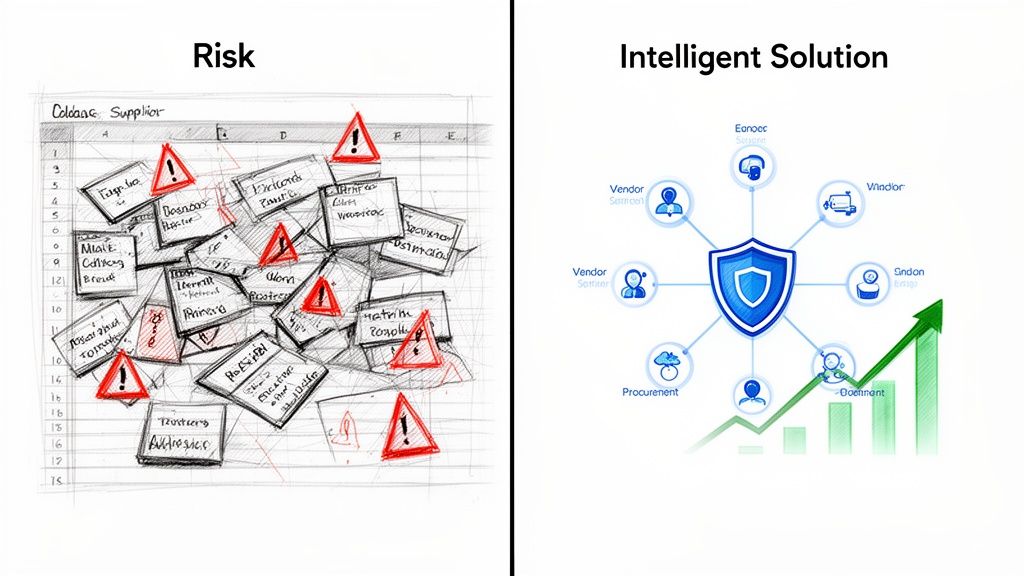
Relying on spreadsheets for procurement in today's fast-moving economy is like navigating a cross-country road trip with a crumpled, outdated map. It’s not just slow and full of potential mistakes; it’s a huge operational risk. Most procurement teams I've worked with are stuck wrestling with messy vendor data, tedious proposal reviews, and ever-growing compliance headaches. These manual tasks don’t just kill productivity—they create blind spots, hiding potential savings and leaving your supply chain wide open to risk.
This is exactly where intelligent procurement software steps in. It takes all that chaos and centralizes it, giving you clarity and control over the entire process. By automating the grunt work, these platforms let your team focus on what really matters: negotiating better deals, building stronger supplier relationships, and digging into spend data to find smart insights.
The market growth tells the same story. The global procurement software market is valued somewhere between USD 7.5 billion and USD 9.3 billion, with big companies making up about 65% of that demand. This isn’t just a trend; it's a fundamental shift away from clunky, old-school systems. If you're interested, you can learn more about procurement software growth and see the data for yourself.
Common Headaches Solved by Modern Platforms
Switching to a modern platform immediately starts solving the core problems that plague traditional procurement. These tools are built to tackle specific pain points you're likely all too familiar with.
- Scattered Vendor Data: Finally, a single, reliable place for all supplier information, contracts, and performance history. No more hunting through disconnected files.
- Painful Proposal Analysis: Instead of spending days manually pulling data from vendor quotes, the software does it for you in minutes.
- Rogue Spending and Compliance Gaps: Automated approval workflows enforce your purchasing policies, stopping unauthorized buys and making sure everyone sticks to the negotiated contracts.
- Zero Spend Visibility: Get real-time dashboards and analytics that show you exactly where the money is going, making it easy to spot opportunities for savings.
Moving past spreadsheets isn't just about being more efficient. It's about building a stronger, more resilient foundation for your entire operation. The right tool turns procurement into a strategic advantage that protects your margins.
This guide is designed to give you a detailed procurement software comparison to help you make this critical choice. Understanding the risks of sticking with the old way and seeing what’s possible with the new is the first step toward finding a platform that fits your business now and supports your growth in the future.
How to Create Your Procurement Software Evaluation Framework
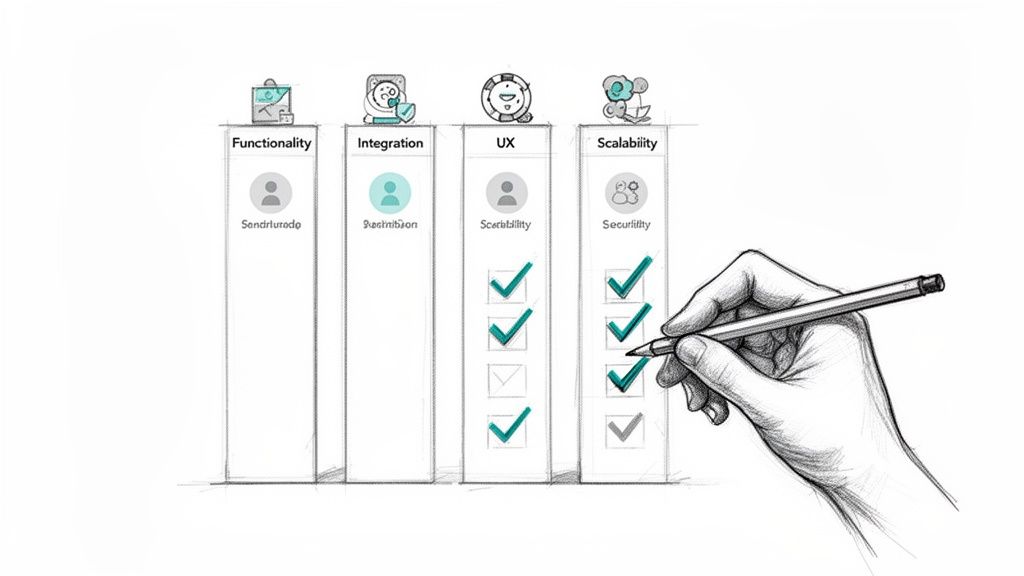
Jumping into demos without a plan is a classic mistake. Before you even think about comparing software, you need to build your own evaluation framework. This is your scorecard, your North Star—it keeps you focused on what your business actually needs, not just what a sales rep wants to show you.
This simple step turns a gut-decision into a strategic one. When you know your priorities upfront, you can easily cut through the marketing fluff and zero in on the features that will genuinely improve your operations. It’s like drawing up the blueprint for your dream house before you start looking at properties.
Plus, a solid framework gets everyone on your team on the same page, which helps avoid those painful internal debates later on. It makes the entire selection process a methodical, data-driven exercise.
Defining Your Core Functional Needs
First things first: map out your must-haves. These are the non-negotiable features your team needs to do their jobs better. Every company’s list will look different because it should be tied directly to your biggest bottlenecks and goals. Don't let yourself get distracted by the "nice-to-haves" until the fundamentals are covered.
Think about the core tasks the software needs to handle. Are you struggling to find and vet new suppliers? Or is your biggest headache managing contracts and tracking vendor performance?
Your list of essentials might include things like:
- E-sourcing and Supplier Management: Tools for finding, onboarding, and rating suppliers.
- Contract Lifecycle Management (CLM): Features to create, negotiate, store, and renew contracts efficiently.
- Procure-to-Pay (P2P) Automation: Workflows that handle everything from the initial purchase request all the way to final payment.
- Spend Analysis and Reporting: Dashboards that give you a crystal-clear view of where the company's money is going.
A common pitfall is getting impressed by a long list of features. A platform that perfectly automates your purchase order process is infinitely more valuable than one with a dozen flashy tools your team will never touch.
Assessing Integration and Scalability
Modern procurement software can't live on an island. It has to play nice with the other systems you already use, like your ERP and accounting software. Without solid integrations, your team will be stuck manually transferring data between systems, which completely defeats the purpose of buying new software in the first place.
So, when you're talking to vendors, get specific. Do they have ready-made connectors for your ERP, whether it's NetSuite, SAP, or something else? If not, how good is their API for building custom connections? Poor integration can turn a dream solution into a nightmare fast. Understanding how an automated purchase order system works, for example, really underscores why these data connections are so critical.
Scalability is the other half of the puzzle. The software you pick today has to be able to keep up with you as your company grows.
Here's what to look for in terms of scalability:
- User and Volume Growth: Can the system handle more users, more transactions, and more suppliers without slowing to a crawl?
- Global Capabilities: If you have international ambitions, does it support multiple currencies, languages, and local regulations?
- Module Expansion: As your needs change, can you easily add on new features, like advanced analytics or inventory management?
Choosing a system that can grow with you saves you from the massive headache and expense of having to switch platforms in a few years. This kind of forward-thinking is what a successful procurement software comparison is all about.
Comparing the Top Procurement Software Platforms
Now that we know what to look for, let’s roll up our sleeves and see how the leading procurement platforms stack up in the real world. This is where we move past the glossy marketing brochures and dig into how tools like SAP Ariba, Coupa, and Oracle NetSuite actually perform.
This isn't about finding one "winner." It's about finding the right tool for your business. The powerhouse platform that a global giant relies on could easily crush a mid-sized company with unnecessary complexity, while a nimble startup tool might lack the controls a larger enterprise needs.
We’ll break down each one based on our criteria, focusing on the small details that make a huge difference in your team's day-to-day work.
SAP Ariba: The Enterprise Powerhouse
When you think of enterprise-grade procurement, SAP Ariba is often the first name that comes to mind. It's a comprehensive, sprawling platform built to handle the immense scale and complexity of global corporations. Think intricate supply chains, multi-country regulations, and massive transaction volumes—that's Ariba's home turf.
Its crown jewel is the Ariba Network, a massive, pre-vetted global marketplace of suppliers. For a large company, this is a game-changer, dramatically simplifying how they find and onboard new vendors. And as you evaluate procurement tools, it's smart to consider how they connect with other critical systems, like the best inventory management software for Shopify, especially if you're in e-commerce.
Ariba truly shines in direct procurement—the raw materials and components that go into making a product. It plugs directly into SAP's ERP systems, linking sourcing decisions with manufacturing and inventory planning. This is crucial for avoiding production delays.
But all that power comes at a price. Getting Ariba up and running is a major project, often requiring a team of specialized consultants. And while it can do just about anything, its user interface feels dated and less intuitive compared to newer, cloud-first competitors.
Coupa: The User-Friendly Spend Champion
Coupa has carved out a huge piece of the market by focusing on what it calls Business Spend Management (BSM). The entire platform is designed around a simple idea: make it incredibly easy for employees to use. This focus on a clean, intuitive experience is its biggest differentiator.
Where Ariba flexes its muscles in direct spend, Coupa's sweet spot is indirect procurement. We're talking about all the things a business needs to run itself: IT equipment, marketing services, office supplies, and so on. Its guided buying features steer employees toward approved suppliers and pre-negotiated prices, which is a huge help in taming rogue spending.
Coupa operates on a simple philosophy: if the software is easy, people will actually use it. This drives compliance through the roof and gives you a complete, real-time view of where the money is going—a common blind spot for many companies.
As a cloud-native platform, Coupa is generally faster to implement and gets updated more frequently than older systems. Its analytics dashboards are also fantastic, making it easy for procurement teams to spot savings opportunities without having to be data scientists. It might not have the same granular depth for direct materials as Ariba, but for managing company-wide spend, it's a leader.
Oracle NetSuite: The All-in-One Business Suite
Oracle NetSuite plays a different game entirely. Instead of offering a standalone procurement tool, it bundles procurement into a fully integrated business management suite that includes ERP, finance, CRM, and e-commerce. The biggest win here is that everything just works together from day one.
This makes NetSuite an incredibly attractive option for mid-sized businesses that are starting to outgrow their basic accounting software. It provides a single source of truth for the entire company. The procurement module handles all the essentials—purchase orders, vendor management, and approval workflows—and it's all directly connected to the general ledger.
For a company needing to manage both direct and indirect spend from one place, NetSuite hits a nice balance. A growing manufacturer, for instance, can manage its raw material buys (direct) and office supply orders (indirect) in the same system that handles its financials and inventory.
The catch? You're buying into the entire Oracle ecosystem. If your company is already running on a different ERP, trying to bolt on NetSuite just for procurement probably doesn't make sense. You'd be better off with a "best-of-breed" solution.
Comparative Analysis of Leading Procurement Platforms
To make this all a bit clearer, we've put together a table that breaks down the key differences at a glance. Think of this as your cheat sheet for understanding where each platform really shines.
| Platform | Key Features | Ideal Company Size | Strengths & Use Cases | Pricing Model |
|---|---|---|---|---|
| SAP Ariba | Ariba Network for supplier discovery, deep direct materials integration, advanced contract management. | Large Enterprise | Best for global organizations with complex supply chains and a strong focus on direct spend and compliance. | Quote-based, typically subscription with transaction fees. |
| Coupa | User-friendly interface, strong indirect spend control, real-time spend analytics, open API for integrations. | Mid-Market to Enterprise | Ideal for companies prioritizing user adoption, spend visibility, and controlling indirect or "tail" spend. | Subscription-based, often tiered by modules and spend volume. |
| Oracle NetSuite | Fully integrated with ERP/financials, unified data model, strong procure-to-pay automation. | Small to Mid-Sized Businesses | Perfect for growing companies seeking an all-in-one platform to manage procurement alongside core business operations. | Subscription-based, tiered by user count and modules. |
In the end, the right choice really boils down to your specific situation. If you're a multinational juggling billions in direct material costs, SAP Ariba's industrial-strength features are tough to beat. If your main goal is getting a handle on company-wide indirect spending with a tool your team won't hate using, Coupa is a top contender. And if you're a growing business that needs a single, unified platform to run everything, Oracle NetSuite is a powerful, integrated choice.
Choosing the Right Software for Your Business Scenario
Any detailed software comparison is only valuable when you can tie it back to what's happening in your own business. The "best" platform isn't the one with the longest feature list. It's the one that solves your most pressing problems without adding a bunch of complexity and cost you don't need. A solution that a global corporation raves about could easily sink a small business with features it will never touch.
This is where context is king. Your company’s size, industry, and strategic goals have to be the driving force behind your decision. A manufacturer has vastly different priorities than a software company, and a startup's needs are a world away from a multinational's. Matching the tool to your specific situation is the only way to ensure you're investing in something that delivers immediate value and can grow alongside you.
This diagram breaks down the core strengths of leading procurement tools, showing how platforms like SAP Ariba cater to enterprises, Coupa excels at cloud-based spend management, and NetSuite provides integrated business operations.
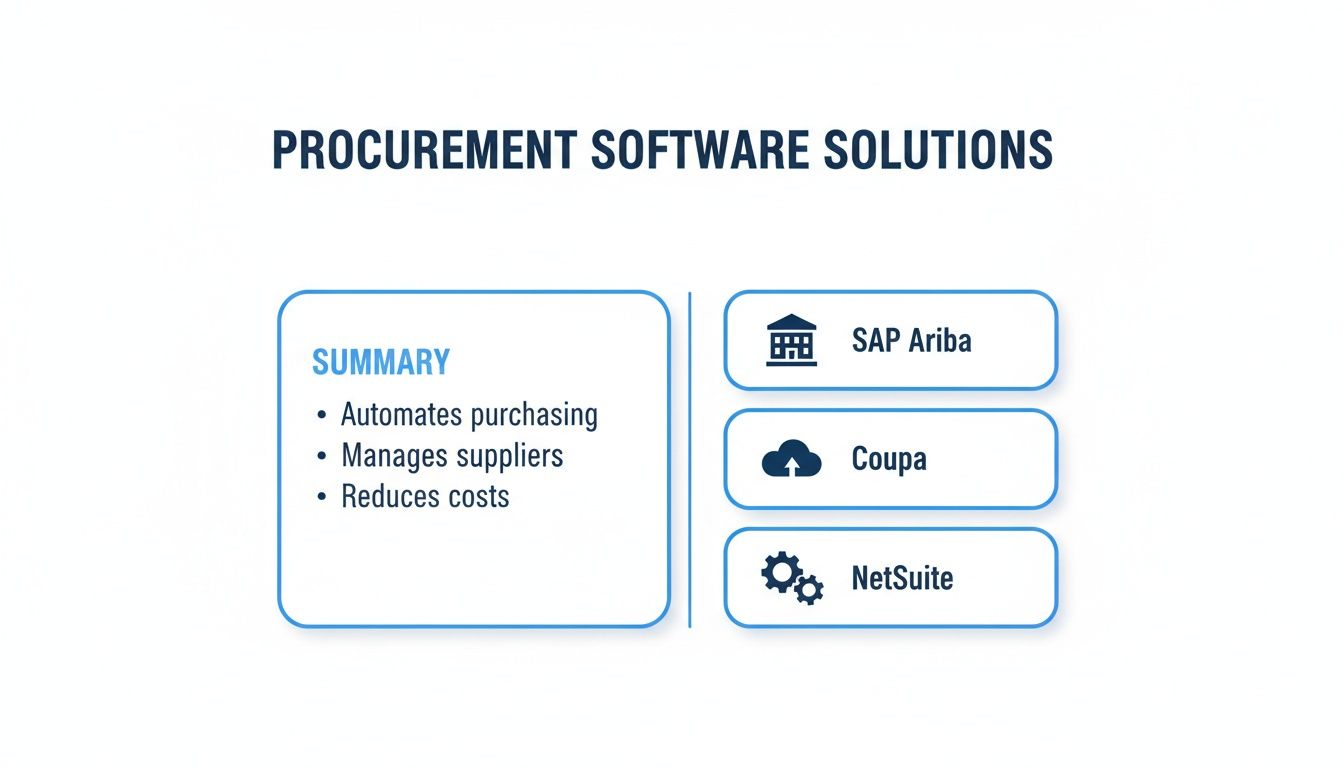
The takeaway here is that there’s no silver bullet. The right choice hinges on whether your main goal is deep supply chain integration, user-friendly spending controls, or an all-in-one business suite.
For Small Businesses Focused on Cost and Simplicity
For a small business, procurement is all about getting the fundamentals right. You need to control costs, stamp out rogue spending, and establish a simple approval process. The name of the game is efficiency and visibility, without a huge learning curve or a scary price tag. You don't need a system to manage a global supply chain; you just need to stop people from buying monitors on their personal credit cards.
Look for platforms that offer:
- An intuitive user interface: The software has to be easy enough for someone who isn't a procurement pro to pick up and use.
- Fast implementation: You need a tool that’s up and running in days, not months.
- Core procure-to-pay automation: The focus should be on smoothly creating purchase requests, getting approvals, and issuing purchase orders.
- Affordable subscription models: Predictable, user-based pricing that won't break a tight budget is a must.
A tool like Oracle NetSuite often hits the mark here. Its integrated approach bundles procurement with accounting and other essential functions, giving you a single system to run the business.
For Mid-Sized Companies Needing Scalable Operations
Mid-sized companies are in that exciting—and challenging—growth phase. Their procurement needs are getting more complex, fast. They’re juggling more suppliers, handling a higher volume of transactions, and need better analytics to find savings. The magic word here is scalability. The software you choose today has to handle tomorrow's growth without falling over.
Your non-negotiables at this stage include:
- Strong integration capabilities: The platform absolutely must connect with your existing ERP and financial systems without a fuss.
- Advanced spend analytics: You need dashboards that give you a clear, real-time picture of company-wide spending to spot trends and opportunities.
- Supplier management tools: Features for onboarding suppliers, tracking their performance, and assessing risk suddenly become critical.
Coupa is often a top contender for mid-market companies. Its focus on Business Spend Management and its famously user-friendly experience drives high adoption, giving you the visibility required to get a handle on costs as you expand.
A mid-sized business needs a platform that strikes a balance between robust functionality and ease of use. It should be powerful enough to professionalize procurement but not so complex that it requires a dedicated team just to manage the software itself.
For Enterprises Managing Complex Global Supply Chains
At the enterprise level, procurement is a deeply strategic function. We're talking about managing thousands of suppliers across multiple countries, navigating a maze of regulations, and mitigating massive supply chain risks. The focus shifts from basic P2P to direct procurement—the raw materials and components that go directly into your final product. Here, even tiny efficiencies can translate into millions of dollars in savings. If your team is buried in complex documents, you might also look at tools that streamline procurement data extraction to support your core platform.
For large enterprises, the critical software components are:
- Direct spend capabilities: The system must integrate with production and inventory systems to manage bills of materials (BOMs) and ensure supply continuity.
- Advanced sourcing and contract management: You need sophisticated tools for complex negotiations, global sourcing events, and rigorous contract lifecycle management.
- Global compliance and risk management: The platform must handle multiple currencies, languages, and tax laws while actively monitoring supplier risk.
SAP Ariba has dominated this space for a reason. Its powerful Ariba Network and deep-seated integration with SAP’s ERP systems make it the default choice for organizations managing intricate, high-stakes global supply chains.
Speeding Up Proposal Analysis with Smart Automation
Even with the best procurement software, there’s one bottleneck that just won’t go away: comparing vendor proposals. Your team gets hit with dozens of quotes, each in its own unique format. Someone then has the tedious job of copying and pasting every line item, price, and term into a spreadsheet just to make a fair procurement software comparison. It’s slow, mind-numbing work that’s practically an invitation for costly human errors.
This manual data entry is where even the most advanced platforms can't always help. They're great at managing workflows, but they often struggle to actually read and understand the unstructured documents that are the lifeblood of the procurement process. It’s the missing piece that keeps teams stuck doing administrative chores instead of focusing on high-level strategy.
But what if you could automate this entire step? This is where intelligent document processing (IDP) tools come in. They add a powerful automation layer to your existing setup, acting as a translator between messy vendor documents and your neat, organized procurement system. Using AI, they read any file and pull out the key data, turning chaos into clarity.
Go From Days of Data Entry to Minutes of Analysis
Picture this: you've just received twelve complex proposals for a critical new piece of equipment. Manually, a procurement manager could easily spend the better part of a week just getting all that data into a usable format. With an automation tool, that entire process changes.
The manager simply uploads all twelve PDF proposals at once. The software then gets to work, automatically identifying and extracting the important information from each document, like:
- Line Item Descriptions: The exact product names or service details.
- Unit Pricing and Quantities: How much each item costs and the quoted amount.
- Delivery Terms and Timelines: Stated lead times, shipping costs, and payment schedules.
- Supplier Information: Contact details, tax IDs, and other key identifiers.
This diagram illustrates how smart automation takes a pile of unstructured vendor proposals and transforms them into organized, searchable data that’s ready for a side-by-side comparison.

The system then neatly organizes all this extracted data into a single, structured spreadsheet. What used to take days of painstaking manual work is now done in minutes. This frees up your manager to immediately start the real work: analyzing the offers and negotiating better terms.
The biggest win from automating proposal analysis isn't just speed—it's accuracy. When you get rid of manual transcription, you dramatically cut down the risk of errors that could lead to flawed comparisons and, ultimately, bad purchasing decisions.
This technology is a game-changer. It allows your team to evaluate more suppliers more thoroughly, making sure you always get the best possible value. This approach to https://docparsemagic.com/blog/what-is-intelligent-document-processing unlocks a level of efficiency that supercharges any procurement platform you choose.
Taking Automation Across the Entire Procure-to-Pay Cycle
The power of smart automation doesn't stop at proposals. You can apply the same technology across the entire procure-to-pay lifecycle, bringing more speed and accuracy to every document-heavy task.
For instance, after a purchase is made, the same system can process the invoices that follow. Instead of someone manually typing in invoice numbers, amounts, and line items for three-way matching, the software extracts it all automatically. This speeds up payment cycles, helps you grab early payment discounts, and slashes the risk of paying the same invoice twice. In fact, an automated invoice system is a common and high-impact use case.
By adding this automation layer, you're not replacing your procurement software—you're making it better. You create a smooth, efficient, and data-driven operation from the first sourcing request all the way to the final payment.
The Future of Procurement and How to Prepare for It
Choosing procurement software based only on what you need today is a classic mistake. It's a surefire way to fall behind. The whole field is moving fast, with technologies like artificial intelligence (AI) and machine learning (ML) changing the game entirely. We're seeing procurement evolve from a reactive, cost-cutting department into a strategic, value-creating engine for the business. Getting a handle on this shift is critical to making a smart software investment.
The market growth tells the same story. Projections show a steady compound annual growth rate (CAGR) of 9-11% into the mid-2030s, with the market expected to hit anywhere from USD 17.5 billion to USD 21.9 billion. This isn't just random growth; it's driven by increasingly complex supply chains and the simple fact that procurement now has a seat at the strategy table. You can dig into the numbers yourself and discover more insights about procurement software trends.
All this momentum means one thing: you need to get ready for what’s coming.
Key Innovations Shaping Tomorrow's Procurement
The future isn't about slightly better spreadsheets. It's about fundamentally smarter ways of working. AI and ML are already delivering capabilities that felt like science fiction a few years ago, making procurement teams more nimble and strategic.
Three big trends are leading the charge:
- Predictive Sourcing: Imagine this: instead of waiting for a department to submit a request, AI algorithms are already analyzing past spending, market fluctuations, and supplier scorecards to anticipate what you'll need next. This lets your team get ahead of the curve, locking in better deals and securing supply long before a crunch happens.
- Automated Risk Assessment: Machine learning models can act as a 24/7 watchdog, scanning global news, financial markets, and supplier data to flag potential disruptions as they happen. Risk management stops being a quarterly review and becomes a live, automated shield for your supply chain.
- Advanced Spend Analytics: AI-powered analytics are a world away from basic dashboards. They can uncover hidden savings, spot weird spending patterns that might signal fraud, and suggest the best purchasing strategies—all with very little manual effort.
Picking a modern, adaptable platform isn't just an IT decision anymore; it’s a core business strategy. Your ability to plug into new AI tools will define your competitive edge in a market that gets more complex by the day.
Future-Proofing Your Software Choice
To stay competitive, you have to look beyond a simple feature checklist. When you compare platforms, you need to ask how adaptable they really are. A rigid, closed-off system will be a dinosaur in a few years. Look for solutions built with open APIs and a clear roadmap that shows they're serious about integrating AI.
Think of it this way: the software you choose today is the foundation you'll build on for the next decade. By picking a flexible, forward-thinking platform, you’re giving your procurement team the tools it needs to adapt, evolve, and keep delivering real strategic value.
Frequently Asked Questions About Procurement Software
Choosing the right procurement software can feel overwhelming, and it’s natural to have a lot of questions. Getting the right answers is key, because this decision will shape your daily operations for years to come. The right platform smooths everything out; the wrong one just adds new headaches.
We've gathered the most common questions that pop up when teams are comparing their options. Let's dig into what you can expect with implementation, how to measure your return on investment, and the all-important topic of system integration.
What Is the Typical Implementation Timeline for Procurement Software?
This is a classic "it depends" situation, but the answer really hinges on the software’s complexity and the size of your company. A cloud-based tool designed for small or medium-sized businesses can get you up and running surprisingly fast—often in just a few weeks.
On the other hand, if you're looking at an enterprise-level platform like SAP Ariba, you need to plan for a much more involved project. These rollouts can easily take several months and usually require:
- Data Migration: Pulling all your supplier info, contracts, and historical spending data into the new system.
- System Integrations: Hooking the new software into your existing ERP and other business-critical tools.
- Team Training: Making sure everyone, from the power users in procurement to the occasional requester, knows their way around the platform.
How Do I Calculate the ROI of New Procurement Software?
To get a true sense of your return on investment (ROI), you have to look past the monthly subscription fee. A good ROI calculation blends hard cost savings with softer efficiency gains to show you the full picture.
Your ROI calculation should capture direct cost reductions from better negotiations and eliminating off-contract spending, alongside efficiency gains like increased team productivity and reduced compliance risk. Quantify time saved through automation to see the full financial impact.
Start with the easy stuff: add up the hard savings from things like negotiated supplier discounts. Then, think about the soft savings—how much time (and money) will you save by automating manual tasks? What's the value of finally having a clear, real-time view of every dollar your company spends?
Can Procurement Software Integrate with Our Existing Accounting System?
Absolutely. Most modern procurement platforms are built with integration in mind and are designed to play nicely with common ERP and accounting systems like NetSuite, QuickBooks, or SAP. This connection is non-negotiable for keeping all your financial data in one reliable place.
Before you sign on the dotted line, make sure the vendor has a pre-built connector for the system you use. If they don't, ask about their API. A custom integration is always possible, but it will add time and cost to your implementation.
Ready to stop manually typing data from vendor proposals and invoices? DocParseMagic uses AI to automatically pull out line items, pricing, and key terms from any document. It turns stacks of messy files into clean, comparable spreadsheets in minutes. Sign up for free and start automating your procurement workflow today.