Define Utility Bill: What It Is & How to Read It
At its most basic, a utility bill is the monthly invoice you get for essential home or business services. Think of it as the tab for your electricity, water, gas, and internet.
It’s essentially a report card from your service providers, detailing exactly how much you’ve used over the last month and what you owe for it.
Here’s a quick breakdown of what a utility bill is and what it does.
Utility Bill Quick Answer
| Concept | Simple Definition |
|---|---|
| What It Is | A monthly bill for essential services like power, water, gas, or internet. |
| Primary Function | Shows your usage, the total amount due, and the payment deadline. |
| Key Role | Serves as official proof of address and is a crucial tool for budgeting. |
Ultimately, a utility bill connects you, the consumer, with the companies that supply these fundamental services.
What Is a Utility Bill and Why It Matters
A utility bill is much more than just another piece of mail asking for money. It’s a vital financial document that plays a surprisingly large role in our lives, both personally and professionally. Getting a handle on what it is and what it does is the first step to managing your finances better.
Think about it—without this detailed statement, you’d have no idea how much power you used during a summer heatwave or why your water costs suddenly spiked. It holds your providers accountable and gives you a clear record of your consumption.
Your utility bill isn't just an expense to cross off your list. It’s a source of valuable information. Use it to build a smarter budget, prove where you live, and spot trends in your household or business spending.
Beyond simply paying for a service, your utility bills are incredibly practical documents. Here’s why they matter so much:
-
Proof of Address: This is one of the most universally accepted documents for proving you live where you say you live. It's often required when you open a bank account, apply for a state ID, or register to vote.
-
Budgeting and Financial Planning: By tracking your utility bills, you can build a realistic budget, plan for seasonal cost swings (like higher heating bills in the winter), and find real opportunities to save cash.
-
Legal and Rental Agreements: For renters and landlords, the utility bill is key to clarifying who pays for what. If you're putting together a lease, a good California rental lease agreement template often includes specific clauses to outline these responsibilities, preventing confusion down the road.
How to Actually Read Your Utility Bill
Ever feel like you need a secret decoder ring to understand your monthly utility bill? You're not alone. Let's break it down, piece by piece, so you can see exactly where your money is going. The first step is to stop thinking of it as just a demand for money and start seeing it as a detailed report on your usage.
Right at the top, you’ll find your basic account information. This is the easy part: your name, the service address, and a unique account number that identifies you. You'll also see the billing period, which tells you the exact start and end dates for the charges on that statement. Think of this as the "who, what, and when" of your bill.
Below that, you’ll find the real meat of the report: your usage data. This section shows how much of a service—like electricity, water, or gas—you used during the billing period. It's often shown with meter readings and measured in units like kilowatt-hours (kWh) or cubic feet. This is your personal report card, showing your consumption habits.
Breaking Down the Charges and Fees
Now for the part that usually causes the most confusion: the breakdown of charges. This is where the bill explains how they got to the total amount you owe.
Here’s what you’ll typically find listed out:
- Base or Fixed Charges: This is a flat monthly fee you pay simply for being connected to the grid or service. Think of it as a subscription fee that you pay whether you use a lot, a little, or nothing at all.
- Consumption Charges: This is the part of the bill that changes based on how much you actually used. It's often calculated with tiered rates, meaning the price per unit goes up once you use more than a certain amount.
- Taxes and Surcharges: These are the extra costs added on by your city, state, or other government bodies. They’re a standard part of almost any utility service.
Utility bills can feel complicated because they pack so many different costs onto a single page. This diagram helps to visualize how all the different pieces fit together.
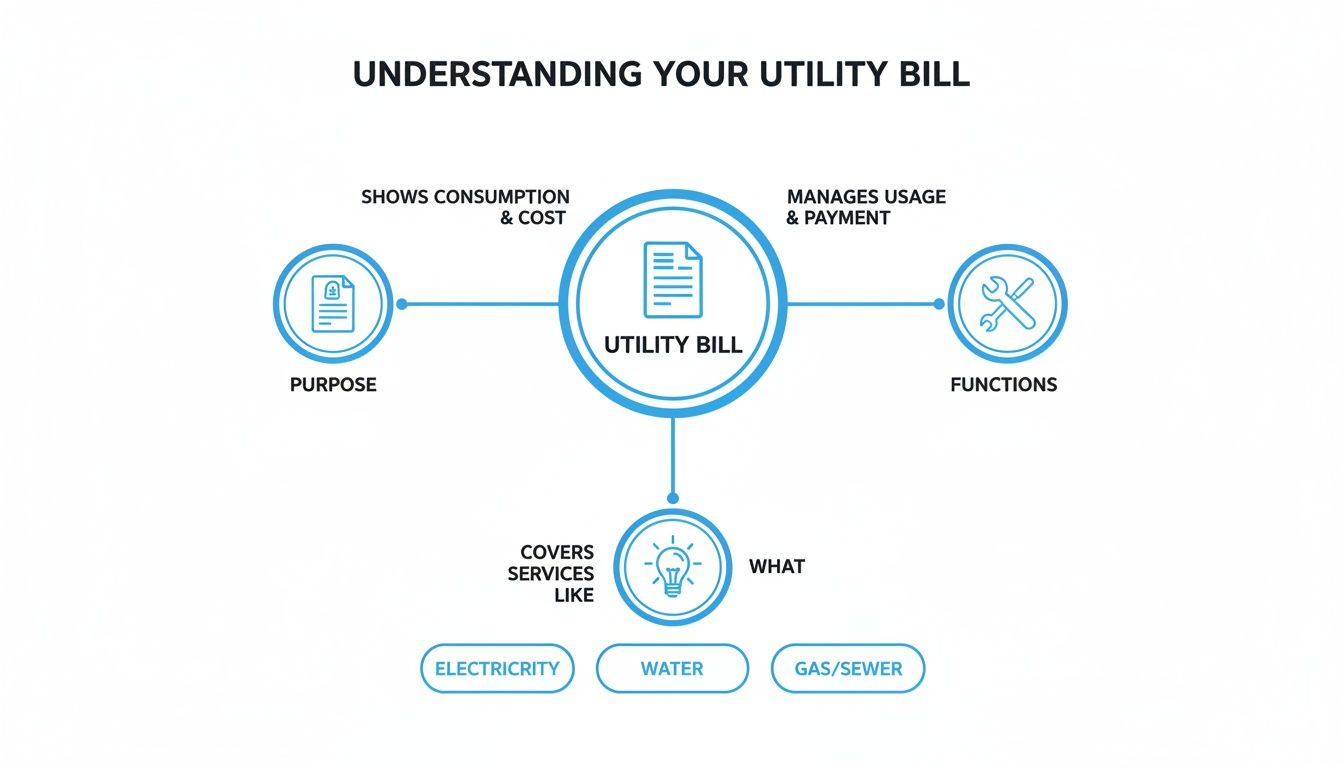
As you can see, the bill does more than just ask for payment; it provides the data you need for budgeting and verifying your costs. Each individual charge—for supply, delivery, or taxes—is its own line item. Getting a handle on your total bill is much easier once you understand what a line item is and how each one contributes to the final number.
Exploring Common Types of Utility Bills
While most utility bills share the same basic layout, the services they cover are all quite different. Getting familiar with these differences is the key to understanding what you're actually paying for each month.
Let's break down the usual suspects you'll find in your mailbox or inbox.
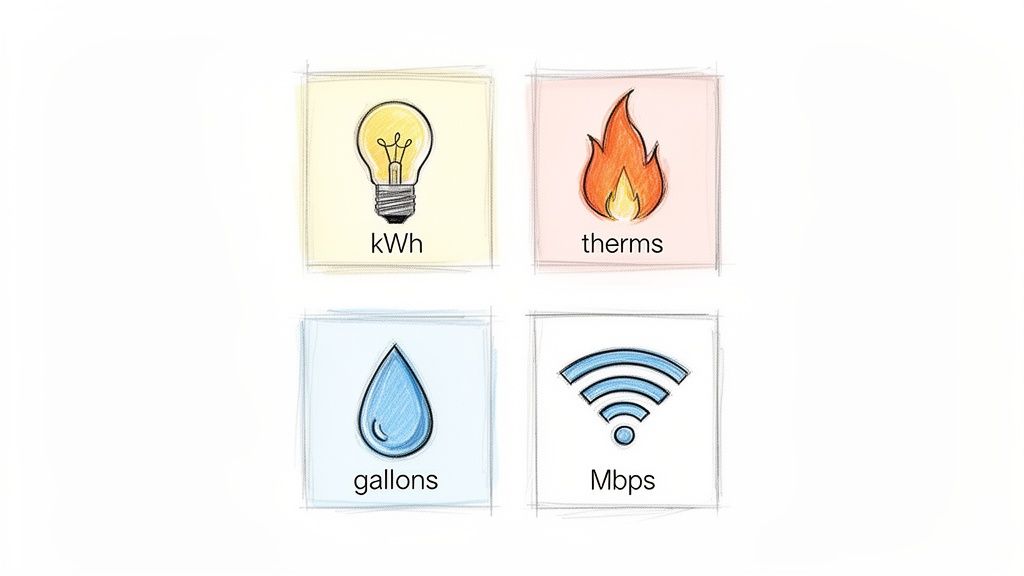
Think of each bill as a unique report card for a specific service. Your electricity bill, for instance, is all about your consumption in kilowatt-hours (kWh). You've probably noticed this bill can swing wildly depending on the season, climbing in the summer from A/C use or in the winter if you have electric heat.
Key Household Services
Beyond electricity, a few other services are staples for most homes and businesses. Each one comes with its own way of measuring what you've used.
- Natural Gas: This is what typically fuels your furnace, water heater, and stove. Gas usage is measured in therms or cubic feet, and just like electricity, the costs often spike during the colder months when the heat is running constantly.
- Water and Sewer: This one’s pretty straightforward—it tracks your household's water consumption in gallons or cubic feet. The rates can change a lot from one town to the next, as they're tied to local water supplies and the cost of maintaining infrastructure.
- Internet and Cable: Once considered a luxury, these are now essential utilities for most of us. The bill is usually a flat monthly fee for a certain service tier, like a specific internet speed (Mbps), but you might see extra charges for going over a data cap.
Though the services are different—power for your lights, gas for your stove, and data for your devices—the purpose of each bill is the same. It provides a transparent account of what you used and what you owe, which is the core way to define a utility bill in practice.
This underlying consistency is what helps you read your bills confidently and manage your budget, no matter which service you're looking at.
Why Are Your Utility Bills Suddenly So High?
If you’ve recently opened your monthly bills and felt a serious case of sticker shock, you're definitely not alone. It's easy to blame yourself—maybe you left the AC running or forgot to turn off the lights. While how much we use is always a factor, the real story behind today’s sky-high costs is often much bigger than our own habits.
The truth is, powerful economic shifts are hitting your wallet directly. Since 2021, electricity prices have shot up by nearly 40%. We’ve seen a 7% jump in residential retail prices and an 11% hike in piped gas, easily outpacing inflation. Utility companies across the U.S. have been filing for record-breaking rate increases, and we’re all feeling the squeeze.
This isn’t just a minor blip. It's a fundamental change in the energy market that's affecting almost everyone.
Market Forces Driving Up Costs
So, what's really going on here? The main culprit is the rising cost of energy itself. Think of it as a ripple effect. Natural gas is a key fuel for generating a lot of our electricity, and its price has been incredibly volatile. When the wholesale cost of energy goes up for your provider, they have no choice but to pass those increases down to you.
It's a widespread issue. At least 237 utilities have recently raised their rates, impacting over 112 million electric customers and 52 million gas customers. These aren't just tiny adjustments; they reflect a new, higher cost of doing business for the companies that keep our lights on and homes warm.
A surprisingly high bill is often a signal of broader economic trends, not just a change in your personal habits. This makes double-checking your bill more important than ever for keeping your finances on track.
If you're trying to get a handle on these costs, learning how to lower home energy bills can make a real difference. For businesses, where these costs are magnified, knowing how to track business expenses effectively is the first step toward managing this new reality.
Taking Control of Business Utility Bills
For any business, managing utility bills is a whole different ball game compared to handling them at home. Finance teams often find themselves buried under a mountain of invoices from different providers, for different locations, all with their own unique layouts. Trying to key all that data in by hand is not only slow but a recipe for errors, making it nearly impossible to get a real grip on fluctuating costs.
On top of that, costs are skyrocketing. We’ve just seen a major tipping point where utility companies requested a staggering $31 billion in rate hikes—that’s double the $15 billion from the year before. With increases from 237 providers already approved or pending, 112 million electric and 52 million gas customers are feeling the pinch, creating huge uncertainty for business budgets. You can dig into the numbers behind these record-breaking increases on Power Lines.
Turning Bills Into Actionable Data
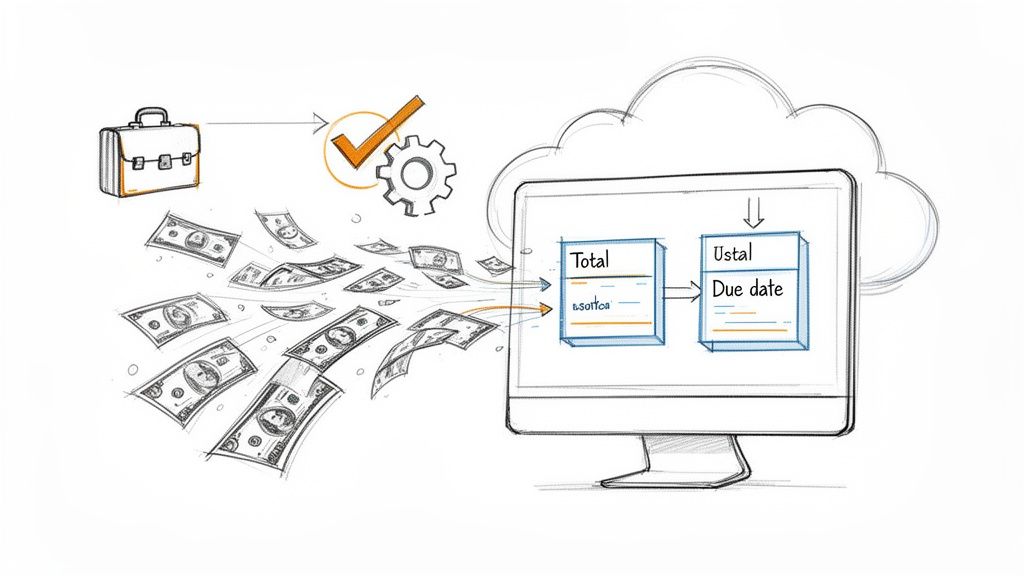
The good news is that you don't have to be stuck in this manual data-entry rut. Modern tools like no-code document parsing platforms (DocParseMagic is one example) can completely change how you handle these documents. They act as a smart translator, turning those messy piles of paper or PDF invoices into perfectly organized, usable data.
Instead of a person manually typing out numbers, these platforms automatically "read" the bills and pull out the important details with incredible accuracy. This includes things like:
- Invoice Numbers and Dates: Crucial for keeping clean records and sailing through audits.
- Total Amounts Due: To keep your accounts payable process running smoothly.
- Usage Metrics: So you can track consumption in kWh, therms, or gallons and spot trends.
- Individual Line Items: To break down exactly where your money is going on specific fees and taxes.
By automating data extraction, businesses can slash hours of tedious work, eliminate costly typos, and finally get a single, clear picture of utility spending across every part of the company.
This is a huge shift. It lets your finance team stop being data entry clerks and start being strategists. They can instantly see odd spikes in usage, compare rates between two different facilities, and predict future costs with confidence. For a closer look at how this works, check out our guide on automated invoice processing. It’s all about turning that monthly utility bill from a simple cost into a powerful tool for smarter budgeting.
Frequently Asked Questions About Utility Bills
Even when you know the basics, real-life questions about utility bills always seem to pop up. Here are some quick, straightforward answers to the most common things people ask.
What Should I Do If I Find an Error on My Bill?
If you spot something that looks off, the first thing to do is a little detective work. Carefully compare the current bill to past ones. Are the meter readings consistent? Did the rates suddenly change? Is there a charge on there you simply don't recognize?
Once you’ve pinpointed the likely error, get on the phone with your utility provider’s customer service. Make sure you have your account number and the bill handy. Clearly explain what you think is wrong and provide any proof you might have, like a quick photo of your meter. Most companies have a straightforward process for looking into these kinds of disputes.
How Long Should I Keep Old Utility Bills?
For your personal files, holding onto utility bills for at least one year is a good rule of thumb. This gives you a great reference for tracking your usage over time and helps you budget for those seasonal spikes in heating or cooling costs.
However, if you claim a home office deduction on your taxes, the IRS suggests keeping those records for three to seven years. The same goes for businesses—you’ll want to hang onto those bills for at least three to seven years to be ready for any tax questions or audits. Saving digital copies is a fantastic, space-saving way to stay organized.
Key Takeaway: A utility bill is one of the most widely accepted forms of proof of address. Banks, government offices like the DMV, and other institutions will often ask for a recent bill (usually from the last 30-90 days) to verify where you live.
What Is the Difference Between Residential and Commercial Bills?
The biggest differences come down to pricing and fees. Bills for commercial or business accounts are often more complex than what you see at home. For example, they might include demand charges, which are based on the single highest peak of power used during a billing cycle, not just the total amount consumed over the month.
On top of that, businesses might be subject to different tax rates or have access to energy-buying programs that residential customers don't. At the end of the day, residential bills are generally simpler and more directly tied to your total usage.
Can a Utility Bill Be Used As Proof of Address?
Yes, absolutely. In fact, it's one of the most common ways to prove where you live. When you’re opening a bank account, getting a driver's license, or registering to vote, you'll almost certainly be asked to provide a recent utility bill with your name and address on it. It’s a standard and trusted form of identification.
Tired of manually entering data from messy utility bills? DocParseMagic is a no-code platform that automatically extracts key information from any invoice or statement in minutes. Turn piles of PDFs into clean, analysis-ready spreadsheets so you can stop copying and start strategizing.