Data Extraction Programs: Turn Data Into Insights
Think of data extraction programs as automated tools that find and pull specific, valuable information from a sea of digital documents—things like websites, PDFs, and spreadsheets.
They’re like a hyper-efficient research assistant, capable of sifting through thousands of files in seconds to grab exactly what you need and organize it into a neat, ready-to-use format.
What Are Data Extraction Programs Actually Doing?
At its heart, a data extraction program is a piece of software built to pinpoint and grab data from one or more sources. So much of the information we need today is locked away in formats that aren't easy to work with—think customer details buried in a scanned invoice or pricing data scattered across a competitor’s website.
These tools are the bridge between that raw, messy data and clean, usable insights. They take over the mind-numbing, error-prone job of manual data entry and turn it into a lightning-fast, accurate process. Without them, we'd all be stuck copying and pasting for hours on end, which just doesn't scale.
Tackling Structured and Unstructured Data
Where modern data extraction programs really shine is in their ability to handle two very different kinds of data:
- Structured Data: This is information that’s already nicely organized. Think of a spreadsheet with clear columns and rows or a database table. Pulling data from here is pretty straightforward because you know exactly where everything is.
- Unstructured Data: This is the messy stuff. It's the free-flowing text in an email, the content of a PDF report, or a comment on a social media post. This kind of data makes up more than 80% of all business data, and extracting it requires smarter technology that can understand context and layout.
A great example of the smart tech behind this is Change Data Capture (CDC). It’s a method that allows extraction tools to identify and capture only the changes made to a database in real time. Instead of re-processing everything, the tool just grabs what's new or updated, making the whole process incredibly fast and efficient.
From Raw Information to Actionable Intelligence
Ultimately, the goal isn't just to get data; it's to use it. A data extraction program is the critical first step in turning information into action. It takes all sorts of raw inputs—a folder with thousands of invoices, a live feed from a website—and converts them into a clean, organized format like a CSV file or a database entry.
Once the data is structured, it can be plugged directly into other business systems. That extracted sales data can instantly update a dashboard for your team to see, or customer feedback from online reviews can be analyzed for sentiment. It’s the foundational process that transforms digital chaos into a real strategic asset.
A Look Under the Hood: How Extraction Tools Really Work
Think of a data extraction program like a highly skilled mechanic's toolkit. You wouldn't use a wrench to change a tire; you'd use a lug wrench. Similarly, these programs have specialized components designed for specific jobs, all working together to take apart complex documents and websites to get at the good stuff inside.
At its heart, the process is about three things: identifying the right information, capturing it, and then whipping it into a structured, usable format. It's a sophisticated sequence that turns a messy pile of raw information into a clean, organized asset for your business.
This diagram gives you a bird's-eye view of that journey, from a jumble of sources to a neat, analysis-ready output.
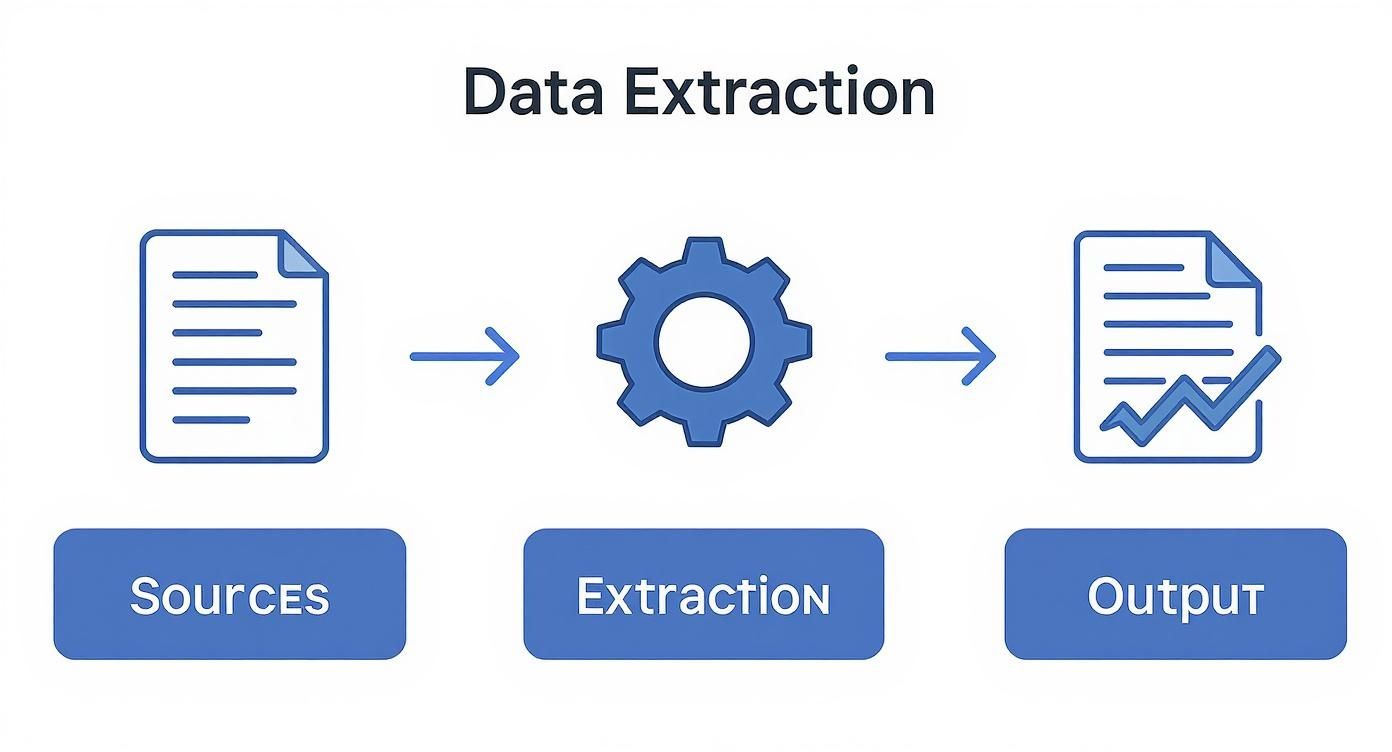
As you can see, the main job of this "engine" is to wrangle all sorts of different inputs and produce a single, high-quality, standardized result.
The Key Technologies Driving the Engine
So, what are the main components in this digital toolkit? A few core technologies do most of the heavy lifting, each built to handle a specific kind of data source, whether it's a dynamic website or a stack of scanned paper invoices.
- Web Scraping: This is the tool for automatically grabbing data from websites. An e-commerce brand, for example, might use a scraper to pull competitor pricing straight from their product pages every morning.
- Optical Character Recognition (OCR): This is the magic that turns text within an image—like a scanned contract or a photo of a receipt—into actual, editable text. It’s essentially giving the software a pair of eyes to "read" documents that aren't text-based to begin with. Our guide on what OCR technology is dives much deeper into how this foundational process works.
- Natural Language Processing (NLP): This goes a step beyond just reading words. NLP helps the software actually understand the meaning and context of human language. This is what allows it to pinpoint specific bits of info from unstructured text like customer emails or product reviews.
Web scraping, in particular, has become a go-to strategy for businesses that need a competitive edge. The market for these tools was valued at $1.01 billion and is expected to climb to $2.49 billion by 2032. This growth is largely driven by industries like finance and AI that are hungry for alternative data.
Turning Raw Text into Structured Gold
Once the raw text is captured, the real work begins. This is where a data extraction program earns its keep, performing a few crucial follow-up steps to transform a jumble of characters into a valuable dataset.
The real power isn't just in grabbing text, but in making sense of it. The best programs don't just copy and paste; they interpret, clean, and organize the data so it’s immediately ready for action.
This transformation boils down to three key stages:
- Parsing: The software intelligently breaks down the extracted data into its component parts. Based on rules or AI-driven context, it identifies key fields like "Invoice Number," "Due Date," or "Total Amount."
- Transformation: Next comes the cleanup crew. The data is standardized and scrubbed. This could mean fixing typos, making sure all dates follow the same format (like MM/DD/YYYY), or converting different currencies to a single standard.
- Integration: Finally, the clean, structured data is sent where it needs to go. This might be a direct export to an Excel spreadsheet, a new entry in your CRM, or a record automatically created in your accounting platform.
How AI Is Making Data Extraction Smarter
Think of old-school data extraction tools as a very strict, very literal-minded librarian. You tell it to find a book on the third shelf, fifth from the left, and it will do that perfectly every time. But if someone moves that book, even by an inch, the librarian is completely lost. Traditional programs work the same way, relying on rigid templates and rules. If an invoice layout changes—say, a vendor moves the "Total Amount" field—the whole process grinds to a halt.
This is where artificial intelligence completely changes the game. AI turns these rigid rule-followers into adaptive, intelligent systems.
Instead of just following a map, AI learns the landscape. It begins to understand that "Total," "Amount Due," and "Balance" are all pointing to the same concept, no matter where they show up on the page. It's the difference between memorizing a script and actually understanding the language.

This ability to grasp context, not just coordinates, is what makes modern data extraction so powerful and resilient.
The Rise of Intelligent Document Processing
This smarter approach is best seen in a technology called Intelligent Document Processing (IDP). While older OCR tools could "read" text, IDP uses AI to actually comprehend it. It’s not just scanning words; it's understanding the document's structure, purpose, and meaning by combining a few key technologies:
- Machine Learning (ML): The system trains on thousands of real-world documents, learning from each one to get better and more accurate over time without constant human hand-holding.
- Natural Language Processing (NLP): This is the magic that helps the software understand the nuances of human language. It can spot key bits of information like names, dates, and addresses buried in a dense paragraph.
- Computer Vision: This gives the program a pair of "eyes" to analyze the visual layout of a document, recognizing tables, columns, and form fields just as a person would.
When these technologies work together, you get data extraction programs that are incredibly versatile. They can tackle a huge variety of document types and layouts without needing a custom-built template for every single one. If you want to dive deeper, you can learn more about what Intelligent Document Processing is and how its components fit together.
The core shift is from giving explicit commands ("find the text 'Invoice No.' at these exact coordinates") to training a model on examples ("this is what an invoice number generally looks like—now go find it for me").
Comparing Traditional vs AI-Powered Data Extraction
The differences between these two approaches are stark. While both aim to pull data from documents, how they get there and the results they produce are worlds apart. This table breaks down the key distinctions.
| Feature | Traditional (Rule-Based) Extraction | AI-Powered Extraction |
|---|---|---|
| Flexibility | Highly rigid; fails with layout changes | Adapts to new formats and variations |
| Setup Time | Requires extensive manual template creation | Learns quickly from a few examples |
| Document Types | Limited to structured, consistent documents | Handles unstructured and semi-structured data |
| Accuracy | High on known templates, 0% on unknown ones | Continuously improves; handles imperfections |
| Maintenance | Constant updates needed for new templates | Self-learning, minimal human oversight |
| Scalability | Difficult and time-consuming to scale | Easily scales to handle growing volumes |
As you can see, AI-powered systems are built for the messy reality of modern business, where documents come in all shapes and sizes.
The Real-World Impact of AI Extraction
This AI-first approach delivers benefits you can actually feel. It’s not just about convenience; it fundamentally changes what’s possible with automation.
For example, imagine an AI tool processing a crumpled, poorly scanned receipt from a team member's lunch meeting. A traditional, rule-based system would see a blurry mess and give up. But an AI model sees the context—it understands the likely relationships between line items, taxes, and totals—and makes a highly educated guess.
This ability to navigate imperfection drastically cuts down on the need for manual review and correction. The end result is higher accuracy, far greater scalability, and a huge reduction in the tedious work of managing unpredictable data sources. It frees up your team to stop keying in data and start analyzing it.
The Business Case for Automated Data Extraction
While the tech behind data extraction programs is fascinating, what really matters is the tangible impact on your bottom line. Switching from manual data entry to an automated system isn't just about tweaking a process—it’s a fundamental business decision that pays for itself by completely changing how you manage information.
At the heart of it all, automation solves the two biggest headaches in data processing: speed and accuracy. Imagine your team spending hours every day just copying information from invoices, forms, or reports. An automated tool can do that same work in seconds, freeing up your people to focus on tasks that actually grow the business.
This is exactly why the global data extraction software market is booming. The steady growth shows just how much companies across every industry need better ways to handle massive amounts of data. You can dig into the specifics of this market growth on ResearchAndMarkets.com.
Accelerating Operations and Boosting Accuracy
The first thing you’ll notice is a massive boost in operational speed. Think about a mortgage company processing loan applications. A task that once required days of painstaking manual verification can now be wrapped up in minutes. This speed lets you serve more customers and gain a serious edge over the competition.
At the same time, automation eliminates the ever-present risk of human error. Manual data entry is a minefield of typos, misplaced numbers, and simple mistakes that can lead to expensive fixes and poor business decisions down the road.
Automated systems don't get tired or distracted. By removing manual keystrokes, you can achieve near-perfect data accuracy, ensuring that the information fueling your business is reliable and clean from the start.
Scaling Smart and Making Better Decisions
As your business grows, your data piles up. With a manual system, that means hiring more people just to keep pace with the paperwork. Automated data extraction programs offer a much smarter path to scaling your operations.
- Handle Volume with Ease: You can process thousands of documents a day without ballooning your headcount, keeping operational costs in check.
- Maintain Consistency: The software ensures data is captured and formatted the exact same way every single time, no matter where it came from or how much of it there is.
Ultimately, all of these advantages funnel into one critical outcome: better, faster decision-making. When your analytics tools are fed a steady diet of clean, accurate, and up-to-the-minute data, your insights become exponentially more powerful. A retailer, for instance, could automatically pull competitor pricing every day, allowing them to adjust their own strategy in real-time instead of waiting a week for a manual report.
Seeing Data Extraction in Action Across Industries
It's one thing to talk about what data extraction tools can do, but it’s another to see them solving real problems. This is where the true value of the technology comes into focus. These programs aren't just abstract ideas; they're actively creating real advantages in countless fields, from making patient care safer to outsmarting retail competitors.
Let's look at a few examples of how different businesses are turning raw, messy information into a genuine competitive edge. Each scenario is simple: a common problem, an automated solution, and a clear, measurable result.
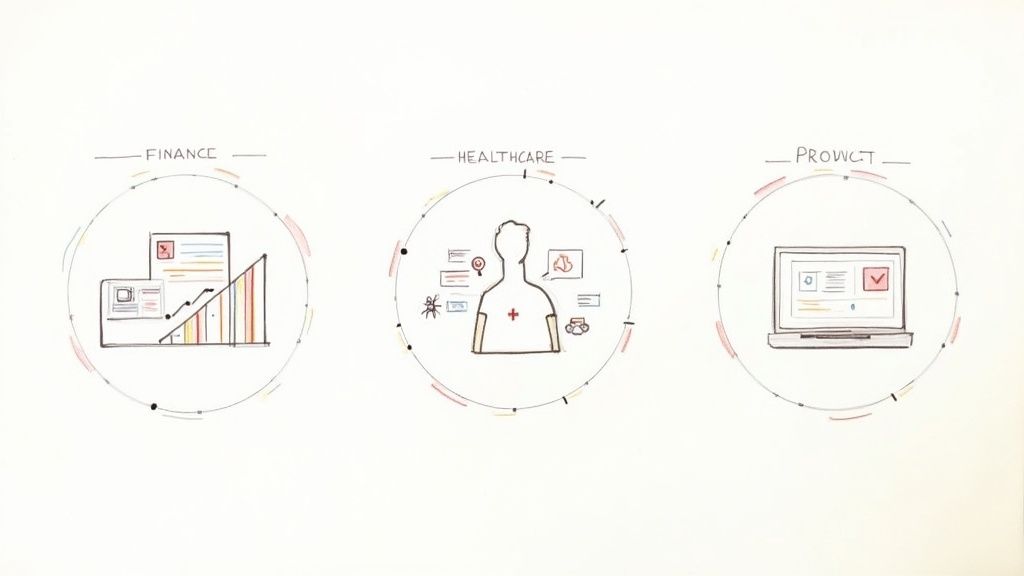
Financial Services and Investment Analysis
In the fast-paced world of finance, every second counts. Investment firms need to digest hundreds of corporate annual reports, SEC filings, and financial statements to make smart calls. Manually slogging through these dense PDFs to find key metrics like revenue, debt-to-equity ratios, or cash flow is painfully slow and can mean missing a critical opportunity.
This is where a data extraction program shines. An investment firm can set up a tool to automatically scan thousands of these documents, pulling out specific financial data in minutes. The extracted numbers are then fed directly into their quantitative models, letting analysts spot trends and opportunities almost in real-time.
The result is a game-changer: a task that once took a team of analysts weeks can now be completed before the market even opens, paving the way for faster, more informed investment strategies.
Healthcare and Patient Data Management
Hospitals and clinics are often buried in fragmented patient information. One person's medical history can be spread across totally separate systems—lab results in one portal, billing details in another, and a doctor's handwritten notes in a third. These data silos make it nearly impossible to get a full picture of a patient's health, which can directly impact their care.
An extraction tool can act as a bridge. By pulling key information from disconnected and unstructured sources like scanned referral forms, EMR printouts, or insurance claims, it can stitch everything together into a single, unified patient record. This ensures that a doctor has the complete story right at their fingertips.
E-commerce and Competitive Intelligence
For online retailers, the market is constantly shifting. To keep up, brands must track competitor pricing, monitor product availability, and understand what customers are saying. Trying to manually check hundreds of product pages or read through thousands of reviews is just not feasible.
This is where data extraction programs become tireless market researchers. They can be set up to:
- Scrape competitor websites every day for the latest pricing and stock levels.
- Analyze thousands of customer reviews from different platforms to spot common complaints or popular features.
- Monitor social media for brand mentions and shifts in customer sentiment.
This continuous flow of automated intelligence helps e-commerce brands make quick, strategic decisions on everything from pricing and inventory to marketing. It’s what helps them stay one step ahead.
While adoption is growing everywhere, the financial services and insurance sectors are leading the way, often driven by strict compliance requirements. You can learn more about these market trends in data extraction on VerifiedMarketResearch.com.
How to Choose the Right Data Extraction Program
Picking the right data extraction program is a lot like choosing a vehicle. You wouldn't buy a Ferrari to haul lumber, and you wouldn't take a semi-truck on a winding country road. The best tool isn't about flashy features; it's about what fits your specific journey—your business goals, data sources, and the team you have on hand.
Before you even start looking at vendor websites, take a step back and get a clear picture of what you actually need. What information are you trying to pull? Is it all sitting nicely in structured databases, or is it trapped in messy PDFs, scanned images, and customer emails? Just answering that one question will help you filter out a huge chunk of the market.
Evaluate Your Core Requirements
Not all data extraction programs are built the same. Some are no-code platforms with simple drag-and-drop interfaces that anyone can use. Others are complex APIs and developer libraries designed to be woven into custom-built software. To find the right match, you need to be honest about these factors:
- Supported Data Sources: Does the tool excel at scraping websites, or is it designed to handle a chaotic mix of PDFs, images, and emails? Make sure its specialty aligns with the actual documents your business runs on.
- Technical Skill Level: Will your marketing team be using this, or will it be in the hands of your developers? Be realistic about your team's technical skills to avoid a tool that's either too restrictive or requires a PhD to operate.
- Scalability: Think about the future. Can the program process 10,000 documents a month just as easily as it handles ten? You need a solution that can grow with your business, not one you'll outgrow in six months.
The most critical step is a self-assessment. A clear understanding of your own workflows, data types, and team capabilities is the best compass for navigating the market and avoiding a tool that's either too simple or overly complex for your needs.
Integrations and Final Checks
A data extraction tool is pretty useless if it lives on an island. Its real value comes from how well it connects with the other software you use every day. How easily can it push clean, structured data into your CRM, accounting platform, or business intelligence dashboard?
A program with pre-built integrations for tools like Salesforce, QuickBooks, or Tableau can save you a mountain of headaches and development time. As you weigh your options, it's smart to see what the best data extraction software on the market offers. For a deeper dive into tools built specifically for paperwork, our guide on document data extraction software can point you in the right direction.
By thinking through these points, you can confidently choose a program that actually solves your problems and fits your budget.
Got Questions About Data Extraction Programs? We’ve Got Answers.
Jumping into the world of data extraction programs often brings up a few key questions. It's smart to wonder about the legal side of things, or whether your team has the right skills to even use these tools. Let's clear the air and tackle some of the most common things people ask.
So, Is This Stuff Actually Legal?
This is probably the number one question we hear, especially when it comes to web scraping. For the most part, yes—pulling information from publicly available websites is generally legal.
But it’s not always a simple yes or no. The legal ground can get a bit shaky depending on a few factors:
- A website’s terms of service: Many sites have rules that specifically forbid automated scraping.
- The kind of data you're after: If you’re collecting personal information, you'll run into strict privacy laws like GDPR.
- What you plan to do with the data: Using it for commercial gain can put you in a different risk category.
When in doubt, it’s always a good idea to read a site's policies carefully. And if you're still unsure, looping in a legal expert is the safest bet.
Does My Team Need to Know How to Code?
Not like they used to. The old-school data extraction programs were definitely a "developers only" club, requiring heavy coding. But that’s changed dramatically.
Today, there's a whole new wave of "no-code" and "low-code" tools. These platforms are built for the rest of us, with intuitive drag-and-drop interfaces that feel more like putting a puzzle together than writing code. This means your marketing team or operations specialists can build their own powerful extraction workflows without a single line of code.
The big shift is that modern tools are designed for business users, not just programmers. You don’t need a technical background to get started—you just need to know what data you want and why.
What Happens When a Website Changes Its Layout?
Ah, the classic scraper’s nightmare. This is where older tools really struggle. Traditional, rule-based extractors are rigid; you tell them "find the price in the third box on the left," and when the website redesigns and moves that box, your scraper breaks.
This is where AI-powered programs really shine. Instead of following a strict set of rules, they use machine learning to understand the context of the page. They learn to recognize what a price, an address, or a product name looks like, no matter where it appears. This makes them incredibly resilient, allowing them to adapt on the fly to most layout changes and keep the data flowing without constant manual fixes.
Ready to stop wasting hours on manual data entry? DocParseMagic uses AI to pull structured data from any document—invoices, receipts, or forms—and turns it into a clean spreadsheet in seconds. Try it for free and see how much time you can save. Learn more at https://docparsemagic.com.