A Complete Guide to Understanding the Bill of Lading
A bill of lading (BOL) is, quite simply, the most important document in the shipping world. Think of it as the shipment's official passport. It's a legally binding document that does three critical jobs at once: it's a contract between the shipper and the carrier, a receipt for the goods, and in many cases, it even acts as the deed of ownership for the cargo.
Without a correct BOL, global trade would grind to a halt.
Unpacking the Bill of Lading
Imagine you're sending a valuable, one-of-a-kind antique. You wouldn't just hand it over to a delivery driver without getting some form of official paperwork confirming what you gave them and where it's going, right? The bill of lading is exactly that, but on an industrial scale.
It's the master document that ensures the person sending the goods (the shipper), the company moving them (the carrier), and the person receiving them (the consignee) are all working from the same script. It tells the complete story of the shipment’s journey, from start to finish.
This document is so central to global commerce that getting the details right is non-negotiable. One small error on a bill of lading can cause a massive ripple effect, leading to delays and costs that reverberate through the entire supply chain.
The Three Core Functions
At its heart, the bill of lading wears three different hats. Getting a handle on these functions is the first step to truly understanding how shipping works and how to protect your business.
Let's break down the three essential jobs a BOL performs. This simple table makes it easy to see why this single document carries so much weight in every shipment.
| Function | What It Means | Why It Matters for Your Business |
|---|---|---|
| Evidence of a Contract | The BOL lays out the legal terms and conditions for moving the cargo. It's the carrier’s formal agreement to transport goods from point A to point B for a specific fee. | This is your legal protection. It defines the responsibilities of each party, preventing disputes over freight charges, routes, or delivery timelines. |
| Receipt for Goods | When the carrier signs the BOL, they are officially confirming they have received the cargo from the shipper, exactly as described (quantity, condition, etc.). | This is your proof of what you handed over. If your cargo is damaged or lost in transit, this receipt is the foundation of your insurance claim. |
| Document of Title | For certain BOL types, holding the original document is the same as holding the keys to the cargo. It represents legal ownership. | This allows for the buying and selling of goods while they are still in transit. The holder of the BOL has the exclusive right to claim the cargo at its destination. |
Understanding these roles shows that the BOL isn't just a piece of paper; it's a powerful tool for contract enforcement, proof of shipment, and transfer of ownership all rolled into one.
Why Every Detail Matters
In the fast-paced world of global shipping, the importance of the bill of lading cannot be overstated. It's the indispensable backbone of all container trade.
To put it in perspective, recent global container volumes soared to 126.75 million TEU in just eight months—a 4.4% jump despite major economic headwinds. Every single one of those containers moved under the authority of a bill of lading. You can learn more about how to navigate these challenges through improved supply chain automation.
A bill of lading is not just operational paperwork; it is a legally enforceable agreement. An incorrect address, a misstated weight, or the wrong freight classification can result in costly delays, unexpected fees, legal disputes, and even the carrier refusing to release your cargo. Mastering this document is essential for a smooth and resilient supply chain.
Getting to Know the Different Types of Bills of Lading
Not all bills of lading are created equal. Think of them like different types of keys—you need the right one for the right lock. The one you choose hinges on factors like payment arrangements, how the goods are being shipped, and the level of trust between the shipper and the receiver.
Picking the correct BOL isn't just a matter of paperwork; it's a critical decision. The wrong choice can introduce serious financial risks and create a real mess when it comes to proving ownership. Getting it right ensures your cargo gets where it's going without a hitch.
This quick decision tree shows you what makes a document a true bill of lading by breaking down its three essential jobs.
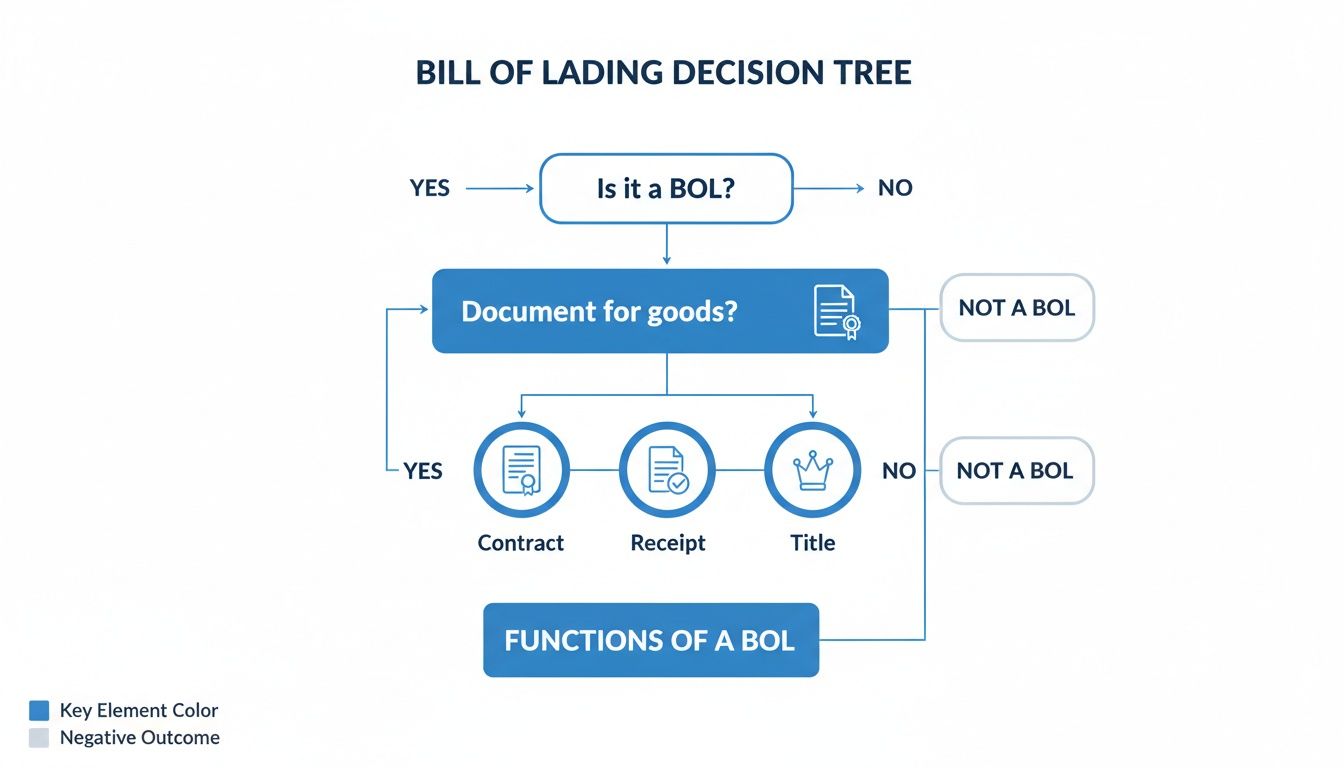
As you can see, for any document to qualify as a bill of lading, it has to function as a contract, a receipt, and a document of title. If it doesn't do all three, it's something else.
Straight Bill of Lading (Non-Negotiable)
The most common and simplest version is the Straight Bill of Lading. You can think of it like a check made out to a specific person—only that person can cash it. It's that simple.
Because it's "non-negotiable," the ownership of the goods can't be transferred to anyone else while they're on the move. The document names a specific consignee, and that’s who the carrier is authorized to release the cargo to, usually after they show proper ID. This makes it a great, secure option when the goods are already paid for or if you're just moving inventory between your own company locations. It's safe, but it’s not flexible.
Order Bill of Lading (Negotiable)
On the other end of the spectrum is the Order Bill of Lading, which is fully "negotiable." This one is less like a personal check and more like a cashier's check made out to "cash." It’s made out "to the order of" a specific party, which means they can endorse it—just by signing the back—and transfer ownership to someone else entirely.
This flexibility is what makes the order BOL a workhorse of international trade, allowing goods to be bought and sold while they're still crossing an ocean.
The Order Bill of Lading is more than just a shipping document; it's a powerful financial tool. Importers can use it as collateral to secure financing from a bank because it represents legal title to valuable cargo that's already in transit.
The carrier will only hand over the shipment to the person or company that presents the original, properly endorsed Order Bill of Lading. This gives sellers a huge advantage, as they can hold onto the BOL until they've received full payment.
Other Common Bill of Lading Variations
Beyond the basic straight and order types, you'll run into a few other variations designed for specific situations. Each one is tailored to a particular mode of transport or a more complicated shipping route.
Here are a few you’re bound to come across:
- Sea Waybill: Used for ocean freight, this is a non-negotiable document. Critically, a Sea Waybill is not a document of title. It’s just a contract and a receipt. This allows for a much faster cargo release at the destination because the consignee doesn't need to present an original paper document. It's perfect for shipments between trusted parties where payment isn't tied to the paperwork.
- Air Waybill (AWB): This is the air freight version of a Sea Waybill. It is always non-negotiable and acts as a contract of carriage. Since air travel is so fast, the complex process of transferring a negotiable title document is completely unnecessary.
- Through Bill of Lading: When a shipment involves multiple modes of transport—like a journey from a ship to a train to a truck—a Through Bill of Lading comes into play. It’s a single document that covers the entire trip from origin to final destination, saving the shipper from juggling a stack of different documents.
- Electronic Bill of Lading (eBOL): This is simply a digital version of a traditional BOL. An eBOL dramatically speeds up the process, cuts down on administrative overhead, and is often more secure than paper. As the logistics world continues to digitize, you'll be seeing these more and more.
How to Read a Bill of Lading Field by Field
At first glance, a bill of lading can look like a wall of text—a jumble of codes, addresses, and jargon. But if you're in logistics, learning to read one is one of the most important skills you can have. This single document is the playbook for your entire shipment.
Think of it as the shipment's passport. Every box and line item gives a specific instruction that carriers, customs agents, and receivers depend on to do their jobs right. When you know how to read this blueprint, you can catch expensive mistakes before they grind your supply chain to a halt.
Let's look at a typical BOL to get a feel for the layout.
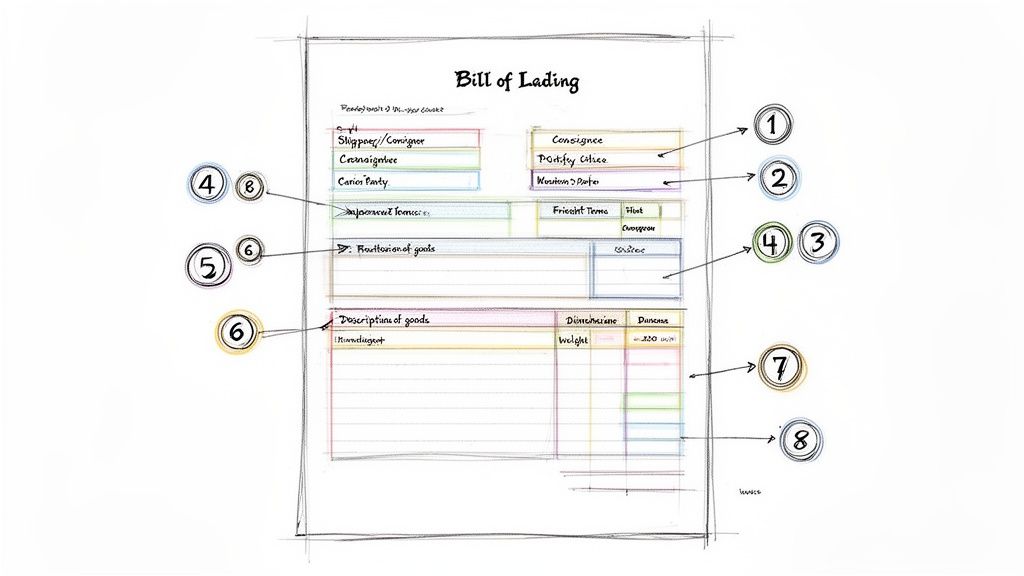
This gives you a good idea of the essential information that makes a shipment work. Now, let’s break down what these key sections actually mean.
Identifying the Key Players
Right at the top of any BOL, you'll find the "who's who" of the shipment. Getting these details 100% correct is non-negotiable. A simple typo in a name or address can send a container to the wrong warehouse or get it stuck at the port for weeks.
- Shipper/Consignor: This is simply the person or company sending the goods. You need their full legal name, address, and contact info. They are the starting point.
- Consignee: This is who the cargo is going to—the intended recipient. The carrier is legally bound to deliver the goods to this specific party, so precision here is everything.
- Notify Party: You'll see this a lot in international shipping. It's the person or company that gets a heads-up when the cargo arrives. It could be the same as the consignee, but often it's a customs broker or freight forwarder who takes over the final arrangements.
- Carrier: This is the shipping line or trucking company physically moving the freight. The BOL will list their name and usually a unique identifier, like their SCAC code.
Decoding the Cargo Description
This is the heart of the bill of lading, and frankly, it's where most of the arguments and delays happen. It’s the detailed inventory of what’s being shipped, making sure everyone is on the same page about what’s actually inside the box or on the truck.
I can't tell you how many times I've seen a shipment held up because of a vague description like "general merchandise." To a carrier or customs official, that’s a huge red flag. It invites inspections, re-classifications, and surprise fees. Always be specific.
Here’s what you need to get right in this section:
- Description of Goods: Give a clear, detailed list of every item. That means the number of pieces (cartons, pallets, drums, etc.), their dimensions, and the total weight.
- NMFC Code (for LTL): If you're shipping LTL (Less-Than-Truckload) in North America, the National Motor Freight Classification (NMFC) code is king. It’s a number that classifies freight based on how easy it is to handle, its density, and its liability. This code directly impacts your shipping cost.
- Special Instructions: This is your spot to flag anything out of the ordinary. "Fragile," "Keep Refrigerated," or notes about hazardous materials (HAZMAT) all go here. HAZMAT, in particular, requires its own set of special paperwork and handling rules.
Understanding the Financial and Contractual Terms
The final piece of the puzzle covers the money and the legally binding agreement. Getting this right is how you ensure a smooth payment process and clarify who's on the hook if something goes wrong.
One of the first things to check is the freight payment terms.
- Prepaid: This means the shipper is paying the freight bill. The charges are settled before the goods are even delivered.
- Collect: This puts the responsibility on the consignee (the receiver). They have to pay the freight charges when the shipment arrives.
These terms are a core part of the deal and must line up with the sales contract between the buyer and seller. If they don't match, you're looking at payment disputes and a carrier who won't release the cargo.
Finally, the fine print on the BOL will reference the carrier's terms and conditions. This is where they outline their liability for lost or damaged goods, often governed by laws like the Carmack Amendment for U.S. domestic shipments. By signing that bill of lading, the shipper is officially agreeing to those terms, turning the document into a binding contract for the entire journey.
The People and Processes Behind a Bill of Lading
A bill of lading doesn't just appear out of thin air. It's a living document that passes through many hands on its journey from a warehouse to its final destination, and each person has a critical part to play. If you want to manage your supply chain effectively—and troubleshoot problems when they inevitably pop up—you need to understand this lifecycle.
Think of it like a relay race. The bill of lading is the baton, and it needs to be passed smoothly from one person to the next. One fumble, and the whole shipment can grind to a halt.
The journey starts long before any goods are loaded onto a truck or ship. It kicks off the moment the BOL is created, setting in motion a chain of events that demands careful coordination from everyone involved. Let's walk through that journey and meet the key players.
The Key Players and Their Roles
Every shipment boils down to three main parties, each with its own set of responsibilities. You might have brokers or other specialists involved, but these three are the foundation of the entire process.
-
The Shipper (or Consignor): This is where it all begins. The shipper is the person or company sending the goods. Their most important job is creating the bill of lading and making sure every single detail—from the cargo description to the delivery address—is 100% accurate. When they sign it, they are legally vouching for everything on that paper.
-
The Carrier: This is the transport company doing the heavy lifting, literally. Whether it’s a trucking company, an airline, or a steamship line, their job is to get the freight from Point A to Point B. By accepting and signing the BOL, the carrier acknowledges they've received the goods as described and are now on the hook to deliver them safely and on schedule.
-
The Consignee: This is the end of the line—the person or company receiving the cargo. The consignee’s job is to accept the delivery, inspect it for damage or missing items, and sign off on it. Depending on the type of BOL, they might need to present the original document just to prove they have the right to claim the goods.
Of course, these aren't the only people who might touch the shipment. Specialists often play a part, and understanding roles like the Importer of Record (IOR) is vital for grasping the full picture.
Mapping the Bill of Lading Lifecycle
The journey of a bill of lading follows a pretty straightforward path. The exact steps might change slightly, but the core stages are almost always the same.
- Creation and Issuance: The shipper fills out the bill of lading and hands it over to the carrier at pickup. This is the starting gun—the moment the shipping contract officially kicks in.
- In-Transit Document: While the cargo is on the move, the BOL acts as its passport. The carrier uses it for everything from internal tracking and routing to special handling instructions.
- Arrival and Notification: Once the shipment hits the destination port or terminal, the carrier uses the BOL's contact info to let the consignee (or a designated "Notify Party") know the goods are ready.
- Cargo Release: The consignee shows up with the bill of lading (if required) to prove they're the rightful owner. After they settle any final freight charges, the carrier hands over the cargo.
This flow is exactly why the document is so critical. A BOL isn't just a receipt; it's the lifeblood of trade data that informs economic decisions worldwide. For example, data pulled from B/L records showed the U.S. international trade deficit was $60.2 billion one recent June, down 16.0% from the month before.
Key Takeaway: Every person in the chain depends on the accuracy of the bill of lading to do their job. A simple typo by the shipper can create a domino effect of delays and costs for both the carrier and the consignee.
When you clearly map out these roles and processes, it becomes much easier to spot bottlenecks and know who is responsible at every stage. For a deeper dive, see how you can streamline your logistics document workflows.
Automating Bill of Lading Data Extraction
Let's be honest: manually keying in data from stacks of bills of lading is a soul-crushing task. It's more than just tedious; it's a huge operational bottleneck that invites mistakes at every turn.
Each document is a minefield of potential errors—a mistyped container number, a misplaced decimal in the freight charges, or a wrong consignee address. It’s slow, expensive, and a constant source of headaches for teams scrambling to keep shipments on track.
Think about it. A single typo can throw a wrench in everything. Your finance team is trying to reconcile invoices, but a wrong number sends them down a rabbit hole. Your ops team is trying to track a shipment, but a bad address sends it to the wrong state. This is exactly where modern automation flips the script, turning a high-risk manual chore into a fast, accurate workflow.
Moving Beyond Manual Data Entry
The logistics industry is finally starting to ditch the paper. For years, the bill of lading has been synonymous with paperwork nightmares, but that’s changing. We’re seeing a big push toward electronic B/Ls (eBLs), and the numbers back it up.
Recent surveys show that the number of users handling both paper and digital formats jumped from 28.0% to 41.7% in just two years. That’s a huge shift. Why? Because eBLs cut processing time from days down to minutes, boosting efficiency by a staggering 90% while also reducing the carbon footprint of shipping.
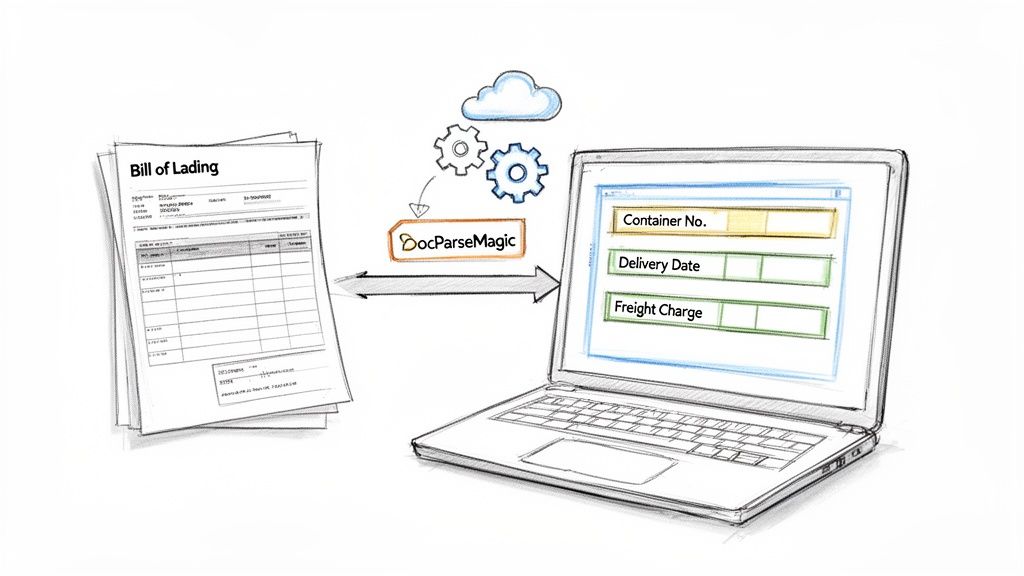
This move to digital makes intelligent data extraction absolutely essential. Tools like DocParseMagic are built to bridge the gap between any document format—a PDF, a grainy scan, even a photo snapped on a phone—and the clean, structured data your systems need to work. It’s not just about turning an image into text anymore; it's about understanding what that text means.
Imagine uploading a complicated BOL and, in seconds, having all the key details pulled out and organized.
- Shipper and Consignee Details: Names, addresses, and contacts are captured perfectly.
- Shipment Identifiers: Container numbers, booking numbers, and tracking codes are pulled without a single typo.
- Freight and Charges: Line items, extra fees, and total costs are ready for accounting.
- Critical Dates: Shipping, delivery, and pickup dates are all there in a consistent format.
How Automated Extraction Works in Practice
Let’s walk through a typical day. An operations manager gets a flood of 50 bills of lading from different carriers, and each one looks a little different. The old way meant someone had to spend hours hunched over a keyboard, punching all that information into a spreadsheet or an ERP system.
With an automation platform like DocParseMagic, that entire process changes:
- Upload the Document: The manager just drags and drops the BOL files into the system. It doesn’t matter if they’re PDFs, JPEGs, or scans.
- AI-Powered Parsing: The software instantly reads each document, identifying and extracting the specific fields you need, no matter where they are on the page.
- Receive Structured Data: Moments later, you get a clean, organized table with all the information, ready to be downloaded or pushed directly into your other software.
To really get ahead, you have to automate data entry with AI. It's no longer a "nice-to-have"—it's a critical step in modernizing how you handle documents.
The Real-World Impact: An accounting clerk who used to burn 10 hours a week on manual BOL data entry can now process the same amount of work in less than an hour. They aren't just saving time; they’re eliminating costly mistakes and can now focus on analyzing freight costs to find real savings.
The difference this makes is stark. Let's compare the two approaches side-by-side.
Manual Processing vs Automated Extraction with DocParseMagic
| Metric | Manual Data Entry | DocParseMagic Automation |
|---|---|---|
| Time per Document | 3-5 minutes | 5-10 seconds |
| Accuracy Rate | ~96% (at best) | 99.5%+ |
| Cost per Document | $0.50 - $2.00 | $0.05 - $0.15 |
| Scalability | Limited by headcount | Nearly infinite |
| Employee Focus | Tedious, repetitive tasks | High-value analysis & problem-solving |
As you can see, the benefits go far beyond just saving time. Automation delivers higher accuracy at a fraction of the cost, all while letting your team focus on what really matters.
For any team managing logistics, this kind of automation is a game-changer. It means the data you rely on to make decisions is solid, up-to-date, and ready for any audit. To see how this technology can work for other business documents, take a look at our guide on https://docparsemagic.com/blog/automated-data-extraction. You’re not just buying software; you’re buying back time and eliminating risk.
Common Questions About Bills of Lading
Even once you've got the basics down, a bill of lading can still throw you a curveball. Real-world shipping isn't always straightforward, and tricky situations pop up all the time.
Knowing how to handle these common hiccups is what separates the pros from the rookies. Getting it right saves you from expensive delays, legal nightmares, and strained relationships with your partners. Let's break down a few of the most common questions that shippers, carriers, and consignees run into.
What Happens If a Bill of Lading Is Lost?
Losing an original bill of lading is a huge deal, especially if it’s a negotiable one. Think of it this way: that document is the legal title to the goods. Without it, the consignee simply can't claim the cargo from the carrier when it arrives.
The shipper has to jump on this immediately. They need to go back to the carrier and ask for a new set of documents, which almost always means providing a Letter of Indemnity (LOI). This isn't just a simple apology letter; the LOI is typically backed by a hefty bank guarantee to protect the carrier in case the original, lost BOL suddenly shows up in someone else's hands. It's a costly, time-consuming process that can bring a shipment to a screeching halt.
A lost negotiable bill of lading is like losing the deed to a house. You can't legally transfer the property until you go through a formal, secure, and often expensive process to prove ownership all over again.
Can a Bill of Lading Be Changed After It Is Issued?
Absolutely, but it’s not as simple as scribbling out a mistake. Amending a bill of lading is a formal process. Usually, it’s done to fix an honest mistake—a typo in the consignee's address, an incorrect cargo description, or wrong freight terms.
To get it changed, the shipper needs to send an official correction request to the carrier. The carrier will then issue a revised BOL, but they'll almost certainly charge an administrative fee for the trouble. If the shipment is already en route or has even arrived, making changes can cause real delays while all the systems get updated. Clear and fast communication is key to keeping the disruption to a minimum.
What Is the Difference Between a Bill of Lading and an Invoice?
This is a big one. People mix these up all the time, but they serve completely different purposes. Confusing them can cause serious problems.
Here’s the simple breakdown:
- A bill of lading is all about the shipment's journey. It's the contract with the carrier, the receipt for the goods, and the title that says who owns them. It’s a legal and logistical document.
- A freight invoice is all about the money. It’s the bill from the carrier breaking down what you owe for their services—transportation costs, fuel surcharges, and any other fees.
So, the BOL says, "Here's what we're moving and under what terms," while the invoice says, "Here's what you need to pay us for moving it."
Stop wasting hours manually typing data from your shipping documents. DocParseMagic can pull all the critical info from any bill of lading in seconds, turning cluttered PDFs and scans into clean, useful data. See how much time you can get back by signing up for a free trial at https://docparsemagic.com.