accounts payable best practices to boost efficiency
The accounts payable department is often seen as a cost center, a necessary but unglamorous part of doing business. But in today's fast-paced economy, this perception is dangerously outdated. An inefficient AP process doesn't just drain resources through manual data entry and slow approvals; it creates bottlenecks that stifle growth, strain vendor relationships, and expose your organization to costly errors and fraud. Moving beyond traditional methods is no longer a choice, it's a strategic imperative.
Adopting modern accounts payable best practices transforms your AP team from a transactional function into a value-driven powerhouse. A streamlined operation can optimize cash flow, capture early payment discounts, and provide critical financial insights that support broader business goals. This shift is crucial for bookkeepers, small business accounting teams, and anyone involved in processing invoices and managing expenses.
This article dives into 10 proven strategies that will help you build a resilient, efficient, and forward-thinking accounts payable operation. From implementing invoice automation and robust internal controls to leveraging data analytics for continuous improvement, you will gain actionable insights to modernize your workflows. We will explore specific, practical steps to implement these practices and drive tangible results for your organization.
1. Implement Invoice Automation and Digitization
One of the most impactful accounts payable best practices is moving from manual, paper-based invoice processing to a digitized, automated system. This fundamental shift involves using technologies like optical character recognition (OCR) and AI-powered data capture to convert incoming invoices into structured digital data. This process eliminates tedious manual data entry, significantly reducing the risk of human error and accelerating the entire AP cycle from receipt to payment.
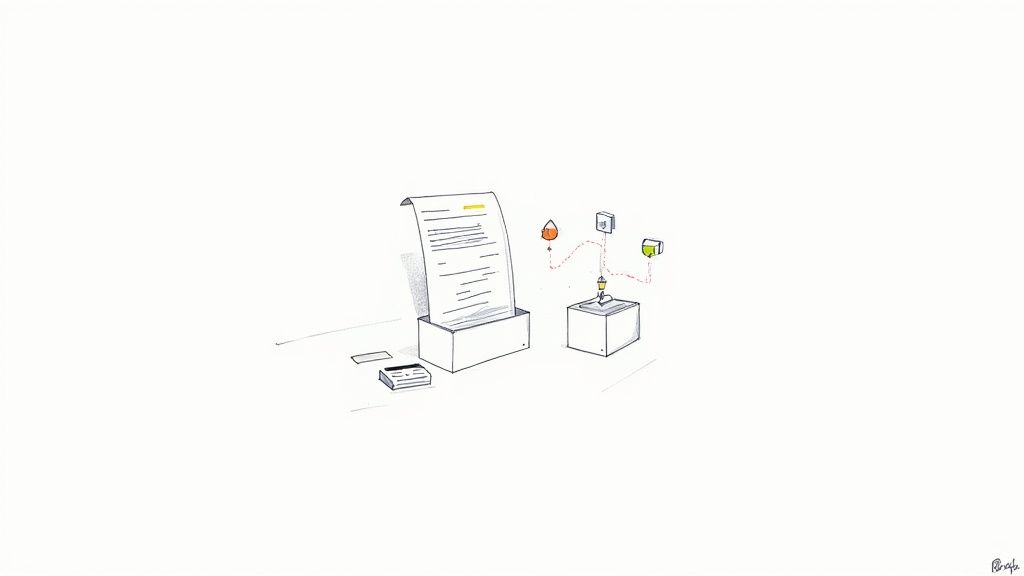
Modern tools, such as those offered by Coupa and SAP Ariba, can automatically extract key information like invoice numbers, due dates, and line-item details. This transforms a chaotic influx of PDFs and paper documents into a clean, organized dataset ready for approval and payment.
Why This Is a Foundational Step
Digitizing invoices is the cornerstone of a modern AP department. It creates a searchable, centralized repository of all invoices, providing greater visibility and control over company spending. This initial step enables further automation, such as three-way matching and automated approval workflows, which are impossible to implement efficiently with paper-based systems. To truly transform your AP department, implementing robust automation tools is essential. Explore various accounts payable automation solutions to understand how they can fit your specific business needs, especially for complex operations like international trade.
Actionable Implementation Tips
- Prioritize High-Volume Suppliers: Begin your transition by focusing on suppliers who send the most invoices. This strategy delivers the quickest and most significant return on investment.
- Establish Data Quality Standards: Define clear rules for data validation to ensure the information captured by the system is consistently accurate and reliable.
- Invest in Training: Ensure your team is thoroughly trained on the new software and processes to facilitate a smooth adoption and maximize its benefits.
By embracing digitization, you lay the groundwork for a scalable, efficient, and error-resistant AP ecosystem. Learn more about the benefits of automated invoice processing software to see how it can streamline your operations.
2. Establish Vendor Master Data Management
A critical accounts payable best practice is to create and maintain a centralized, accurate database of all vendor information. This "vendor master file" acts as the single source of truth for every supplier, containing essential details like payment terms, tax IDs, banking information, and contact details. This organized approach is fundamental to preventing duplicate payments, mitigating fraud, and ensuring compliance with regulations.

By standardizing how vendor data is collected, validated, and stored, you eliminate the chaos of scattered spreadsheets and inconsistent records. Tools like Coupa Vendor Management or SAP Supplier Lifecycle Management help enforce these standards and create a secure, auditable system.
Why This Is a Foundational Step
Poor vendor data management is a direct cause of payment errors, compliance risks, and strained supplier relationships. A clean vendor master file ensures that every payment is sent to the correct entity, using the correct bank details, and under the correct terms. It also serves as a crucial internal control, as it allows you to implement strict approval workflows for adding or modifying vendor information, significantly reducing the risk of fraudulent activities. This structured data is essential for accurate financial reporting and spend analysis.
Actionable Implementation Tips
- Conduct a Full Vendor Audit: Before creating your master file, perform a comprehensive audit of all existing vendor data to identify duplicates, outdated information, and inconsistencies.
- Assign Data Ownership: Designate a specific person or team responsible for maintaining the integrity of the vendor master data. This accountability is key to long-term success.
- Implement Approval Workflows: Create a mandatory, multi-step approval process for adding new vendors or changing existing vendor details, especially banking information.
3. Optimize Payment Terms Negotiation
One of the most strategic accounts payable best practices involves moving beyond passively accepting supplier terms and actively negotiating them to optimize cash flow. This means strategically managing payment windows, securing early payment discounts, and aligning terms with your company's financial cycle. By doing so, you can improve working capital, reduce costs, and strengthen supplier relationships simultaneously.
Proactive negotiation transforms the AP function from a reactive cost center into a strategic partner in financial management. Companies like Procter & Gamble have mastered this by implementing sophisticated supply chain financing programs that offer suppliers early payment in exchange for a small discount, benefiting both parties. This approach allows them to extend their payment terms without straining their crucial supplier network.
Why This Is a Foundational Step
Optimizing payment terms directly impacts your company's liquidity and profitability. It provides the flexibility to hold onto cash longer or to capture valuable discounts that boost your bottom line. This practice is foundational because it ensures your payment policies are not just operational but are actively supporting broader financial goals. Without this strategic oversight, a business might miss significant cost-saving opportunities or create unnecessary cash flow pressure.
Actionable Implementation Tips
- Analyze Discount Capture ROI: Before pursuing an early payment discount, calculate its annualized return on investment to ensure it’s more valuable than using that cash elsewhere in the business.
- Negotiate Staggered Payment Terms: For high-volume suppliers, propose staggered payment schedules that align with your company's revenue collection cycles to better manage cash outflows.
- Monitor Supplier Financial Health: Regularly assess the financial stability of critical suppliers. Offering more favorable terms or supply chain financing can be a strategic tool to support a vital partner and mitigate supply chain risk.
4. Implement Purchase-to-Pay (P2P) Process Integration
A truly optimized accounts payable department operates as part of a larger, cohesive system. Implementing a purchase-to-pay (P2P) process integration connects every stage of the transaction lifecycle, from initial procurement and purchase order creation to goods receipt, invoice processing, and final payment. This holistic approach breaks down silos between procurement and finance, creating a single, transparent workflow.
Platforms like Oracle Fusion P2P, SAP Ariba, and Zycus provide end-to-end solutions that ensure data consistency across the entire process. When a purchase order is approved, the data flows seamlessly through to the invoicing and payment stages, enabling automated three-way matching and reducing discrepancies.
Why This Is a Foundational Step
Integrating the P2P cycle provides unparalleled visibility and control over organizational spending. It transforms accounts payable from a reactive, invoice-paying function into a strategic partner in managing cash flow and supplier relationships. Achieving true P2P integration often requires a robust enterprise resource planning (ERP) system; solutions like Microsoft Dynamics 365 offer comprehensive modules to unify procurement and accounts payable. This integration is a critical accounts payable best practice for scaling businesses.
Actionable Implementation Tips
- Map Current Processes: Before selecting a technology, thoroughly document your existing procurement, receiving, and payment workflows to identify bottlenecks and areas for improvement.
- Establish Cross-Departmental Buy-In: Ensure procurement, AP, and receiving teams are aligned on the project's goals and benefits to facilitate a smoother transition.
- Start with a Pilot Program: Roll out the integrated P2P process with a small group of trusted, high-volume suppliers to test the system and gather feedback before a full launch.
By connecting these traditionally separate functions, you create a powerful, data-driven system that minimizes risk and maximizes efficiency. Learn more about the role of automated purchase orders as a key component of an integrated P2P strategy.
5. Establish Internal Controls and Segregation of Duties
A critical accounts payable best practice for mitigating risk is to design and implement a robust system of internal controls, with a special focus on the segregation of duties. This foundational concept involves separating key AP responsibilities among different individuals to create natural checks and balances. By ensuring that no single person controls an entire financial transaction from start to finish, you drastically reduce the opportunities for fraud, errors, and unauthorized payments.
This framework separates tasks like invoice entry, payment authorization, and account reconciliation. For example, the employee who enters a new vendor into the system should not be the same person who approves that vendor's invoices or processes their payments. This principle is a cornerstone of financial integrity, widely adopted in frameworks like the COSO Internal Control model.
Why This Is a Foundational Step
Implementing strong internal controls is essential for safeguarding company assets and ensuring the accuracy of financial reporting. A lack of segregated duties creates significant vulnerabilities that can be exploited internally or lead to costly mistakes. This practice provides a transparent and accountable workflow where discrepancies are more likely to be caught before they escalate. It builds a secure foundation that supports all other AP processes, from invoice processing to supplier management.
Actionable Implementation Tips
- Document All Approval Requirements: Clearly define and communicate who is authorized to approve invoices at different value thresholds.
- Use Role-Based Access Controls: Leverage your accounting software to restrict user permissions, ensuring employees can only access the functions relevant to their specific roles.
- Conduct Periodic Audits: Regularly test your internal controls to confirm they are functioning as intended and identify any potential weaknesses or policy deviations.
- Train Staff on Policies: Ensure every team member understands the importance of internal controls and their specific role in upholding them.
By building a strong control environment, you create a resilient AP department. Discover how to automate your accounts payable process while maintaining these essential checks and balances.
6. Implement Exception-Based Processing and Workflow Management
A powerful accounts payable best practice is shifting to an exception-based processing model. This approach automates the approval and payment of routine, compliant invoices while systematically flagging and routing only the exceptions for manual review. By defining clear rules for what constitutes a "standard" transaction, such as a perfect three-way match, you allow your system to handle the majority of invoices without human intervention.
This risk-based strategy frees your AP team from repetitive tasks, enabling them to focus their expertise on resolving complex issues like pricing discrepancies, quantity mismatches, or missing purchase orders. Modern platforms like Tipalti and SAP Ariba excel at creating these automated workflows, ensuring that only non-standard transactions require manual attention, which significantly boosts efficiency and control.
Why This Is a Foundational Step
Exception-based processing is a cornerstone of a mature AP function because it optimizes resource allocation. Instead of reviewing every single invoice, your team becomes a strategic control point, managing by exception. This not only speeds up the payment cycle for compliant invoices but also provides valuable data on recurring issues. Analyzing exception trends helps identify systemic problems, such as supplier invoicing errors or internal purchasing process gaps, allowing for continuous improvement.
Actionable Implementation Tips
- Define Clear Rules: Start by establishing explicit, documented criteria for what qualifies as a standard, touchless invoice versus an exception that needs review.
- Create Escalation Paths: Design clear, time-bound workflows for different types of exceptions, ensuring they are routed to the correct person for timely resolution.
- Analyze Exception Data: Regularly review a dashboard tracking the volume and types of exceptions. Use this data to refine your rules, provide feedback to suppliers, or improve internal processes.
7. Establish Key Performance Indicators (KPIs) and Analytics Monitoring
To truly master your accounts payable processes, you must measure what matters. Establishing and consistently monitoring key performance indicators (KPIs) transforms AP from a purely administrative function into a strategic, data-driven department. This practice involves defining specific metrics to track efficiency, cost, accuracy, and compliance, allowing for continuous improvement and demonstrating tangible business value.

By leveraging analytics frameworks from organizations like Deloitte or Gartner, or using built-in dashboards in platforms like Coupa, you can gain deep insights into your operations. This data-backed approach shifts decision-making from guesswork to informed strategy, highlighting bottlenecks and opportunities for optimization.
Why This Is a Foundational Step
Tracking KPIs is a cornerstone of effective financial management and one of the most critical accounts payable best practices. Without metrics, it's impossible to quantify the impact of process changes, justify investments in new technology, or identify areas of inefficiency. Key metrics like Cost Per Invoice and Invoices Processed Per AP Employee provide a clear benchmark for performance and help align departmental goals with broader company objectives, such as cost reduction and operational excellence.
Actionable Implementation Tips
- Select Relevant KPIs: Focus on metrics that align with your business goals. Common examples include Days Payable Outstanding (DPO), invoice processing cycle time, and the percentage of early payment discounts captured.
- Establish a Baseline: Before implementing any new initiatives, measure your current performance to create a baseline. This allows you to accurately track progress over time.
- Utilize Dashboards for Visibility: Implement a visual dashboard to provide real-time visibility into your KPIs. This helps stakeholders quickly understand performance and trends.
- Benchmark Against Industry Standards: Compare your metrics against industry benchmarks, such as those provided by the American Productivity & Quality Center (APQC), to gauge your competitive standing.
8. Deploy Centralized Payment Processing and Pooling
One of the most strategic accounts payable best practices for larger organizations is to consolidate payment processing from various business units or locations into a centralized hub. This center of excellence (CoE) approach creates economies of scale, standardizing procedures and strengthening financial controls across the entire enterprise. Instead of fragmented teams making payments independently, a single, specialized group manages all outgoing transactions.
This model significantly improves efficiency, enhances cash management visibility, and reduces the risk of payment fraud. Companies like Microsoft and Nestlé have successfully implemented global or regional payment hubs, streamlining operations and leveraging their scale to negotiate better banking terms. Centralization transforms a disparate set of activities into a unified, high-performance function.
Why This Is a Strategic Step
Centralizing payments provides unparalleled control and oversight over company-wide cash flow. It eliminates redundant processes and technology stacks in different departments, leading to direct cost savings. This approach is fundamental for organizations seeking to optimize liquidity, enforce uniform compliance standards, and gain a holistic view of liabilities. A centralized model is a key enabler for advanced cash forecasting and working capital optimization.
Actionable Implementation Tips
- Implement a Phased Rollout: Begin by centralizing payments for a few similar business units or regions. This allows you to refine processes and address challenges before a full-scale deployment.
- Establish a Governance Structure: Create a clear framework that defines decision-making authority, standardizes payment schedules, and outlines communication protocols for all stakeholders.
- Invest in Technology: Use a shared payment platform or system that provides visibility and control for the central team while allowing business units to submit and track payment requests.
9. Implement Early Warning Systems and Fraud Detection
A critical accounts payable best practice is to proactively identify and prevent fraudulent activities before payments are disbursed. This involves deploying analytics-driven, rule-based systems that continuously monitor for suspicious patterns, anomalies, and red flags. These systems use machine learning and exception reporting to protect company assets from both internal and external threats.
By establishing a baseline of normal payment behavior, these tools can instantly flag deviations. For instance, a system like FICO’s fraud detection solution can identify a sudden change in a supplier’s bank account details or an unusually large invoice amount that deviates from historical data, triggering an immediate alert for manual review.
Why This Is a Foundational Step
In an era of rising cybercrime, a reactive approach to fraud is no longer sufficient. Early warning systems shift your AP department from a defensive to an offensive posture, safeguarding cash flow and preventing potentially devastating financial losses. Implementing these controls is fundamental to building a secure and resilient financial operation, ensuring that every payment is legitimate and authorized. This proactive stance is essential for maintaining trust and financial integrity.
Actionable Implementation Tips
- Establish Baseline Payment Patterns: Use historical data to define what constitutes "normal" activity for each supplier, including typical invoice amounts, frequencies, and payment details.
- Regularly Update Fraud Rules: Fraud schemes evolve constantly. Keep your system's detection rules and algorithms updated to recognize new threats and patterns.
- Train Staff on Red Flags: Educate your AP team on common fraud indicators, such as pressure for urgent payments, slight variations in supplier email addresses, or unexpected changes to payment instructions.
10. Adopt Continuous Process Improvement and Lean Methodology
Transforming your accounts payable department isn't a one-time project; it's an ongoing commitment. Adopting a continuous improvement mindset, rooted in methodologies like Lean or Six Sigma, is a powerful best practice for achieving long-term excellence. This approach involves systematically identifying and eliminating waste, such as redundant approvals, unnecessary paperwork, and process bottlenecks, to create a more efficient and agile workflow.
By embracing this philosophy, your AP team becomes an active participant in refining its own operations. Renowned companies like Toyota and General Electric have famously used these principles to drive world-class efficiency. In an AP context, this means constantly asking, "How can we do this better?" instead of settling for "This is how we've always done it."
Why This Is a Foundational Step
A culture of continuous improvement ensures your AP processes evolve with your business needs and technological advancements. It prevents stagnation and empowers your team to solve problems proactively. This is a crucial element of modern accounts payable best practices, as it shifts the department's role from a reactive cost center to a strategic, value-adding function that actively contributes to the company's financial health and operational efficiency.
Actionable Implementation Tips
- Train Your Team: Begin by educating AP staff on core lean concepts like the "eight wastes" and simple process mapping tools.
- Target High-Impact Areas: Start by analyzing a high-volume, repetitive task, such as invoice entry or payment run preparation, to secure an early win.
- Engage Frontline Staff: Involve the employees who perform the daily tasks in identifying inefficiencies and brainstorming solutions. Their hands-on experience is invaluable.
- Measure and Communicate: Establish key performance indicators (KPIs) to track improvements. Celebrate successes, no matter how small, to build momentum and reinforce the new culture.
Accounts Payable: 10-Point Best Practices Comparison
| Initiative | Complexity 🔄 | Resources & Cost ⚡ | Expected Outcomes ⭐📊 | Ideal Use Cases | Key Advantages & Tips 💡 |
|---|---|---|---|---|---|
| Implement Invoice Automation and Digitization | High 🔄🔄🔄 | High — OCR, integration, vendor onboarding, training | ⭐⭐⭐⭐ · 50–80% processing time reduction; fewer errors; real-time tracking 📊 | High-volume invoice environments; ERP-integrated orgs | Reduces manual entry and storage costs; improves cash visibility. 💡 Start with high-volume suppliers to maximize ROI |
| Establish Vendor Master Data Management | Medium 🔄🔄 | Moderate — data cleanup, governance, ongoing maintenance | ⭐⭐⭐ · Fewer duplicates; improved payment accuracy; lower fraud risk 📊 | Organizations with many suppliers or duplicate-vendor issues | Central single source of truth; supports better negotiation. 💡 Conduct a comprehensive vendor audit and assign data ownership |
| Optimize Payment Terms Negotiation | Medium 🔄🔄 | Low–Moderate — finance analysts, forecasting tools | ⭐⭐⭐ · Improved cash flow; discount capture; lower working capital 📊 | Companies seeking cash optimization or discount capture programs | Improves liquidity and can realize discounts. 💡 Analyze discount ROI and monitor supplier relationships |
| Implement Purchase-to-Pay (P2P) Process Integration | Very High 🔄🔄🔄🔄 | Very high — cross-system integration, change management, tech investment | ⭐⭐⭐⭐ · End-to-end visibility; reduced cycles; stronger controls 📊 | Large organizations with separate procurement and AP systems | Eliminates silos and strengthens audit trails. 💡 Map processes and pilot with select suppliers first |
| Establish Internal Controls and Segregation of Duties | Medium 🔄🔄 | Low–Moderate — policy, role design, access controls, training | ⭐⭐⭐⭐ · Reduced fraud; improved compliance and data integrity 📊 | All organizations; required for regulated or public companies | Strong prevention of unauthorized payments; better audit readiness. 💡 Document approvals and use role-based access controls |
| Implement Exception-Based Processing and Workflow Management | Medium 🔄🔄 | Moderate — rules engine, workflow tooling, monitoring | ⭐⭐⭐ · Faster routine processing; focused review on exceptions 📊 | Mixed-invoice environments where many invoices are standard | Increases productivity and reduces manual work. 💡 Start with clear, simple rules and refine using exception analytics |
| Establish Key Performance Indicators (KPIs) and Analytics Monitoring | Low–Medium 🔄🔄 | Moderate — BI tools, data collection, analyst time | ⭐⭐⭐ · Identifies bottlenecks; measures ROI; enables continuous improvement 📊 | Any org seeking data-driven AP optimization | Enables objective performance tracking and benchmarking. 💡 Align KPIs with business goals and establish baselines |
| Deploy Centralized Payment Processing and Pooling | High 🔄🔄🔄 | High — CoE setup, banking arrangements, multi-entity integration | ⭐⭐⭐⭐ · Cost reductions, stronger fraud controls, pooled liquidity 📊 | Multi-nationals or companies with many subsidiaries and high volumes | Economies of scale and standardized payments. 💡 Roll out in phases and create governance structures |
| Implement Early Warning Systems and Fraud Detection | High 🔄🔄🔄 | High — ML/analytics tools, tuning, data privacy controls | ⭐⭐⭐⭐ · Proactive fraud prevention; anomaly detection; lower losses 📊 | High-risk environments or large transaction volumes | Detects suspicious activity before loss occurs. 💡 Establish baseline patterns and continuously update detection rules |
| Adopt Continuous Process Improvement and Lean Methodology | Medium 🔄🔄 | Moderate — training, facilitators, time for Kaizen events | ⭐⭐⭐ · Waste reduction; sustained process improvements; higher engagement 📊 | Organizations pursuing cultural change and efficiency gains | Drives ongoing internal improvements and ownership. 💡 Start with high-impact processes and involve frontline staff |
From Cost Center to Strategic Asset: Your AP Transformation Starts Now
The journey through these ten accounts payable best practices reveals a powerful narrative: the evolution of AP from a transactional, back-office cost center into a strategic, data-driven nerve center for your organization. Moving beyond the manual processes of the past is no longer an option, it's a competitive necessity. The principles we've explored are not isolated tactics but interconnected components of a holistic financial strategy.
Adopting these practices means you are building a more resilient, efficient, and intelligent financial operation. By implementing invoice automation, you eliminate the foundational bottleneck of manual data entry. By establishing robust vendor master data management and internal controls, you create a fortress against fraud and costly errors. Integrating a full purchase-to-pay (P2P) process provides unparalleled visibility, while KPIs and analytics turn your AP data into a source of actionable business intelligence. The true power lies in combining these elements to create a seamless, self-optimizing system.
Your Path to AP Excellence
Embarking on this transformation can feel daunting, but it doesn't require a complete overhaul overnight. The key is to take a phased, strategic approach. Start by identifying your department's most significant pain points. Is it the sheer volume of paper invoices? The time spent on manual approvals? The lack of visibility into spending?
Once you've identified your primary challenge, you can prioritize the implementation of specific accounts payable best practices:
- For High-Volume Invoices: Begin with Invoice Automation and Digitization. This single step delivers immediate ROI by reducing processing times and error rates, freeing up your team for more strategic work.
- For Fraud & Error Concerns: Focus on Vendor Master Data Management and Internal Controls. These foundational practices are critical for securing your financial ecosystem.
- For Lack of Visibility: Prioritize KPI Monitoring and P2P Integration. Gaining a clear, real-time view of your financial commitments is essential for effective cash flow management and strategic decision-making.
This is not a one-time fix but a commitment to continuous improvement. By fostering a culture that embraces lean methodologies and exception-based processing, you ensure your AP department remains agile, adaptive, and aligned with the broader goals of the business. The ultimate goal is to empower your team to move from reactive problem-solving to proactive financial stewardship, directly contributing to improved vendor relationships, better negotiation leverage, and optimized cash flow. Your AP transformation begins with the first step, so choose your starting point and commit to progress today.
Ready to eliminate the biggest bottleneck in your AP workflow? DocParseMagic provides the powerful, AI-driven data extraction you need to automate invoice processing, digitize documents, and implement the accounts payable best practices discussed here. Start your free trial at DocParseMagic and turn your invoices into actionable data instantly.